

之前上了三堂大人學線上語音課程,分享了兩堂課程筆記。
I attended three online lessons and have shared notes from two of them.
接下來要分享我上的第三堂課《知識型商品的文案寫作課》的課程筆記,這堂課是Bryan以系統化的方式講解知識型商品寫文案的核心概念,以下是我彙整的內容。
In this note, I will share what I learned in the third lesson, “Copywriting course for knowledge-based products," which was taught by Bryan. The lesson covered the core concepts of writing effective copy for knowledge-based products in a systematic way. Here are the key takeaways from the lesson that I have compiled.
這堂課的內容相較之前的兩堂課「軟」,但一樣,知易行難。
Compared to the previous two lessons, the content of this class was relatively “soft," but as always, the knowledge is easy to understand but difficult to apply.
- 知識型商品的特性 The characteristics of knowledge-based products
- 三種類型的文案及架構 Three types of copywriting
- 兩種文案的寫作原則 Principles of writing in two styles
- 品牌打造 Brand building
- 型塑風格 Shaping writing style
- 技巧運用 Application of techniques
- 提升寫作能力 Improving writing skills
- 好文案 Good copywriting
知識型商品的特性
The characteristics of knowledge-based products
首先Bryan提出知識型商品的特性:
First, Bryan presented the characteristics of knowledge-based products:
- 因為是無形的交付物,較難彰顯產品價值。
Being intangible, it is difficult to highlight the value of the product. - 需要消費者投注心力才能展現成效。
Consumers need to invest effort to demonstrate effectiveness. - 訴求對象設定嚴謹,不是人人都是受眾。
The target audience must be set rigorously, as not everyone is a potential customer. - 消費者不易比較競品,因為可能就買這一次,格外重視評價。
It is difficult for consumers to compare competitors because they may only buy once and place a high value on reviews. - 創作者是商品一部分,信任資產是販賣知識型商品最重要的關鍵。
The creator is a part of the product, and trust is the most crucial asset when selling knowledge-based products. - 知識型商品的購買者對廣告套路免疫。
Buyers of knowledge-based products are immune to advertising tricks.
三種類型的文案及架構
Three types of copywriting
接著Bryan說明有三種類型的文案:
Next, Bryan explained that there are three types of copywriting:
- 品牌文案:不講商品,只是為了塑造品牌形象。
Brand copywriting: It does not focus on the product but is used to shape the brand image. - 形象文案:不講商品也不講品牌,但用文字風格體現品牌形象。
Image copywriting: It does not focus on the product or the brand but reflects the brand image through the style of writing. - 產品文案:促銷特定產品。
Product copywriting: It promotes a specific product.
三種類型的文案結構:
The structures of the three types of copywriting are as follows:
AIDCA(適用於銷售文案)
- Attention:爭取注意
- Interest:引發興趣
- Desire:誘發渴望
- Conviction:說服購買
- Action:呼籲行動
ORID(適用於論述型文案)
- Objective:描述外部事實
- Reflective:探討有何感受
- Interpretive:分析感受
- Decisional:結論與行動
SMAP(適用社群網站文案)
- Story:小故事
- Meaning:故事含意
- Action:行動
- Product:產品
AIDCA (applicable to sales copywriting)
- Attention
- Interest
- Desire
- Conviction
- Action
ORID (applicable to argumentative copywriting)
- Objective
- Reflective
- Interpretive
- Decisional
SMAP (applicable to social media copywriting)
- Story
- Meaning
- Action
- Product
其中SMAP是Bryan自己發明也是最常使用的。
SMAP is the one Bryan invented and also the most commonly used one.
我有追蹤Joe和Bryan的FB,的確發現他們的每篇文章幾乎都能看到SMAP的架構,以下隨意挑出一則舉例:
I have been following Joe and Bryan on Facebook and I did find that almost every article they posted had the SMAP framework incorporated in it. Here’s an example I randomly picked:
【有一種職場悲劇…】
Story:
有一種職場悲劇,是去了一個商業模式或是文化很明確的環境工作,但偏偏不能忍受那個模式,所以想加以改造。而之所以會是悲劇的原因,通常在於當事人並不理解自己的政治狀態,以至於想蠻力硬幹,所以每次好心的努力卻都被當成白目。
當「這人是白目」的印象越來越深植人心後,最後將什麼都無法做。因為當大家覺得這人很白目後,連原本能力可及的事情,也會被大家用懷疑的眼神端詳著。當事情走到這程度,大概就無法逆轉了。除了離職,沒有別招了。
像最近有幾位網友來找我詢問的,都是類似的狀況。可能他是看流程不順眼、可能是看效率不章、可能是覺得公司該嘗試不同的經營方法、甚至覺得公司根本該做別的,於是自己明明不在其位、老闆也沒有指示,但是自己卻跳出來硬想快速改變。想做大事,這其實是好事,我們也總是鼓勵年輕人不要只是做著重複性高的事情。但你想撼動過去幾十年的習慣,你要有策略、你要有佈局、你尤其要搞清楚自己的立場以及力量。Meaning:
這部分的前置準備,就是我們常常提到的看懂局。
你若看不懂局,你就會在錯誤的地方努力。最後你很挫折,結果老闆與同事也很挫折。因為你是好心沒錯,但你常常也沒真的理解他們,不理解他們的保守與顧慮來自於哪裡?也沒有安撫或是處理他們的憂慮,當然也無法獲得他們的支持。而因為溝通不足,他們也往往無法理解你。不理解你為何有這樣的建議,這樣的建議又能帶著大家走去哪裡?
結果,人生悲劇莫過於此,明明大家都想成事,但因為相互不理解,最後彼此憎恨。Action:
所以我其實都跟年輕的朋友講,你越是想做大事,越要搞懂人性與職場政治。看懂局,你就能找到方法與謀求改變。無論這是人際關係、這是戀愛、或是職場其實都是如此。一般的看懂局我們有很多文章在談(歡迎搜尋大人學的網站)。若能好好提升自己看懂局的能力,人生其實可以更順暢與優雅的。
Product:
以下是工商時間
另外,如果你在職場上總是過度努力,可是周圍的人都無法理解你;或是你明明是好心,卻常被老闆與同事誤解,那我真心建議你來聽聽Bryan的人生關鍵大課:【A101職場大人學-職場人際關係與優勢策略】
There is a workplace tragedy where one joins an environment with a clear business model or culture but cannot tolerate that model, so they try to change it. However, often, the individual does not understand their political status, so their well-intentioned efforts are seen as misguided.
When people view someone as misguided, even tasks within their abilities become scrutinized. This situation can lead to an inability to make any changes. Once people view you as misguided, you will always be questioned, and there may be no way to reverse this impression. The only solution may be to leave the job.
Recently, some internet users asked me about their similar situations. Perhaps they did not like the process, thought the efficiency was poor, or believed that the company should attempt different management methods. They wanted to make significant changes, which is admirable, and we encourage young people to do so. However, to change decades of habits, you must have a strategy and understand your position and power.
The prerequisite for this is understanding the situation or “the big picture."
If you don’t understand the situation, you will work in the wrong places. You and your colleagues will be frustrated, and your boss will be too. Your intentions are good, but you often don’t understand your colleagues’ conservatism and concerns. You have not addressed or allayed their concerns, nor have you gained their support. Due to poor communication, they often fail to understand you. They do not understand why you have such suggestions or where those suggestions will lead them.
Therefore, I always tell young friends that if they want to make significant changes, they must understand human nature and workplace politics. By understanding the situation, you can find ways to seek change. This applies to interpersonal relationships, romantic relationships, and the workplace. We have many articles on understanding the situation, which you can find on our website. If you can improve your ability to understand the situation, your life can be more straightforward and elegant.
Additionally, if you work too hard, but your colleagues cannot understand you, or you are often misunderstood by your boss and colleagues, I suggest that you listen to Bryan’s life-changing course: A101 Workplace Master Class – Workplace Relationships and Strategic Advantage.
兩種文案的寫作原則
Principles of writing in two styles
- 說故事原則:依順序說明內容
Narrative Principle: Present the content in a sequential order. - 金字塔原理:先說結論再補充細節
Pyramid Principle: Present the conclusion first, followed by supporting details.
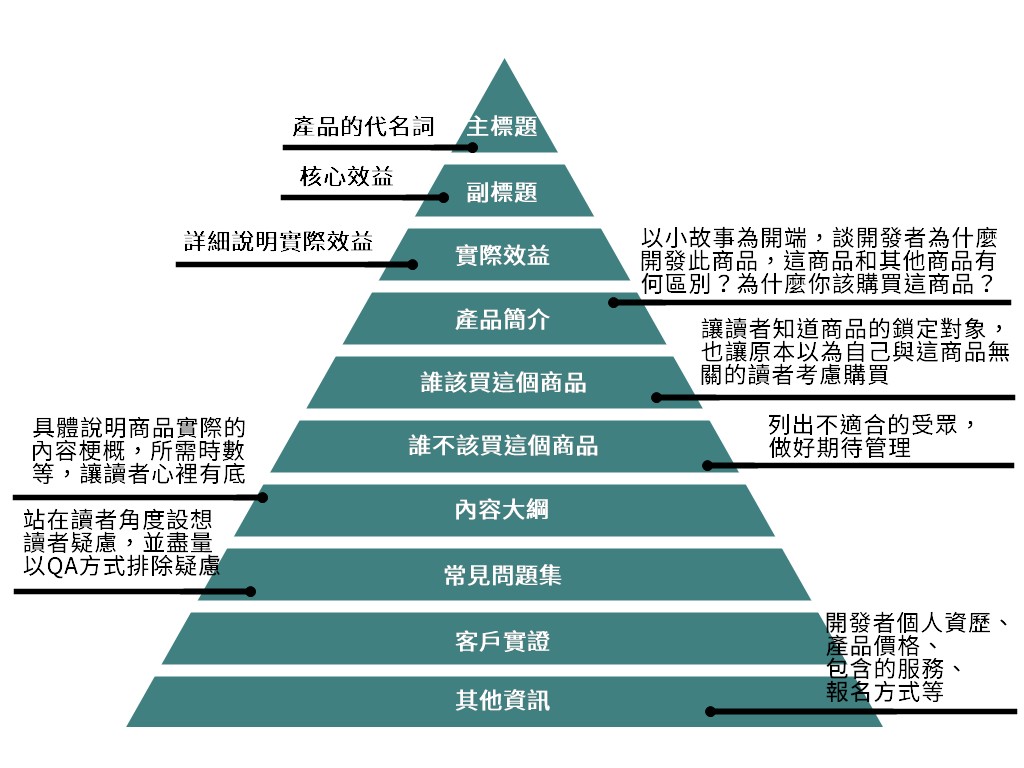
Bryan說明「到達網頁」的文案架構應該採取金字塔原理。
Bryan explained that the copy structure for the landing page should follow the Pyramid Principle.
可以邊閱讀這堂課的到達網頁邊看說明,URL:https://shop.darencademy.com/product/view/id/98
我也同步將內容貼在下方,比較好對照閱讀。
You can read this lesson’s landing page while referring to his explanation below for better understanding.
| 金字塔 | 內涵 | Bryan範例 |
|---|---|---|
| 第一層 | 主標題:產品的代名詞 | 知識型商品的文案寫作課 |
| 第二層 | 副標題:用淺顯的字句一句話說明核心效益 | 帶你寫出好文案,打響你的品牌知名度、獲得穩定的現金流。 |
| 第三層 | 實際效益:詳細說明第二層的效益 | 不假手他人,把自身優勢與特色寫成具吸引力的文案 十四年經營顧問與教學品牌的經驗,教會我們最重要的一件事就是:許多業務都可以外包,但品牌定位絕不能假手他人!知識創作者賴以為生的就是專業服務與高價值資訊,這類產品既抽象又個人化,某種程度就像我們的「分身」,最了解它們的唯有我們自己。再厲害的文案顧問也不會比你自己更了解創作背後的細節與精神,所以文案一定得自己寫才到位。然而,許多創作者無法站在消費者或外行人的角度來檢視自己的作品,因此常常看到明明很有價值的知識型商品,但文案看起來卻平凡無奇,自然就淹沒在資訊大海中。這門課裡,我們用系統化、結構化的寫作技巧,幫助你把自己的商品特徵具象化、模組化,並且轉化成外行人也能理解,並受到吸引的文案形式,讓產品的價值完整彰顯! 學會辨識消費者內隱需求,讓你的文案打中粉絲的心 行銷界有句名言:「當客戶來買電鑽時,他心裡要的其實不是電鑽,而是一個牆壁上的洞!」多年經營品牌的經驗告訴我,客戶要的還不只是一個「洞」,而是要掛上一幅畫,至於為什麼要掛畫,可能是要展現自己的創作才華,或是向朋友炫耀財力或風雅…這些沒說出來的「內隱需求」才是整個消費行為的「核心動機」。知識型創業者賣的不是柴米油鹽這些生活必需品,所以更需要深度判讀消費者與粉絲的內隱需求,才能成功激發其購買動機。這門文案課不光是教大家寫作,更以學會分析消費者的心態為基礎,透過近年來心理學家、行為經濟學家,行銷與廣告專家的研究,讓你知其然,也知其所以然。我們摒棄那些賣弄文筆、標新立異或浮誇俗艷的推銷文案,幫助大家能夠寫出文句平實誠懇,卻能精準打中消費者需求的高效文案! 養成持續性的創作習慣,深化品牌的價值並創造長期現金流 對於知識型創業者來說,文案不光是用在產品銷售頁面,也存在於Facebook、IG與Twitter上的貼文、YouTube頻道的簡介、部落格發文、人力資源網站(如LinkedIn,104求職網)個人介紹、教材或DM的介紹頁、投影片中的自我介紹、名片上的短語、LINE或其他通訊軟體的個人描述……每次的對外露出,都是一個與消費者溝通的好機會。因此想要成為成功的知識創業者,絕不能排斥文字,更不能寫好一篇文案就放個數年不改。許多人不善寫作,常歸因於沒有天分,缺乏靈感!其實身為理工宅的Bryan與Joe,也不是文案奇才,但我們多年來從一開始為了品牌不得不寫,到後來逐步歸納出商業寫作的規則、尋覓題材的捷徑,還有養成創作習慣的方法,也將一併在這門課程中與各位分享。專業品牌無法一蹴可及,但涓滴可成汪洋,在這個網路時代,終生的寫作習慣將成為人生的一大資產! |
| 第四層 | 產品簡介:以小故事為開端談開發者為什麼開發此商品?這商品和其他商品有何區別?為什麼你該購買這商品? | 多年以前曾聽過這個故事,開啟了我對文案的興趣: 在繁華熙攘的大街上,有個盲眼的流浪漢坐在路旁乞討,地上一個破碗,一片紙板寫著:「我是盲人,請幫幫我!」顯然沒人在意他的渴求,碗裡空空如也。這時一位紳士經過看到了,駐足片刻,拿起了那塊紙板,轉個面寫了幾個字,放回乞丐身邊。接著神奇的事發生了,越來越多行人停下腳步,施捨零錢給予乞丐祝福,不到一小時那碗就滿了。那位紳士寫的是:「春天來臨,而我,卻看不見!」 文字就是如此地充滿魔力,短短一句話,就把流浪漢、行人、與季節三個原本毫無關係的元素串接在一起:行人因此感受到春日的美好(情境),緊接著急轉直下留意到流浪漢的苦楚(刺激),這強烈的反差激起人們的惻隱之心,進而給予關懷協助(行動)。你看,「寫文案」不光是一門銷售的技術,更是一門打動人心的藝術啊!而一個會寫文案的人是非常讓人羨慕的,他只需一枝筆,便能扭轉氛圍,引導行為。 2010年,我和Joe首次將多年的顧問經驗轉化成多堂管理課程,並在部落格開放招生。沒有行銷背景,更沒有受過文案訓練的我,為了寫招生文案。參考了許多範例,也看了幾本書,上了一些課,但獲得的幫助卻有限,倒不是那些內容不好,而是以下幾個原因: 1.市面上多數文案的範本、書籍或教材,都是以消費型商品為標的,這跟我們要推廣的知識型商品有很大的落差。針對實體商品很容易提出規格、功效、製程與競品差異這些資訊來說服客戶,但知識型商品卻很難具體描述這些特徵,反倒更需要強調其設計理念、核心價值與內容特色這些相對抽象的價值。 2.許多消費型文案的撰寫目的,是擄獲受眾的注意,誘發其渴望,進而購買商品。有越多人注意並引發購買的文案就是成功文案。但知識型商品的文案不同,以課程文案為例,一個班級頂多收個40人,而且不同的課程適合不同的學員,有的適合初學者,有個適合高階主管,我們必須篩選出「對的學員」課程滿意度才會高!如果文案沒有把課程屬性說清楚,來了太多「不對的人」,一方面也沒那麼多名額可賣,另一方面還會造成學員滿意度下降,得不償失。這是知識型商品文案的另個難處。 3.承上,幾乎所有文案都是讓貨賣越多越好。所以不少文案教學非常強調要利用「聳動的標題」、「誇張的陳述」、與「流行的話題」來引發關注,提升銷售。但對於知識型創業者來說,我們賣的其實就是「自己」,賺錢固然重要,但我們更希望在受眾面前呈現專業、可靠的品牌形象,大家產生信任之後才會成為我們的學員、讀者、訂戶或粉絲。過度銷售導向的文案雖能獲取短暫關注,但對於長期的品牌經營往往不利。 由於實在找不到理想的參考對象,只好依靠我們自帶的兩項專長:工程師的分析能力+顧問的邏輯推理自己動手寫文案!我們試著站在學員的角度,去分析一位上班族為什麼要上課?他處在一個什麼樣的情境?他想得到什麼樣的效益?還有如何從眾多選擇中挑出課程?接著,我們也分析自己的商品,到底跟別人的商品有何不同?憑甚麼我們有資格教這門課?學員想要的效益我們該用什麼方法滿足? 我們花了很多時間自問自答這些問題,並且用最簡單、直白、平舖直敘的方式說明我們的產品。沒有華麗的詞藻、押韻的順口溜、或是聳動的標題,只希望能誠心誠意地跟消費者坦率溝通,把文案當做橋樑,讓大家能找到符合自己需要的商品,我們也藉此找到「對的客戶」。 沒想到,這些看起來很不商業的文案,反倒帶來超乎預期的成功,熱銷且長銷,連續數十場滿班,並帶動了我們其他的課程。我們持續用這種「與客戶坦率對話」文案風格,推廣我們的實體課程、線上課程、顧問服務、部落格、Podcast(播客),都帶來了穩定的成長。「課程」這個原本是嘗試性的知識型商品,目前也成為公司的獲利主軸。有趣的是,我們在文案中出現的一些句子,逐漸成為讀友、學員間朗朗上口的佳句,像是「人多的地方不要去」、「相信思考、勇於改變」、「看懂局、選策略、積籌碼」等。而這些句子傳遞的概念也自然而然成為「大人學」品牌的基石。 我們相信,一篇好文案,尤其是知識型產品的文案,不應該嘩眾取寵,以短期業績為目標。文案該做為與消費者間的溝通工具,藉此闡述品牌價值,確保客戶的期待能被滿足。如果你認同這個理念,希望大幅提升自己撰寫文案的能力,讓你的知識品牌長久經營,這門課會為你帶來明確的幫助。 |
| 第五層 | 誰該買這個商品:列出受眾,也讓原本以為自己非受眾的讀者考慮購買 | 1.實體課程與線上課程的講師,說書人、顧問與接案者 2.銷售知識型商品的的行銷企劃、社群小編、文案美編等 3.經營部落格、YouTuber、Podcaster、或直播節目的KOL 4.想培養文案寫作能力的專業工作者 5.公部門負責政令宣導、民眾教育與訊息公告的承辦人 6.企業中負責內部宣導、員工教育、公共關係的人 7.需對民眾病患進行衛教的醫療人員 |
| 第六層 | 誰不該買這個商品:列出不適合的受眾,做好期待管理 | 1.文案的目標僅是衝高點擊(而非閱讀),藉此賺取廣告利潤的新聞網站、或甚至內容農場經營者 2.沒有品牌經營需求,純粹透過文案促銷單檔商品者 3.對消費者心理與寫作技巧沒興趣,只希望採取搶眼金句與聳動標題者 |
| 第七層 | 內容大綱:具體說明商品實際的內容梗概,所需時數等,讓讀者心裡有底 | 每集內容約9-15分鐘,總長度7.5小時。 建議使用【大人學】App收聽,以獲得最佳學習體驗! 01 在課程開始之前 10:20 02 兩篇文案,你能看出關鍵差異嗎? 09:43 03 案例解析:以大人學男性穿搭課為例 09:26 04 五個要點,讓知識型商品文案更有效 11:03 05 四種類型,構成廣告文案的主體 09:54 06 不只廣告,文案還有更多元的應用 11:52 07 常見錯誤:把文案當成文學來創作 09:52 08 文案練習:文案珠寶盒與300字個人介紹 05:59 09 自我介紹:最熟悉卻也最難寫的文案 09:41 10 優雅自誇:大方宣揚自己卻不惹人討厭的表達 12:48 11 理解動機:消費者為何購買知識型商品 10:11 12 關鍵差異:知識型商品與一般商品的不同(上) 09:44 13 關鍵差異:知識型商品與一般商品的不同(下) 08:59 14 翻譯蒟蒻:把產品特色翻譯成使用者效益 10:32 15 挖掘效益:利用自問自答的方式寫出更貼切的效益 09:36 16 效益清單:條列知識型商品常見的效益 11:14 17 製作過程:你若不說,客戶永遠不會知道的賣點 13:12 18 創造意外:利用反直覺論述打破讀者思維慣性 13:53 19 懸疑推理:先把訊息留個洞,隨後再補上它 12:12 20 畫龍點睛:如何下一個好標題 11:42 21 行動呼籲:直接且自信地請讀者採取行動 10:36 22 文案結構:讓文案內容合理順暢地組織起來 10:47 23 對話口吻:用和朋友聊天的語氣來介紹產品 12:32 24 隱形標籤:只要確實掌握就能擺脫注意力的軍備競賽 11:33 25 具象比喻:在讀者心中勾勒一幅具體的圖像 13:18 26 感官描繪:善用文字來引導讀者的感官知覺 10:44 27 臉書文案:運用臉書建立專業品牌並與目標對象交流 14:37 28 以終為始:運用金字塔原理來傳遞複雜的資訊 12:12 29 到達網頁:金字塔原理的商業應用 13:36 30 善用故事:引發讀者興趣並刺激後續行動 13:38 31 化解疑慮:讀者從點閱文案到下單結帳的最後一哩路 13:58 32 提出問題:運用提問的力量拉住讀者的心 13:31 33 核心主軸:你能否用一句話,涵蓋整篇文案主旨 10:36 34 拋光打磨:讓你的文案讀起來更舒服,更有趣 11:16 35 善用典故:讓文案的質感大大提升的小撇步 12:26 36 圖文編排:善用圖片與字型為文案加分 13:58 37 原創風格:四個方向,讓你的作品更具風格特色 12:09 38 品味鍛鍊:體察細微差異,用高解像度鏡頭看世界 15:12 39 遇見靈感:調整自己的創作狀態,讓靈感源源不絕而來 10:41 40 習慣養成:讓寫作成為豐富你一生的養分 11:07 |
| 第八層 | 常見問題集:站在讀者角度設想讀者疑慮,並盡量以QA方式排除疑慮 | Q:這門課跟坊間其他文案課有何區別?已經上過其他文案課還值得來上嗎? A:從商品角度來看,市面上文案課的重點放在實體商品的銷售占大宗,也有部分文案課談的是文案基礎寫作技巧,並未針對特定類型的商品。而本課程是市面上極少數聚焦在「知識型商品」的文案課程。知識型商品特殊之處在於,消費者看重的不光是商品本身,更會在意創作者這個人的特質、風格與形象(所謂的個人品牌),藉此決定要不要購買商品,就像我們選擇電影會考慮導演、編劇和演員是誰一樣。所以,若你有撰寫「知識型商品」文案的需求,縱使你上過其他文案課,這門課也會帶給你更深入的體驗。 Q:我對撰寫商業文案沒有經驗,我適合上這門課嗎? A:別擔心,絕對適合。所謂文案,不過是一種利用文字與消費者溝通的方式,就像說話、唱歌一樣,並非某種高大上的專業學科,而是人人都能使用的溝通技能。市面上有許多寫文案的套路、捷徑、公式,把初學者搞的眼花撩亂,據此寫出來的文案往往「匠氣十足」卻少了幾分誠懇,很吸睛卻沒能解答客戶的疑慮。我們認為,「知識型商品」的創作者是最了解商品的人,應該自己執筆寫文案,才能忠實地反映出創作的精神,也才能真正打動受眾。所以別擔心自己有沒有經驗,只要你了解自己的產品,這門課就是為你而設計的。 Q:我平常銷售的是實體商品,這門文案課對我有幫助嗎? A:如果你的企業很重視品牌形象、社群經營、商品風格與客戶溝通這些柔性的價值,那這門課對你撰寫文案會很有幫助,因為這些正好都是「知識型商品」的行銷重點。但如果你的行銷工作仰賴商品規格優勢、價格優勢,那麼這門課程就未必是你的首選,因為學到的知識跟實際運用會有差距。 Q:我既非行銷人員也不是知識型商品的創作者,這門課對我的價值是什麼呢? A:寫文案的目的不一定是銷售商品,也可能是打響品牌、宣揚理念、傳遞知識、或是呼籲人們採取某些行為。可能是醫護人員對民眾進行衛教、企業HR對內部員工宣導政令、或政府單位對百姓公布法規,都是文案發揮作用的情境。懂得運用文案的人,等於拿到了一張通往群眾內心的通行證,自然無往不利。 Q:這堂課跟大人學另一堂【銷售專業服務的系統化做法】差異在哪裡呢?兩堂課好像都是針對知識工作者? A:【銷售專業服務的系統化做法】談的是比較戰略面的東西:做為一個知識工作者你該怎麼自我定位、怎麼理解客戶、怎麼設計商品、怎麼思考轉換、怎麼考量個人品牌等事宜。當中有關文案的內容只會提供一些原則性的建議。 至於目前這堂課【知識型商品的文案寫作課】則是針對知識工作者在建立個人品牌或是產品銷售時文案撰寫的更深度知識。換言之,如果你具備了戰略面的觀點,並希望進一步提升自己文案的影響力與轉換率,那這堂課就會對你很有幫助。 不過,我們是建議你都參與。因為透過兩堂課的協助,對於一個新入行的知識工作者而言,應該都能協助你全面銷售能力的提升! Q:課程內容是音檔還是影片呢? A:課程會是以音檔為主,部分章節有可能搭配圖片或表單。大人學線上自學系列的設計概念,是希望你在通勤、運動、燙衣服、或是進行機械式工作時聆聽。讓你可以不知不覺地完成學習。不顯露老師的臉、避開沒意義的視覺特效,以避免很多人看影片時只是焦慮地給自己交代的快轉跑完,但卻沒能深度內化。我們希望讓你能在閒暇之餘,輕鬆舒服地安靜聆聽、尤其聽到心底,才是真正有意義的自學機制! Q:所謂【線上自學】是什麼意思呢? A:透過線上的收聽,在你自己安排的時間內完成收聽並進行相關的功課、思考、以及自主規劃。此模式的優點是時間彈性、並可以反覆收聽。針對可以簡單提供知識點的主題,我們會做成線上自學的模式。至於需要透過案例、活動、練習來深度體驗的主題,我們會做成實體工作坊的形式來提供教學。 Q:我可以用甚麼設備來收聽或收看?有硬體規格的限制嗎? A:線上課程提供2種收聽方式,使用期間須保持網路正常連線狀態。 您可透過網頁收聽:請點選「我的課程列表」 您也可以透過「大人學 APP」收聽 Q:如果在國外或在網路不順的地方,串流收聽時遇到聲音斷斷續續的問題該怎麼辦? A:建議可以下載App。App可以支援離線收聽的功能。你可以把要聽的集數先下載到手機或是平板,就可以順暢收聽了。 Q:可以介紹一下你們的單位嗎? A:本活動主辦單位是大人學,由企管顧問Joe(張國洋)與Bryan(姚詩豪)共同創立。負責營運的公司為識博管理顧問(統編:28552691)。識博管理顧問主要業務除了舉辦各式公開課程與演講外,也提供企業培訓規劃與專案管理顧問諮詢服務。目前亦為美國專案管理協會(PMI)授權之全球教育機構(Global Education Provider),機構代號REP ID:3143。 ProjectUP(專案管理生活思維www.projectup.net)與大人學(www.darencademy.com)為旗下兩個內容平台,持續性地提供管理、經營、職場、兩性與人際關係等領域的優質知識。 我們在台北市區自有二間教室,自2007年來已經協助無數的企業或是個人提升管理或認知技能。 Q:何時可以拿到發票呢? A:電子發票將於購買日後的當月月底前寄送至您報名時所留的email。請於報名時確認email正確無誤。發票中獎會另行通知。 Q:可以開立三聯式發票報帳用嗎? A:沒問題的,請在報名時選擇三聯式發票即可。 Q:如果還有更多問題該怎麼辦? A:若還有問題,歡迎透過本頁「聯絡客服」按鈕或是來信 info@ftpm.com.tw 與我們聯絡。亦可於上班時間 : 週一 ~ 週五 09:00 – 18:00 來電 02-2711-2720 #357 詢問陳小姐。 |
| 第九層 | 客戶實證 | 「我很喜歡每段結尾的重點回顧,還有逐字稿,而且在APP中逐字稿還有紅字標示,APP真的有下功夫在設計。」 「謝謝老師把許多零散的技巧整理起來,有一個系統脈絡可循,確實順遂許多!」 「感謝老師讓我意外收穫『原來我還蠻能寫的』」 |
| 第十層 | 其他資訊:開發者個人資歷、產品價格、包含的服務、報名方式等 | 姚詩豪 Bryan Yao 大人學共同創辦人,同時也是企業顧問、專業講師、作家,擅長以詼諧的筆觸以及理性的思維來探討生活中的大小事。文章常轉載於《商周》、《天下》、《經理人》等媒體。大學時因同學的一席話改變了看待世界的角度,畢業後立志要找出職場中的遊戲規則,花了15年時間經歷小型、中型、大型企業,最終在紐約跨國企業擔任主管一職,非常了解各種情境下的職場人際關係。近年來將自身經歷濃縮成職場攻略,開辦的系列課程廣受喜愛,協助超過3000人次讀友克服職場難關。著有暢銷書《沒了名片,你還剩下什麼?》《三年後你的工作還在嗎?》以及《大人學選擇》。 |
| Pyramid levels | Contents | Bryan’s example |
|---|---|---|
| Level 1 | Main headline: The product’s synonym | Copywriting course for knowledge-based products |
| Level 2 | Subheading: One-sentence description of the core benefit in plain language | Teach you how to write good copy, build your brand awareness, and achieve stable cash flow. |
| Level 3 | Actual benefits: Detailed explanation of the benefits of level 2 | Writing attractive copy that highlights your strengths and unique features without relying on others Having spent 14 years managing consultancy and educational brands, the most important lesson we learned is that while many aspects of a business can be outsourced, brand positioning should never be. As knowledge creators, our livelihood depends on providing professional services and high-value information, which are abstract and personalized. In a sense, they are like our “alter egos," and we are the only ones who truly understand them. Even the most talented copywriter will not know the details and essence behind our creations better than we do, so the copy must be written by us to be effective. However, many creators struggle to view their work from the perspective of a consumer or outsider, resulting in valuable knowledge products that are overshadowed by mundane copy and lost in the sea of information. In this course, we use systematic and structured writing techniques to help you visualize and modularize the features of your products, and transform them into copy that is easy for outsiders to understand and attractive to them, thereby fully showcasing the value of your product. Learning to identify the implicit needs of consumers, and hitting your fans’ hearts with your copy In marketing, there is a saying, “When a customer buys a drill, what they really want is a hole in the wall!" Years of experience in brand management have taught me that customers don’t just want a “hole," they want to hang a picture on it. Whether it’s to showcase their creative talent, flaunt their wealth or elegance to friends, these implicit needs are the “core motivation" behind the entire consumer behavior. As knowledge entrepreneurs, we are not selling daily necessities such as groceries, so it is even more important to deeply understand the implicit needs of consumers and fans to stimulate their purchasing motivation. This copywriting course not only teaches writing, but is based on learning to analyze consumer psychology. Through the research of psychologists, behavioral economists, marketing and advertising experts in recent years, we will help you understand both the why and the how. We abandon the pushy, flamboyant, or tacky copy and help you write efficient copy that is simple and sincere, yet accurately hits the needs of consumers. Developing a consistent creative habit to deepen brand value and create long-term cash flow For knowledge-based entrepreneurs, copywriting is not only used on product sales pages, but also in posts on Facebook, Instagram, and Twitter, introductions on YouTube channels, blog posts, personal introductions on human resources websites (such as LinkedIn, 104 Job Bank), introductions for teaching materials or direct mail, self-introductions in presentations, short phrases on business cards, personal descriptions on LINE or other communication software… Every time you communicate with consumers, it is a good opportunity. Therefore, if you want to become a successful knowledge entrepreneur, you cannot exclude words, and you cannot write a copy and leave it unchanged for years. Many people are not good at writing and often attribute it to a lack of talent and inspiration. In fact, Bryan and Joe, who are techies, are not copywriting geniuses either, but over the years, from the beginning of having to write for their brand, they gradually summarized the rules of business writing, found shortcuts to topics, and developed methods for cultivating a creative habit, which will be shared in this course. A professional brand cannot be achieved overnight, but drops of water can eventually form an ocean. In this internet age, a lifelong writing habit will become a great asset in life! |
| Level 4 | Product introduction: Starting with a small story to talk about why the developer developed this product. What is the difference between this product and other products? Why should you buy this product? | Years ago, I heard this story that sparked my interest in copywriting: On a bustling street, a blind beggar sat with an empty bowl and a cardboard sign that read, “I am blind, please help me!" Clearly, no one paid attention to his plea, and the bowl remained empty. Then, a gentleman walked by and stopped for a moment. He picked up the cardboard sign, turned it over, wrote a few words, and put it back next to the beggar. Something magical happened after that. More and more people stopped and gave the beggar some spare change, and within an hour, the bowl was full. The gentleman had written, “Spring is coming, but I cannot see it!" Words can be so magical. In just a few words, the elements of the blind beggar, passersby, and season were connected: people felt the beauty of spring (situation), then suddenly became aware of the beggar’s suffering (stimulus), and the strong contrast stimulated people’s empathy, prompting them to help (action). You see, copywriting is not just a sales technique, but also an art that moves people’s hearts! A copywriter is someone to be admired. With just a pen, they can change the atmosphere and guide behavior. In 2010, Joe and I transformed years of consulting experience into multiple management courses, and opened enrollment on our blog. I had no marketing background, nor had I received any copywriting training. To write enrollment copy, I looked at many examples, read several books, and took some classes, but the help I received was limited. It wasn’t that the content was bad, but rather for the following reasons: 1.Most copy templates, books, or materials on the market are targeted at consumer goods, which is a big gap from the knowledge-based products we want to promote. It’s easy to persuade customers for physical products by presenting specifications, efficacy, process, and differences from competitors, but it’s difficult to describe these features concretely for knowledge-based products. Instead, it’s more important to emphasize their design concept, core values, and content characteristics, which are relatively abstract values. 2.The purpose of writing many consumer-oriented copies is to capture the audience’s attention, arouse their desire, and then purchase the product. The more people who pay attention and buy, the more successful the copy. However, the copy for knowledge-based products is different. For example, in the case of course copy, a class can only accept up to 40 students, and different courses are suitable for different students, some for beginners, some for senior executives. We must select the “right students" for the course and ensure that the course content matches their needs, rather than attracting as many people as possible. 3.Almost all copywriting aims to sell as much as possible. Therefore, many copywriting tutorials emphasize using “shocking headlines", “exaggerated statements", and “popular topics" to attract attention and increase sales. However, for knowledge-based entrepreneurs, what we sell is actually “ourselves". While making money is important, we hope to present a professional and reliable brand image to our audience, and gain their trust before they become our students, readers, subscribers, or fans. Overly sales-oriented copywriting may attract short-term attention but is often detrimental to long-term brand building. As we could not find an ideal reference point, we relied on our two inherent strengths: engineers’ analytical abilities and consultants’ logical reasoning, and wrote the copy ourselves! We tried to analyze why a salaried worker would attend a course from the perspective of a student, what context he is in, what benefits he wants to get, and how to choose a course from many options. Then we also analyzed our product: how is it different from others’ products? Why do we qualify to teach this course? How do we satisfy the benefits students want with our methods? We spent a lot of time asking ourselves these questions and explaining our product in the simplest, most straightforward, and direct way. Without fancy vocabulary, rhyming slogans, or shocking headlines, we just hope to communicate with consumers sincerely and use copywriting as a bridge, so that everyone can find the products that meet their needs, and we can find the “right customers" through this process. Unexpectedly, these seemingly non-commercial copywriting styles have brought about unexpected success, with consistently high sales and dozens of full classes, which also drove our other courses. We continue to use this “frank dialogue with customers" copywriting style to promote our offline courses, online courses, consulting services, blogs, and podcasts, all of which have brought stable growth. The “course", which was originally an experimental knowledge-based product, has now become the main profit driver for the company. Interestingly, some of the sentences that appeared in our copywriting have gradually become popular among readers and students, such as “Don’t go to crowded places," “Believe in thinking and dare to change," and “Understand the situation, choose strategies, and accumulate chips." The concepts conveyed by these sentences have naturally become the cornerstone of the “Adult Learning" brand. We believe that a good copy, especially for knowledge-based products, should not focus on short-term performance to win popular appeal. Copy should serve as a communication tool between brands and consumers to articulate brand values and ensure customer expectations are met. If you share this belief and wish to significantly enhance your copywriting skills to sustain your knowledge brand in the long run, this course will provide clear assistance for you. |
| Level 5 | Who should buy this product: list the target audience and also encourage readers who originally thought they were not the target audience to consider purchasing. | 1.Instructors of physical and online courses, storytellers, consultants, and freelancers. 2.Marketers, community managers, copywriters, graphic designers, etc. who sell knowledge-based products. 3.KOLs who run blogs, YouTube channels, podcasts, or live shows. 4.Professionals who want to develop their copywriting skills. 5.Government officials responsible for policy advocacy, public education, and information announcements. 6.Employees in companies responsible for internal communication, employee education, and public relations. 7.Healthcare professionals who need to educate the public about illnesses and diseases. |
| Level 6 | Who should not buy this product: List the unsuitable audience and manage expectations well | 1.News websites or content farms that only aim to increase clicks (rather than readership) to generate advertising revenue through their copy 2.Those who do not have a need for brand building and solely rely on copy to promote a single product 3.Those who have no interest in understanding consumer psychology or improving their writing skills, but only wish to use eye-catching phrases and sensational headlines. |
| Level 7 | An outline of the content that specifically explains the actual content summary of the product, required hours, etc., allowing readers to have a clear idea. | Each episode is about 9-15 minutes long, with a total length of 7.5 hours. We recommend using the “Adult Learning" app to listen for the best learning experience! 01 Before the start of the course 10:20 02 Can you tell the difference between two copies? 09:43 03 Case analysis: Taking the “Adult Learning" men’s fashion course as an example 09:26 04 Five key points to make knowledge-based product copy more effective 11:03 05 The four types that make up the main body of advertising copy 09:54 06 More than just advertising, copy has more diverse applications 11:52 07 Common mistake: Treating copywriting as literature 09:52 08 Copywriting practice: Copywriting jewelry box and 300-word personal introduction 05:59 09 Self-introduction: The most familiar but also the most difficult to write copy 09:41 10 Elegant self-promotion: Expressing oneself generously without offending others 12:48 11 Understanding motivation: Why consumers buy knowledge-based products 10:11 12 Key differences: Differences between knowledge-based and general products (part 1) 09:44 13 Key differences: Differences between knowledge-based and general products (part 2) 08:59 14 Translation: Translating product features into user benefits 10:32 15 Mining benefits: Using self-questioning to write more relevant benefits 09:36 16 Benefits list: Listing common benefits of knowledge-based products 11:14 17 Production process: The selling points that customers will never know unless you tell them 13:12 18 Creating surprises: Breaking readers’ cognitive inertia with counterintuitive arguments 13:53 19 Suspense reasoning: Leave a gap in the message, and then fill it in later 12:12 20 Adding the finishing touch: How to write a good title 11:42 21 Call to action: Directly and confidently ask readers to take action 10:36 22 Copy structure: Organizing copy content in a reasonable and smooth way 10:47 23 Conversational tone: Introducing products in a tone of chatting with friends 12:32 24 Invisible labels: Get rid of the arms race for attention by mastering the essentials 11:33 25 Concrete metaphor: Drawing a concrete picture in readers’ minds 13:18 26 Sensory description: Using words to guide readers’ sensory perception 10:44 27 Facebook copy: Using Facebook to build a professional brand and communicate with target audiences 14:37 28 Beginning with the end: Using the pyramid principle to convey complex information 12:12 29 Landing page: Business applications of the pyramid principle 13:36 30 Using stories well: Triggering readers’ interest and stimulating subsequent actions 13:38 31 Resolving doubts: The last mile from clicking on copy to completing the order and checkout 13:58 32 Ask questions: Use the power of questioning to capture the reader’s attention 13:31 33 Core Focus: Can you summarize the main idea of the article in one sentence? 10:36 34 Polishing: Make your copy more pleasant and interesting to read 11:16 35 Utilizing Allusions: A small trick to greatly enhance the quality of your copy 12:26 36 Layout: Using images and fonts to add points to your copy 13:58 37 Original Style: Four directions to give your work more unique characteristics 12:09 38 Taste Training: Perceive subtle differences and see the world with a high-resolution lens 15:12 39 Finding Inspiration: Adjust your creative state to keep inspiration flowing 10:41 40 Habit Formation: Make writing a nutrient to enrich your life 11:07 |
| Level 8 | Frequently Asked Questions: Imagine readers’ concerns from their perspective, and try to eliminate them in a Q&A format. | Q: What distinguishes this course from other copywriting courses on the market? Is it still worth taking if I have already taken other copywriting courses? A: From a product perspective, the focus of copywriting courses on the market is mainly on the sales of physical products. Some courses only cover basic writing skills, without targeting specific types of products. This course is one of the few on the market that focuses on “knowledge-based products." What sets knowledge-based products apart is that consumers not only care about the product itself, but also about the creator’s characteristics, style, and image (the so-called personal brand), in order to decide whether or not to purchase the product, just like how we choose a movie based on who the director, screenwriter, and actors are. Therefore, if you have a need to write copy for “knowledge-based products," even if you have taken other copywriting courses, this course will provide you with a deeper experience. Q: I have no experience writing business copy. Is this course suitable for me? A: Don’t worry, it is absolutely suitable. Copywriting is simply a way of communicating with consumers using words, just like speaking or singing. It is not a high-end professional discipline, but a communication skill that anyone can use. There are many tricks, shortcuts, and formulas for writing copy on the market, which can be confusing for beginners. The resulting copy may be impressive, but it may lack sincerity and fail to address the customer’s concerns. We believe that creators of “knowledge-based products" are the people who know their products best and should write their own copy to faithfully reflect the spirit of their creation and truly engage their audience. So don’t worry about your lack of experience. As long as you understand your own product, this course is designed for you. Q: I usually sell physical goods. Will this copywriting course be helpful for me? A: If your company values brand image, community building, product style, and customer communication, which are all soft values of “knowledge-based products" marketing, then this course will be very helpful for you in writing copy. However, if your marketing relies on product specifications and price advantages, then this course may not be your top choice because there may be a gap between the knowledge learned and practical application. Q: I am neither a marketer nor a creator of knowledge-based products. What is the value of this course for me? A: The purpose of writing copy is not necessarily to sell products, but may also be to establish a brand, promote ideas, convey knowledge, or appeal to people to take certain actions. For example, healthcare professionals educating the public, enterprise HR promoting policies to internal employees, or government agencies announcing regulations to the public are all scenarios where copy plays a role. Those who know how to use copy are like holding a pass to people’s hearts, and naturally have no limits. Q: How is this course different from the course “Systematic Approach to Selling Professional Services" ? Both courses seem to be aimed at knowledge workers, right? A: “Systematic Approach to Selling Professional Services" discusses more strategic issues such as how to self-position as a knowledge worker, how to understand customers, how to design products, how to think about conversion, and how to consider personal branding. The course only provides some general principles regarding copywriting. As for the current course “Copywriting course for knowledge-based products", it is a more in-depth knowledge of copywriting for knowledge workers in establishing personal brands or product sales. In other words, if you have a strategic perspective and want to further enhance the impact and conversion rate of your copywriting, this course will be very helpful. However, we recommend that you participate in both courses because with the help of both courses, it should be able to assist a new knowledge worker in comprehensively improving their sales ability! Q: Is the course content audio or video? A: The course will primarily be in audio format, with some chapters possibly including images or forms. The design concept of the “Adult Learning Online Self-Study Series" is for you to listen while commuting, exercising, ironing clothes, or performing mechanical tasks, allowing you to learn unconsciously. We avoid showing the teacher’s face and unnecessary visual effects to prevent people from anxiously fast-forwarding through videos without internalizing the content deeply. We hope you can listen comfortably and quietly, especially to your heart, during your leisure time, which is the real meaningful mechanism for self-learning! Q: What does “online self-study" mean? A: Through online listening, you can complete the listening and related homework, thinking, and self-planning within your own scheduled time. The advantages of this model are time flexibility and the ability to listen repeatedly. For topics that can simply provide knowledge points, we will create an online self-study mode. For topics that require a deep experiential understanding through case studies, activities, and practice, we will provide teaching through physical workshops. Q: What device can I use to listen or watch? Are there any hardware specifications? A: The online course provides two ways of listening, and you must maintain a normal network connection during use. You can listen through the web page by clicking on “My Course List" or you can listen through the “Adult Learning APP." Q: What should I do if the sound is intermittent when streaming in places where the network is not smooth or overseas? A: We recommend downloading the App. The App can support offline listening. You can download the episodes you want to listen to on your phone or tablet, and then listen smoothly. Q: Can you introduce your unit? A: The organizer of this event is Darencademy, founded by Joe Zhang and Bryan Yao, who are both management consultants. The operating company is Fast-track Project Management Services (Unified Business No.: 28552691). In addition to organizing various public courses and lectures, Fast-track Project Management Services also provides enterprise training planning and project management consulting services. It is currently authorized as a Global Education Provider (REP ID: 3143) by the Project Management Institute (PMI) of the United States. ProjectUP (Project Management Life Thinking, www.projectup.net) and Darencademy (www.darencademy.com) are two content platforms under the company, which continuously provide high-quality knowledge in management, business, workplace, relationships, and interpersonal relationships fields. We have two classrooms in the Taipei area, and we have helped countless enterprises or individuals improve their management or cognitive skills since 2007. Q: When can I receive the invoice? A: The electronic invoice will be sent to the email you provided during registration before the end of the month after your purchase. Please confirm that your email is correct when registering. We will inform you separately if you win the lottery in the invoice. Q: Can I request a triplicate uniform invoice for reimbursement? A: Yes, please select the triplicate uniform invoice when registering. Q: What should I do if I have more questions? A: If you have any questions, please feel free to contact us through the “Contact Customer Service" button on this page or email info@ftpm.com.tw. You can also call Ms. Chen at 02-2711-2720 #357 during business hours: Monday to Friday 09:00-18:00. |
| Level 9 | Customer Testimonials | “I really like the summary at the end of each segment and the verbatim transcript. Moreover, the transcript in the app has red highlights, and the app really put in the effort to design it." “Thank you for organizing many scattered skills into a systematic framework. It really helped me a lot!" “Thanks to the teacher, I unexpectedly gained the realization that ‘I can still write pretty well’." |
| Level 10 | Other Information: Developer’s personal qualifications, product pricing, included services, registration methods, etc. | Bryan Yao is a co-founder of Darencademy, as well as a business consultant, professional lecturer, and writer. He is skilled at using humorous writing and rational thinking to explore the big and small things in life. His articles are often reprinted in media such as Business Weekly, CommonWealth Magazine, and Manager Today. During college, a classmate’s words changed his perspective on the world, and after graduation, he was determined to find the rules of the game in the workplace. He spent 15 years experiencing small, medium, and large enterprises, and finally became a supervisor in a multinational company in New York. He understands the interpersonal relationships of the workplace in various situations. In recent years, he has condensed his own experience into workplace strategies, and his series of courses have been widely loved, helping more than 3,000 readers overcome workplace challenges. He is the author of the bestselling books “What Do You Have Left Without Your Business Card?" “Will You Still Have Your Job in Three Years?" and “Mature Adult’s Independent Thinking Skills." |
品牌打造
Brand building
針對品牌打造Bryan說明應該透過持續創作、反覆使用專屬詞彙、文章皆以正向結論來逐步形成「隱形標籤」,讓讀者一讀到類似的字詞或語氣便馬上辨識出是你。
Regarding brand building, Bryan explains that it should be achieved through continuous creation, repeated use of exclusive vocabulary, and all articles should conclude positively to gradually form an “invisible label," allowing readers to immediately recognize it as yours when they come across similar words or tones.
例如,如果是長期追蹤大人學的朋友,一聽到「看懂局」、「最小戰鬥單位」,便馬上知道這是大人學常用的詞彙。
For example, if a friend has been following Adult Learning for a long time and hears the words “read the situation" or “smallest unit of combat," they immediately know that these are common terms used by Adult Learning.
Bryan也建議知識工作者應該善用較好呈現長篇文字的平台,像是他就以FB為他主要的社群露出。
Bryan also suggests that knowledge workers should make good use of platforms that present long-form text, such as Facebook, which is his main social media platform.
至於書寫的題材,Bryan建議可以寫以下內容,主要目的就是增加曝光,提升讀者的熟悉度。
As for the content of writing, Bryan suggests that the following types of content can be written to increase exposure and familiarity with readers:
- 商品推薦文案
Product recommendation copy - 生活小品短文
Short stories about life - 經營近況分享
Business updates - 募集讀友意見,增加互動
Soliciting reader opinions to increase interaction
另外Bryan建議不要在社群做以下行為,避免後續效應:
Additionally, Bryan advises against the following behaviors on social media to avoid negative effects:
- 與潛在客戶對立:發表偏頗的看法,肯定會激怒其中一方
Opposition with potential customers: expressing biased views will surely anger one side. - 發洩負面情緒
Venting negative emotions - 違背品牌形象
Contradicting the brand image - 與酸民對嗆
Engaging in arguments with trolls
型塑風格
Shaping writing style
要怎麼建立自己的文案風格?
How can you establish your own writing style?
Bryan建議一定要持續產出,越寫就越知道自己的風格,還有就是臨摹寫作,模仿優質的文案風格,從模仿中學習。
Bryan suggests continuous output. The more you write, the more you will know your style. Also, try to imitate high-quality writing styles to learn from them.
也可以問問讀者,最喜歡哪一篇文章、印象最深刻的是哪一篇文章?覺得我的文章和別人的有什麼不同?透過這些問題可以獲得啟發。
You can also ask your readers which article they like the most, which one left the deepest impression, and what they think sets your writing apart from others. These questions can provide inspiration.
再來也可以閱讀並剪裁自己的舊文章,練習凸顯文章的亮點、濃縮個人的特色。
In addition, you can read and edit your old articles to practice highlighting the highlights and condensing your personal characteristics.
技巧運用
Application of techniques
在文案寫作上有以下幾個技巧可以斟酌運用:
There are several techniques that can be used in copywriting:
| 時事梗 Topical memes | 要考量時效性 Consider timely relevance. |
| 觀點新奇 Novel viewpoints | 針對舊的議題,提出新的觀點 Propose new perspectives for old issues. |
| 創造意外感 Create a sense of surprise | 打破讀者思考慣性 Break the reader’s thinking habits. |
| 製造懸疑感 Create a sense of suspense | 讓人想進一步閱讀 Make people want to read further. |
| 字句 Words and phrases | 1.文字直白 Direct language. 2.對話口吻 Conversational tone. -你真的喜歡現在的工作嗎?你上次認真學會一樣東西,是什麼時候?你最近一次覺得自己運氣真好,是什麼時候? -Do you really like your current job? When was the last time you learned something seriously? When was the last time you felt really lucky? 3.減少專業名詞 Reduce professional jargon. 4.避免雙重否定句 Avoid double negatives. 5.條列式標題對仗 Parallelism in list titles. 6.具象比喻 Concrete metaphor. 7.實體名詞取代抽象概念 Use entity nouns instead of abstract concepts. 8.使用疊字加強語氣 Use reduplication to strengthen tone. -看懂局、選策略、積籌碼 -更大、更快、更強 -Understand the situation, choose a strategy, and accumulate chips. -Bigger, faster, stronger. 9.使用「不是○○而是▲▲」句型加強語氣 Use the “not A but B" sentence structure to strengthen the tone. -專案管理的重點不是精準預測,而是靈活應變 -人生所有選擇,都是為了追尋,而非逃避 -The key to project management is not precise prediction, but flexible response. -All life choices are for pursuit, not escape. |
| 小故事帶情境 Small stories with context | 故事元素:主角、處境、演變、結局 Story Elements: Protagonist, Situation, Evolution, and Outcome. 故事題材:克服挑戰、建立人際連結、解開謎團 Story Subjects: Overcoming Challenges, Establishing Interpersonal Connections, and Solving Puzzles. |
| 提問 Questioning | 用提問的方式刺激讀者思考、引發讀者好奇,促進閱讀 Using questioning to stimulate readers’ thinking and curiosity can promote reading. 是非題引發共識;選擇題設定框架;申論題情境融入 A true/false question can evoke consensus; a multiple-choice question sets a framework; and an essay question immerse the reader in the situation. |
| 搭配適當圖片 Match with appropriate pictures | 比起文字首先吸引讀者目光的通常都是圖片,文案應該搭配與主題相關的圖片 Usually, the first thing that catches readers’ attention is pictures, so copy should be accompanied by images related to the topic. |
提升寫作能力
Improving writing skills
Bryan建議提升文案的寫作能力可以透過以下方式:
Bryan suggests that you can improve your writing skills by:
- 深度觀察消費者習慣
Observing consumer habits in-depth - 詢問消費者對產品的看法
Asking consumers for their opinions on the product - 扮演消費者,以消費者的視角閱讀文案
Playing the role of a consumer and reading copy from their perspective - 比對消費者回饋和文案訴求是否一致
Comparing consumer feedback with copy appeals to see if they are consistent
寫作能力也牽涉到品味,Bryan建議大家可以透過以下方式擴張視野、鍛鍊品味:
Writing skills also involve taste, and Bryan suggests expanding your horizons and refining your taste by:
- 接觸高貴奢華事物
Experiencing luxurious things - 理解特殊興趣
Understanding special interests - 正視厭惡事物
Confronting disliked things - 體驗陌生藝術
Experiencing unfamiliar art
體察自己對於什麼事物的感知較敏銳(例如,食物、酒品等),接著可以去理解製作過程,知道是什麼樣的製程提升了質感,也可以查詢那項事物的歷史演進,再來是嘗試運用文字描述感官體驗,將抽象的感受具象化,在這鍛鍊品味的過程中也可以試想是否能將同樣的概念延伸至其他領域。
Identify which things you are most sensitive to, such as food or wine, and then try to understand the production process and what processes enhance quality. Research the history of that item, and then try to describe your sensory experience using words, making your abstract feelings more concrete. While refining your taste, you can also consider whether you can extend the same concept to other areas.
關於靈感怎麼來,Bryan建議可以養成隨手記錄的習慣,捕捉稍縱即逝的想法,或者在怎麼想都寫不出來時,調適身體狀態,出門走走、泡澡、運動、小睡,轉換身體的狀態重新開機大腦後也能獲得靈感。
Regarding how to find inspiration, Bryan suggests developing the habit of recording fleeting thoughts and adjusting your physical state by going for a walk, taking a bath, exercising, or taking a nap when you cannot think of anything to write.
平日也可以多與人互動,清潔員、司機、店家等,延伸觸角,激發靈感。
On regular days, you can interact more with people, such as cleaning staff, drivers, or shopkeepers, and extend your reach to stimulate inspiration.
也可以設定限制,讓自己在限定的題目,用引導的方式寫作(銷售對象是誰?打算解決什麼痛點?帶來什麼實質效益?)。另外照樣照句也不失為一個辦法,以網路流行語或名人金句當作基礎,把自己對於這句話的觀點寫成文章。
You can also set limitations for yourself and use guided writing techniques to write in a restricted topic (who is the target audience? What pain points do they solve? What tangible benefits does it bring?). Alternatively, taking popular internet slang or celebrity quotes as a basis and writing your opinions on the statement can be another approach.
再來也可以嘗試多元創作,運用不同的平台嘗試不同的題材,或許可以和受眾激發出新火花。
Lastly, try multiple types of writing and use different platforms to experiment with different topics. This may spark new ideas with your audience.
好文案
Good copywriting
一個好的文案必須契合品牌精神。
A good copy must align with the brand’s spirit.
一個好的文案可以用一句話說明核心主軸。
A good copy can summarize the core message in one sentence.
好文案的結構其實就是運用上述的金字塔原理,以下再複習一次必須包含的項目並提示寫作要點:
The structure of a good copy actually follows the pyramid principle mentioned above. Let’s review the elements that should be included and the writing tips:
| 項目 | 寫作要點 |
|---|---|
| 標題 | -主標題(產品名) -副標題(核心效益) |
| 聚焦的實質效益 | 掌握消費者動機:提升欠缺能力、減輕既有焦慮 寫作方法: -對比思考(和不具備產品規格特色的對象比較) -反向思考(若沒有這產品特色會產生什麼壞出,推導出產品的實用效益) -自問自答(在腦中假設一個具體的消費者,擬定出文案之後揣測這個消費者會有什麼回應,推導出消費者在意的效益) |
| 產品簡介 | -短段落/短句子 -情感訴求 -詳述製作細節(例如,付費的談科技趨勢的電子報,作者在文案說他每天都會閱讀好幾份英文付費電子報還有專業網站、鼎泰豐小籠包強調有18摺) -產品特色關鍵字 |
| 精準的目標對象 | -使用商品者 -採買決策者 -潛在需求者 |
| 內容大綱 | -具體內容 -時數 |
| 主動排除疑慮 | -擔憂成效:提供數據佐證、提供客戶評價佐證 -擔憂成本:提升產品價值、加強敘述功能/優勢/效益、說明優惠(慎用優惠避免損及品牌) -擔憂反悔:說明退費機制、提供好康、激發無私情操(說明購買這項產品其實可以為周遭人帶來益處) |
| 行動呼籲 | 簡單、清楚、易執行 (讓人容易找到購買頁面、訂閱頁面等) |
| 自我介紹 | 說明自己的專業,在同業的競爭力,能帶給消費者的效益 不誇耀的方式: 引述客觀事實、不批評競爭者、劃定優勢範圍、引述口碑證言 |
| Elements | Writing tips |
|---|---|
| Headline | -Main title (product name) -Subtitle (core benefit) |
| Focused Benefit | Understand consumer motivation: enhance lacking ability, alleviate existing anxiety Writing methods: -Comparative thinking (compare with objects that do not have product specification features) -Reverse thinking (derive practical benefits of the product if it doesn’t have these features) -Self-questioning and answering (imagine a specific consumer in mind, formulate copy and predict the response of this consumer to deduce the benefit they care about) |
| Product Description | -Short paragraph/short sentence -Emotional appeal -Detailed production details (e.g., a paid technology trend newsletter that the author mentions reading multiple English-language paid newsletters and professional websites every day, Ding Tai Fung’s xiaolongbao emphasizing having 18 pleats) -Keywords of product features |
| Precise Target Audience | -Product user -Purchasing decision maker -Potential customer with needs |
| Content Outline | -Specific content -Duration |
| Proactively Address Doubts | -Concerns about effectiveness: provide data and customer reviews -Concerns about cost: enhance product value, strengthen description of features/benefits, explain discounts (use discounts carefully to avoid damaging the brand) -Concerns about regret: explain refund mechanism, provide benefits, stimulate selfless motives (explain how purchasing this product can benefit those around the customer) |
| Call to Action | Simple, clear, and easy to execute (Make it easy for people to find the purchase page, subscription page, etc.) |
| Self-introduction | Explain your expertise, competitiveness within the industry, and benefits that you can bring to consumers In a non-boastful manner: Cite objective facts, do not criticize competitors, delineate the scope of advantages, and quote word-of-mouth testimony. |
以上就是《知識型商品的文案寫作課》的課程筆記,我也有做成心智圖,提供給對於這堂課有興趣的朋友參考。
URL:https://xmind.works/share/ExGwjCtZ
The above is the course notes for “Copywriting course for knowledge-based products". I have also created a mind map for those who are interested in this course.
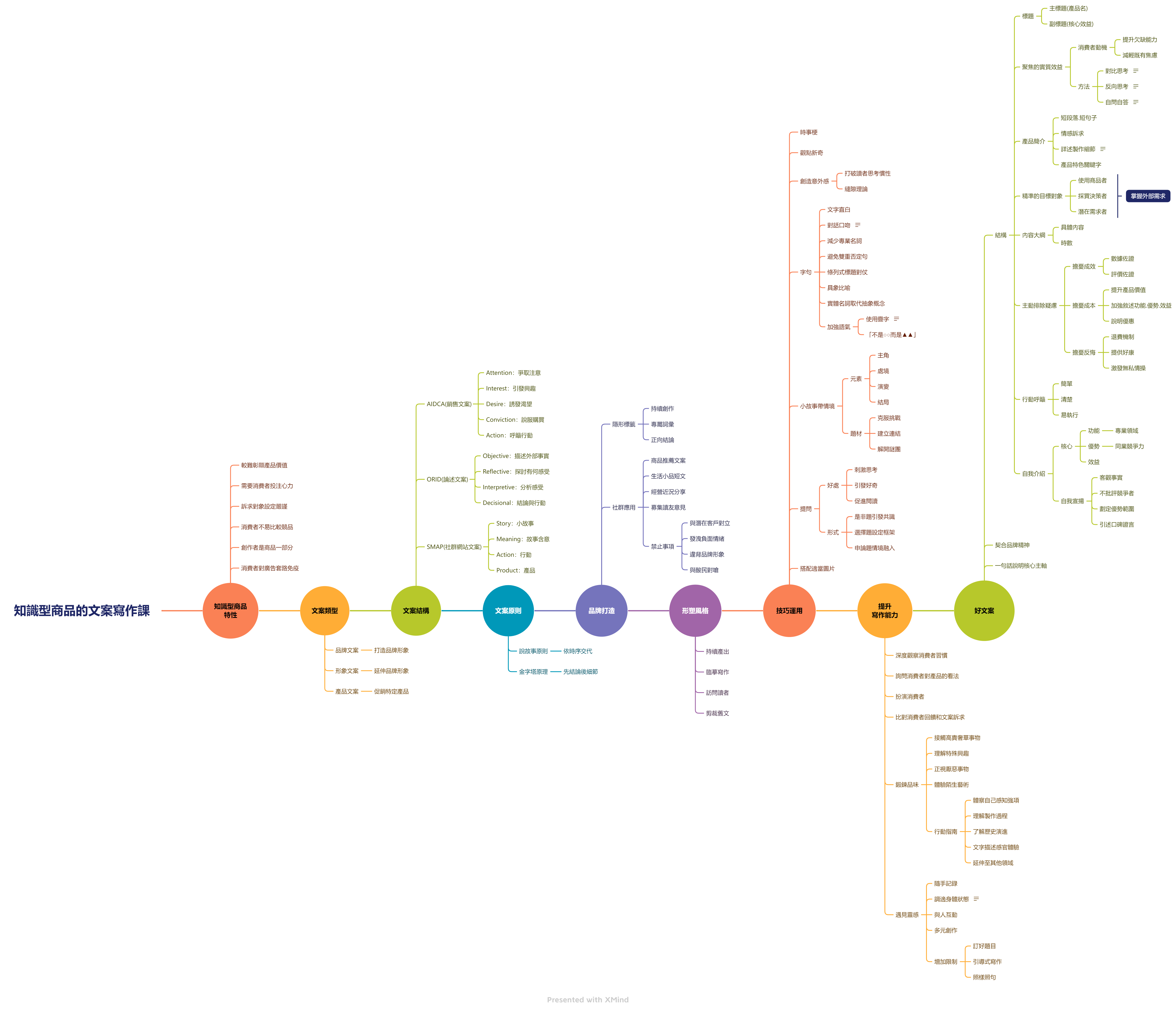
PDF:
Translation using ChatGPT Mar 23 Version.

 遲來的啟蒙 Start From Here Now
《知識型商品的文案寫作課》課程筆記 有 “ 2 則迴響 ”