
今年閱讀的書單可說是不受控,讀的大半的書都不在預計書單內,幾乎都是隨機性、想讀就找來讀的書,所以書的類型比起去年豐富一些。
This year’s reading list can be described as uncontrolled. Most of the books I read were not on my planned list; they were chosen randomly, based on my immediate interest. Consequently, the variety of books I read was richer compared to last year.
總共讀了60本書,希望大家透過我的分享也能找到自己有興趣的書籍。
In total, I managed to read 60 books. I hope that through my sharing, everyone can discover books that pique their interest.
1.走路的人 The Walker / Ha Jung-woo

Living Well
The subtitle of this book should be “Living Well". Understanding how to immerse oneself, relax, eat well, exercise, sleep well, and rest properly is not a simple matter. It mentions the importance of establishing one’s routines, much like anchoring oneself, so that amidst the unstable waves of emotions, one can steady their mind. The author considers walking as his routine. When he feels tired or agitated, he starts walking. Without pursuing any particular meaning, he finds that as he walks, his mind naturally clears up, as many things are beyond our control, and all we can do is stabilize our emotions to face whatever comes our way.
2.以民主之名的獨裁 The Revenge of Power / Moisés Naím
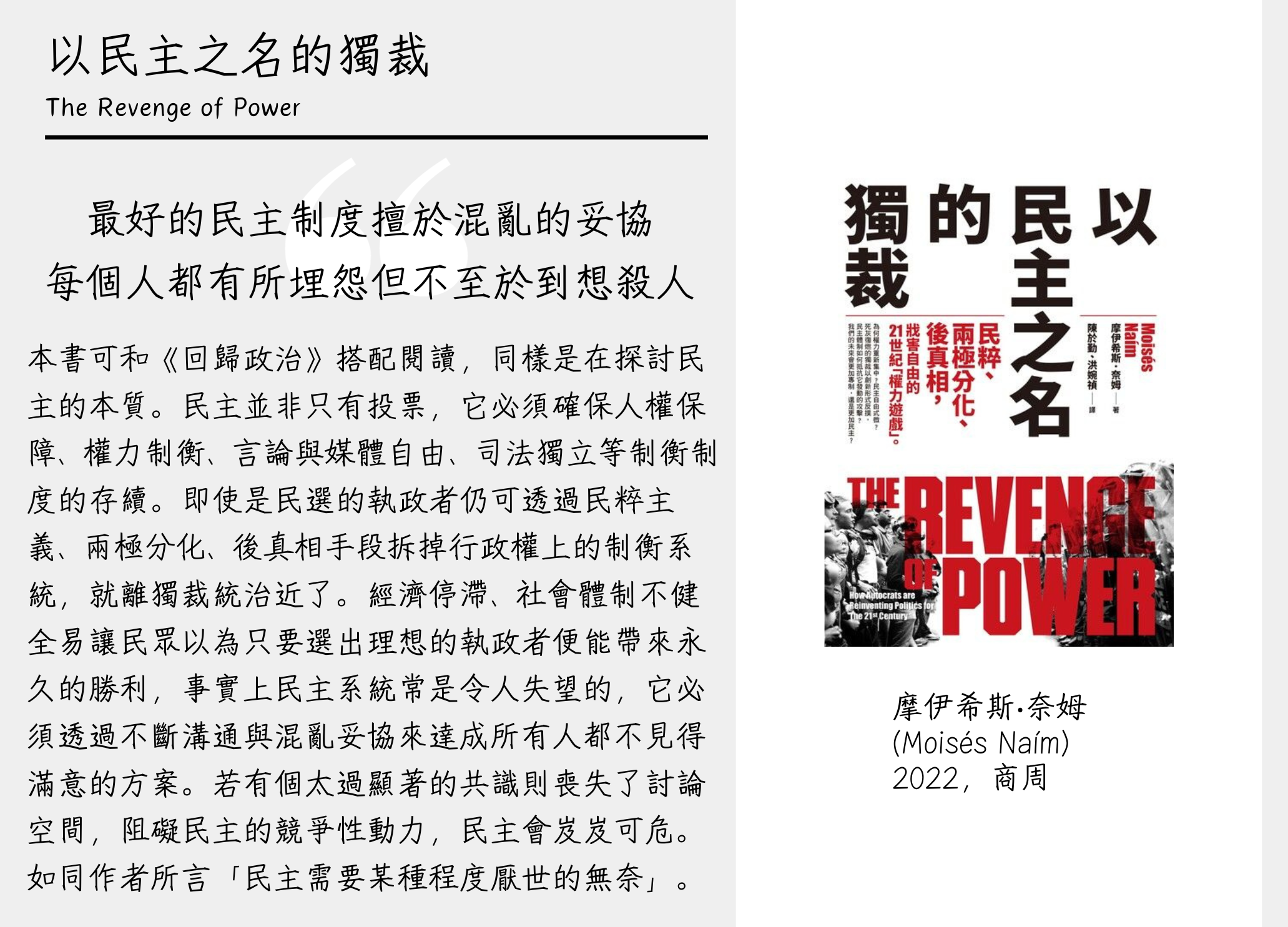
The best democratic system excels in chaotic compromise.
Everyone has grievances, but it never reaches the point of wanting to kill.
This book pairs well with “The Return of the Political," both exploring the essence of democracy. Democracy isn’t just about voting; it must ensure the preservation of human rights, balance of power, freedom of speech and media, and judicial independence. Even elected leaders can dismantle the checks and balances in the executive branch through populism, polarization, and post-truth methods, edging closer to authoritarian rule. Economic stagnation and societal dysfunction can lead people to believe that electing an ideal leader will bring permanent victory, but in reality, democratic systems are often disappointing. They must achieve solutions that satisfy no one through continuous communication and chaotic compromise. If there’s too significant a consensus, it stifles discussion, impeding the competitive drive of democracy, making it vulnerable. As the author puts it, “Democracy requires a certain degree of world-weary resignation."
3.致富的特權 The Privilege of Getting Rich / Chen Hongyu, Wu Congmin, Li Yiting, Chen Xusheng

Economic growth relies on technological innovation and productivity improvement. A restrictive exchange rate policy is not a sustainable solution.
This book pairs well with “Naked Economics," both exploring the impact of economic policies on countries and their people. It’s a conscientious book deeply concerned about Taiwan’s economic development. Although it’s economics, its approach to exploring social phenomena is akin to sociology. What seems like an issue of individuals being unable to afford housing is actually related to the central bank’s monetary policy. This book is particularly suitable for those born in 1990. During the tenure of central bank governor Peng Huainan, which almost coincides with the coming of age of those born in 1990, the monetary policy (restricting the appreciation of the New Taiwan Dollar, keeping interest rates low for a long time) had a profound impact on Taiwan’s economic development. Reading this book can help understand how the central bank’s interest and exchange rate policies have led to stagnant wages and continuously rising house prices in Taiwan.
4.讀書別靠意志力 Garantiert erfolgreich lernen / Christian Gruning
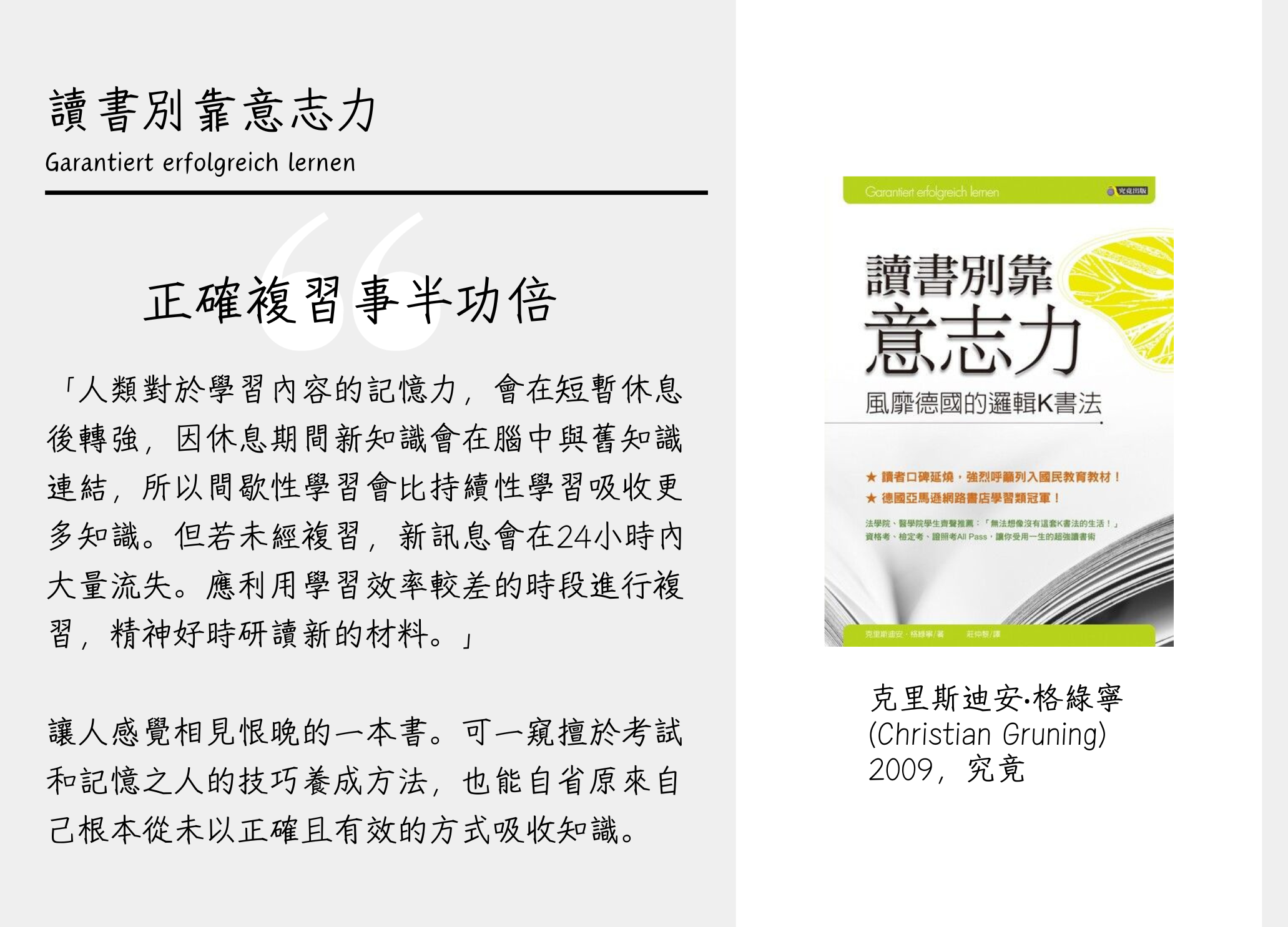
Correct review leads to twice the results.
“The human memory for learning content will strengthen after a brief rest, as new knowledge will be connected with old knowledge in the brain during the rest period. Therefore, intermittent learning absorbs more knowledge than continuous learning. However, without review, new information will be lost in large quantities within 24 hours. Review should be conducted during periods of lower learning efficiency, while studying new material when one’s mind is fresh."
This book feels like a revelation. It offers insights into the methods of those skilled in exams and memory retention, prompting self-reflection on how one has never truly absorbed knowledge in a correct and effective manner.
5.島國毒癮紀事 The Many Faces of Addiction / The Reporter
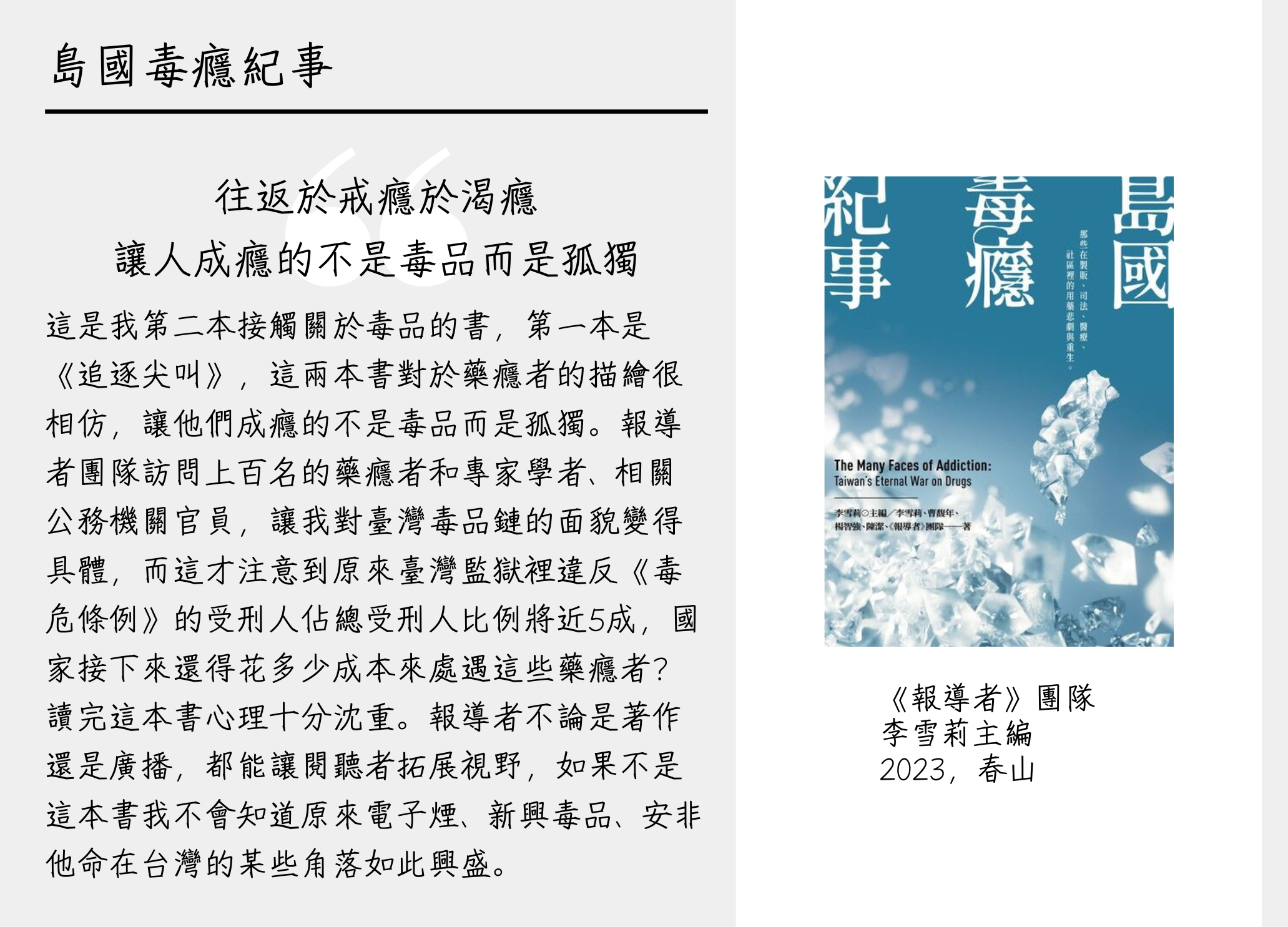
Journeying between addiction and craving.
What ensnares people is not drugs but loneliness.
This is my second encounter with books on drug addiction, the first being “Chasing the Scream." Both books depict addiction as stemming not from drugs but from loneliness. The Reporter team interviewed hundreds of drug addicts, experts, scholars, and relevant government officials, providing me with a concrete picture of Taiwan’s drug chain. It was only through this that I realized nearly 50% of inmates in Taiwanese prisons violate the Narcotics Hazard Prevention Act. How much more will the state have to spend to address these addicts? Upon finishing this book, I felt a heavy burden on my mind. The Reporter, whether through their writing or broadcasting, expand the perspectives of their audience. Without this book, I wouldn’t have known about the prevalence of e-cigarettes, emerging drugs, and methamphetamine in certain corners of Taiwan.
6.回歸政治 The Return of the Political / Chantal Mouffe

Competitive pluralism is the foundation of modern democracy.
“The triumph of liberal democracy, rather than stemming from its own success, owes more to the collapse of its enemies. Will democratic states be able to address the problems that communism has proven incapable of solving? It would be dangerous to assume that the failure of communism has put an end to poverty and the thirst for justice."
This book can be read in conjunction with “The Revenge of Power." The key to deepening democracy and moving towards competitive pluralism lies in whether we recognize and acknowledge the “essence of politics" (the vibrant political struggle of democracy is the driving force behind its continued existence) — the perennial nature of conflict and confrontation. The hallmark of pluralistic democracy is not the absence of domination and violence but the establishment of a set of institutions that limit and counteract domination and violence.
7.聰明學經濟的12堂課 Naked Economics / Charles Wheelan
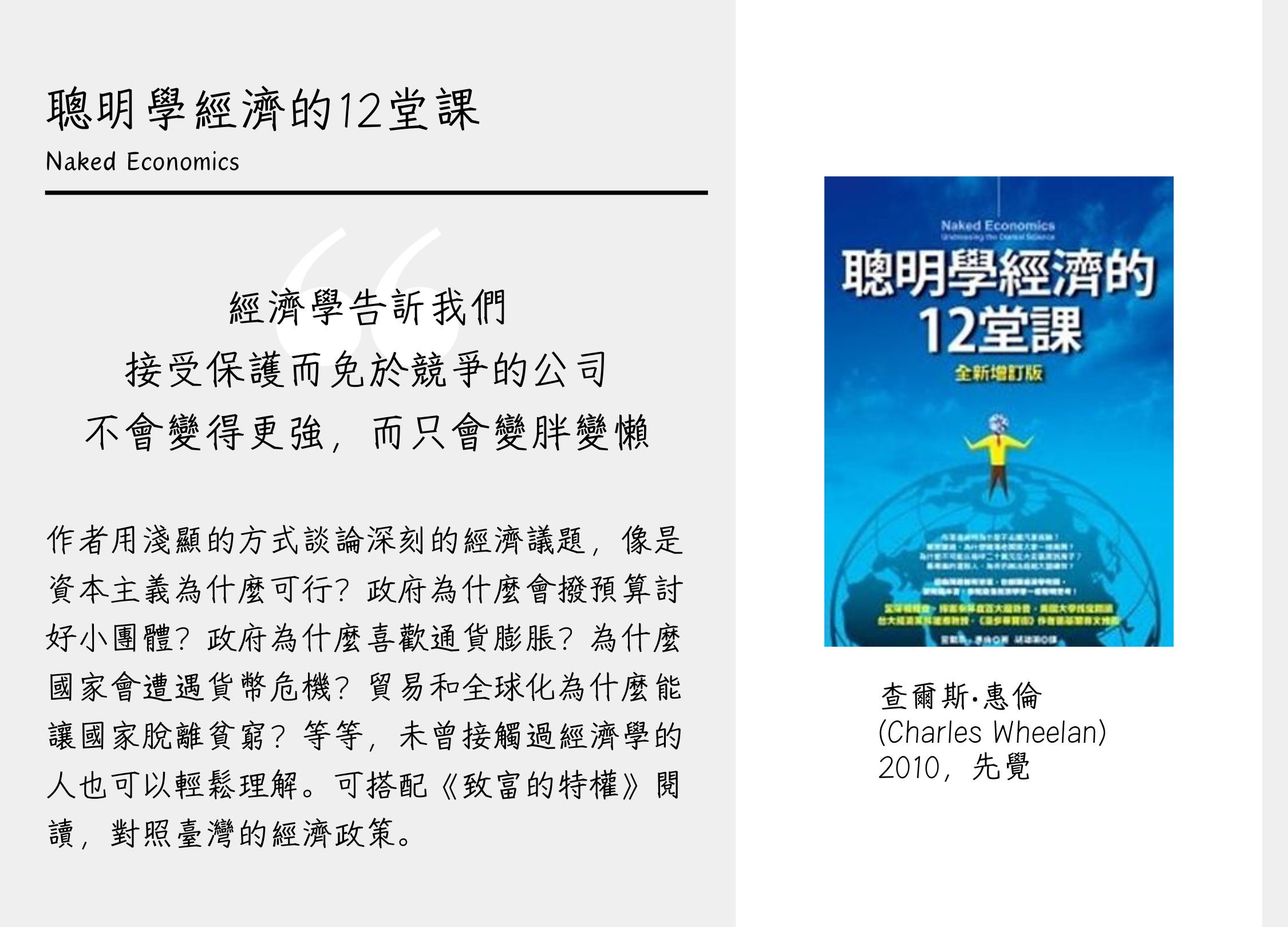
Economics tells us that companies that accept protection and avoid competition will not become stronger, but will only become fat and lazy.
The author discusses profound economic issues in a simple manner, such as why capitalism works, why governments allocate budgets to please small groups, why governments like inflation, why countries encounter currency crises, and why trade and globalization can lift countries out of poverty, among others. Even those who have never encountered economics can easily understand. It can be read in conjunction with “The Privilege of Getting Rich" to compare with Taiwan’s economic policies.
8.謊言 The Liar / Kim Takhwan

Darker than the depths of the sea is the darkness of the human heart, the darkness that extinguishes humanity.
Through this book, I first paid attention to the sinking of the South Korean ferry Sewol and came to realize that it was not simply an unfortunate accident but a tragedy caused by a series of failures within government agencies. When paired with the documentary, one feels even more heartbroken, angry, and helpless about the entire event.
Although the author adopts a novelistic form, it is essentially a work of literary journalism, aiming to bring some hope to people by crafting a more optimistic ending. The true ending, however, is that the diver did not leave behind a suicide note and took his own life.
9.超爆蘋果橘子經濟學 SuperFreakonomics / Steven D. Levitt, Stephen J. Dubner
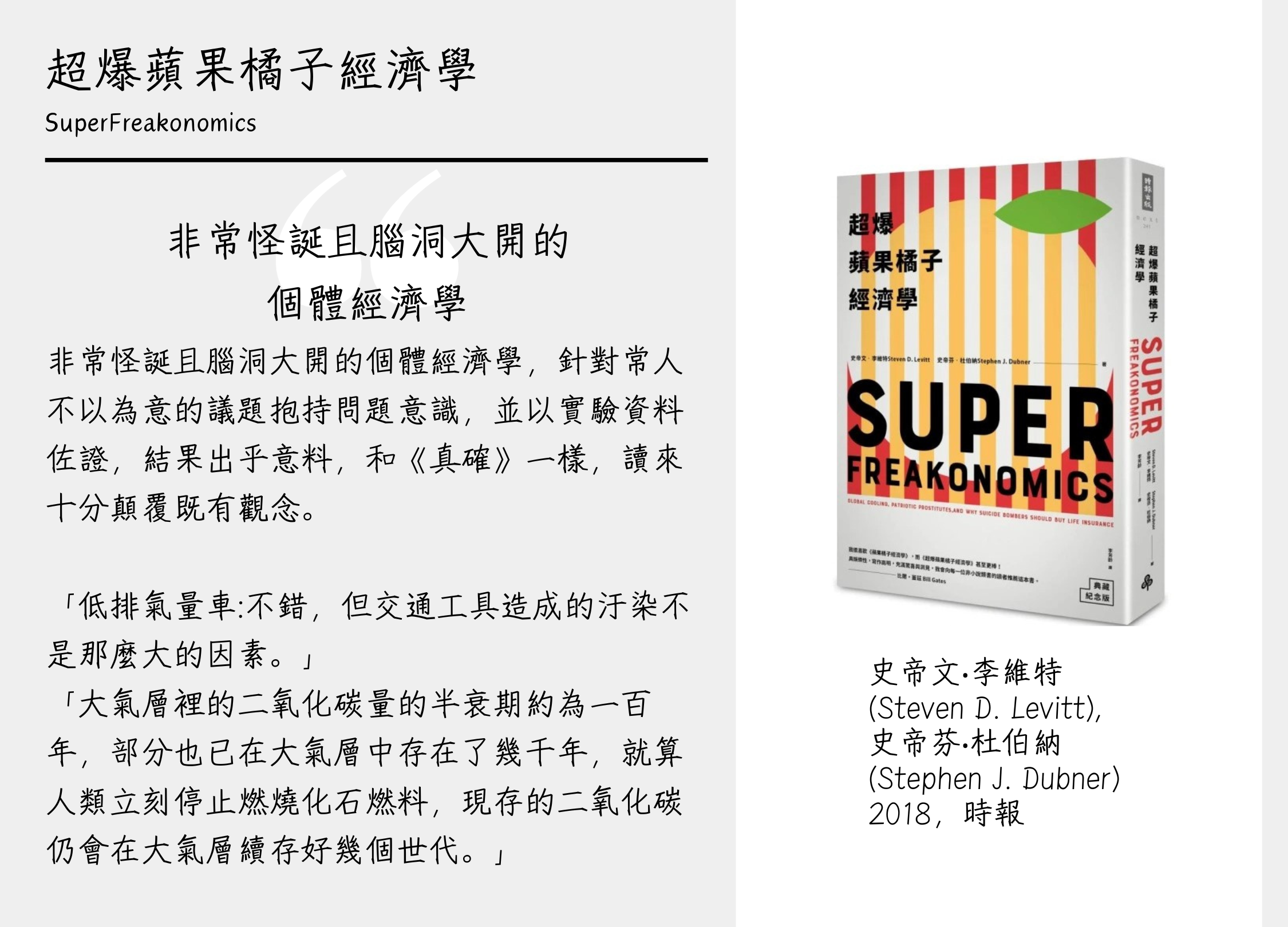
A profoundly bizarre and mind-bending field: individual economics.
It holds a questioning attitude towards issues that most people overlook, using experimental data to support its findings. The results are unexpected and, much like “Factfulness: Ten Reasons We’re Wrong about the World," profoundly overturn conventional wisdom.
“Low-emission vehicles: Not bad, but the pollution caused by transportation isn’t as significant as you might think."
“The half-life of carbon dioxide in the atmosphere is about one hundred years, and some of it has already been present in the atmosphere for thousands of years. Even if humans were to stop burning fossil fuels immediately, the existing carbon dioxide would continue to persist in the atmosphere for several generations."
10.逃避人性 Hiding from Humanity / Martha C. Nussbaum
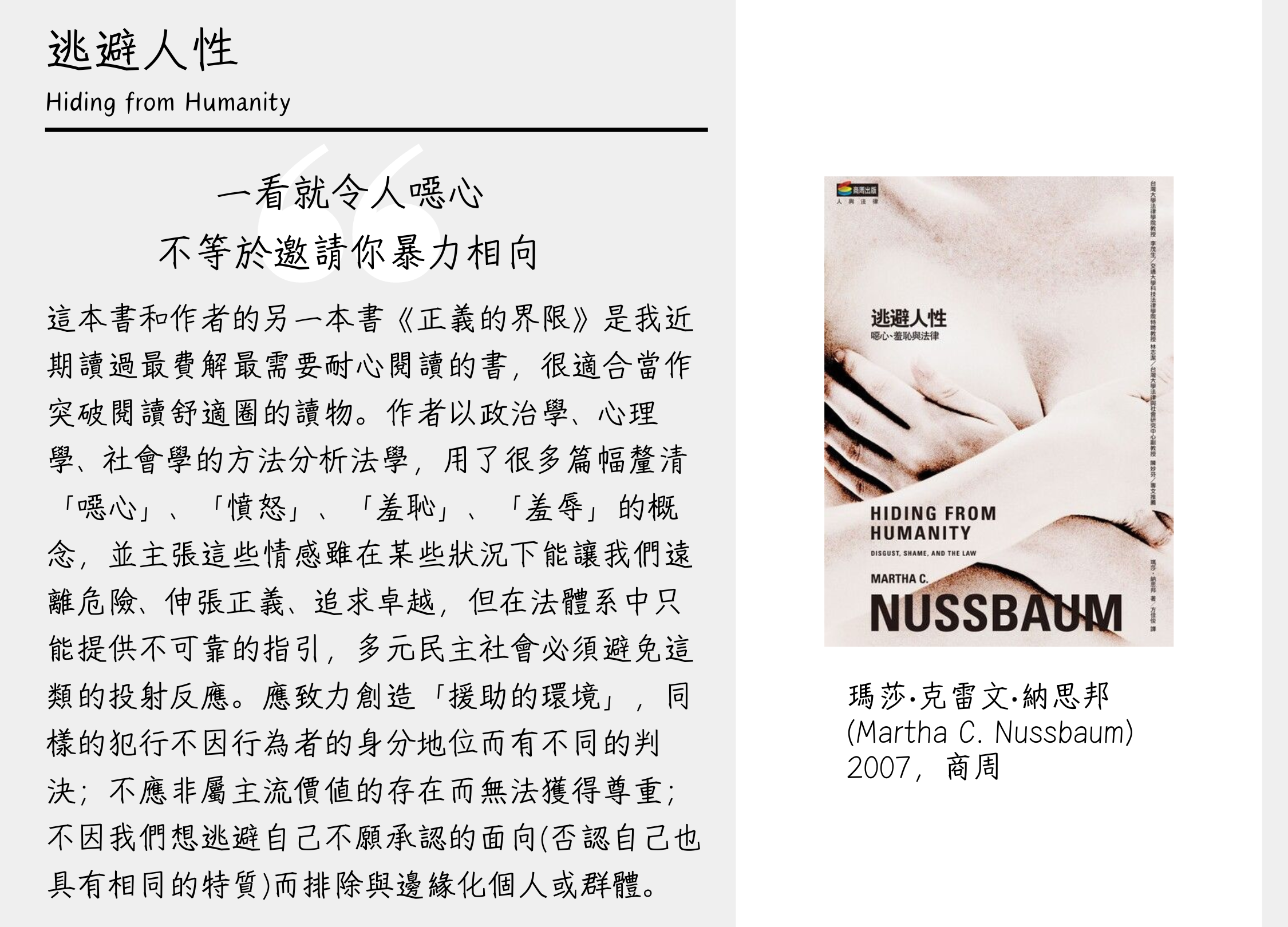
Just because something is disgusting at first glance doesn’t mean it invites you to respond with violence.
This book, along with the author’s other work “Frontiers of Justice," is one of the most challenging and patience-demanding reads I’ve encountered recently, making it ideal for breaking out of one’s reading comfort zone. The author analyzes law through the lenses of political science, psychology, and sociology, dedicating significant space to clarify the concepts of “disgust," “anger," “shame," and “humiliation." While acknowledging that these emotions can sometimes lead us away from danger, advocate for justice, and pursue excellence, the author argues that they offer unreliable guidance within the legal system of a pluralistic democratic society. It is essential to avoid such projected responses. Efforts should be made to create an “assistance environment" where the same offense does not receive different judgments based on the offender’s status; non-mainstream values should not be denied respect; individuals or groups should not be excluded or marginalized because they represent aspects we are unwilling to acknowledge in ourselves.
11.正義的界限 Frontiers of Justice / Martha C. Nussbaum
We don’t necessarily need to increase our productivity to earn the respect of others.
Similar to “Hiding from Humanity," there is a significant amount of literature analysis before delving into the author’s arguments. The author is a scholar adept at engaging with previous works, using literature analysis to explore the shortcomings of past theories before presenting their own views and solutions. The author argues that traditional social contract theories exclude vulnerable groups in society (such as the physically and mentally disabled, as well as non-human species). Their proposed solution is to define the contractors not procedurally but consequentially. The author introduce the “capabilities approach," outlining a list of ten core capabilities, which is broader than the human rights framework and can be applied to non-human species as well. The author believes that if society enables all species to achieve this list of core capabilities, it allows each species to live according to its nature, akin to living as a person for humans. This reflects the author’s concern for marginalized groups excluded by traditional social contract theories.
12.自卑與超越 What Life Should Mean to You / Alfred Adler
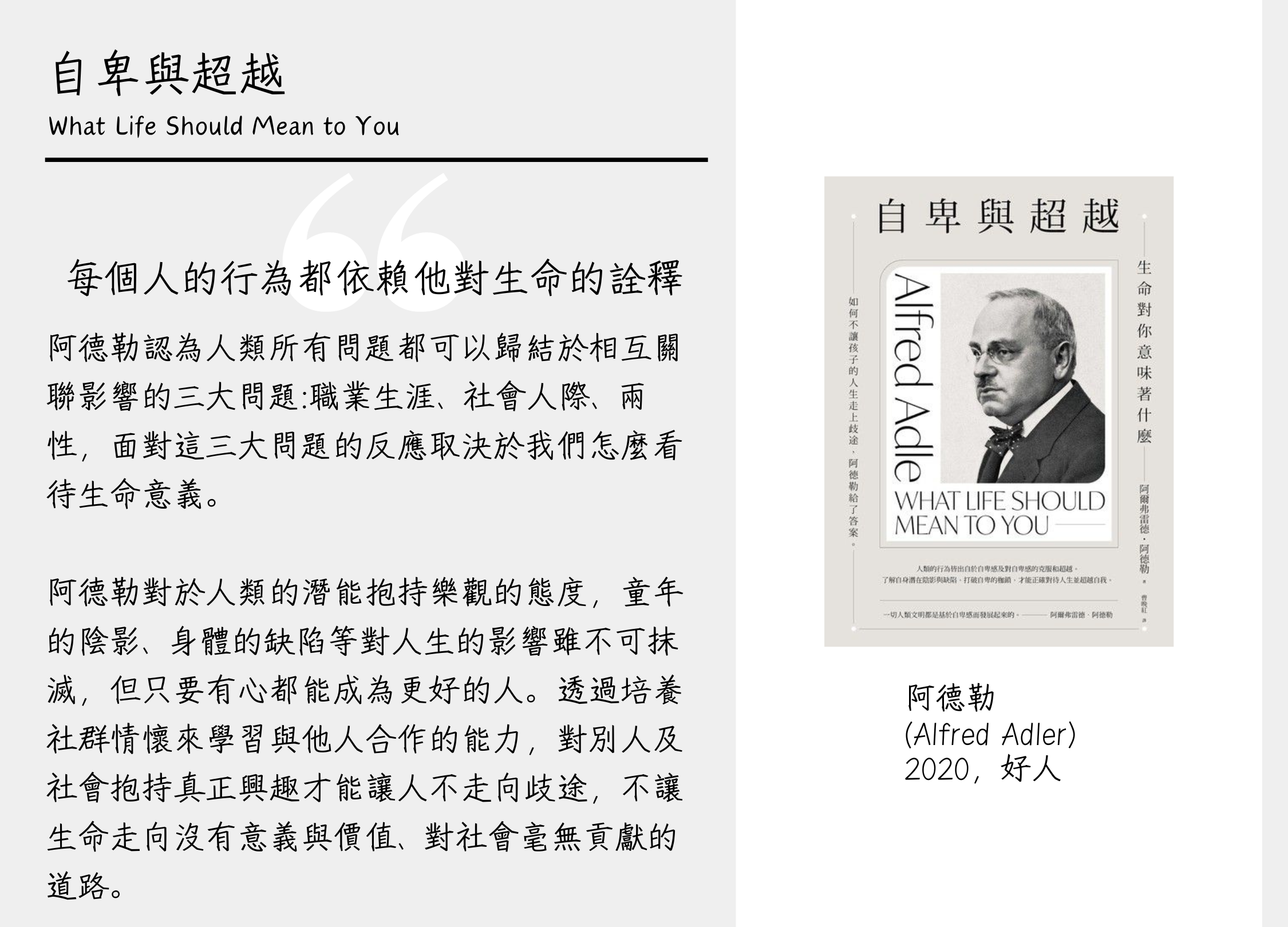
Every person’s behavior relies on their interpretation of life.
Adler believed that all human problems could be attributed to three interrelated issues: career, social relationships, and sexuality, and how we react to these three issues depends on how we perceive the meaning of life.
Adler held an optimistic view of human potential, believing that while the impact of childhood shadows and physical defects on life cannot be erased, anyone with determination can become a better person. By cultivating a sense of community and learning the ability to cooperate with others, one can avoid straying from the right path. Having genuine interest in others and society prevents one from leading a meaningless and valueless life, contributing nothing to society.
13.阿德勒心理學講義 The Science of Living / Alfred Adler
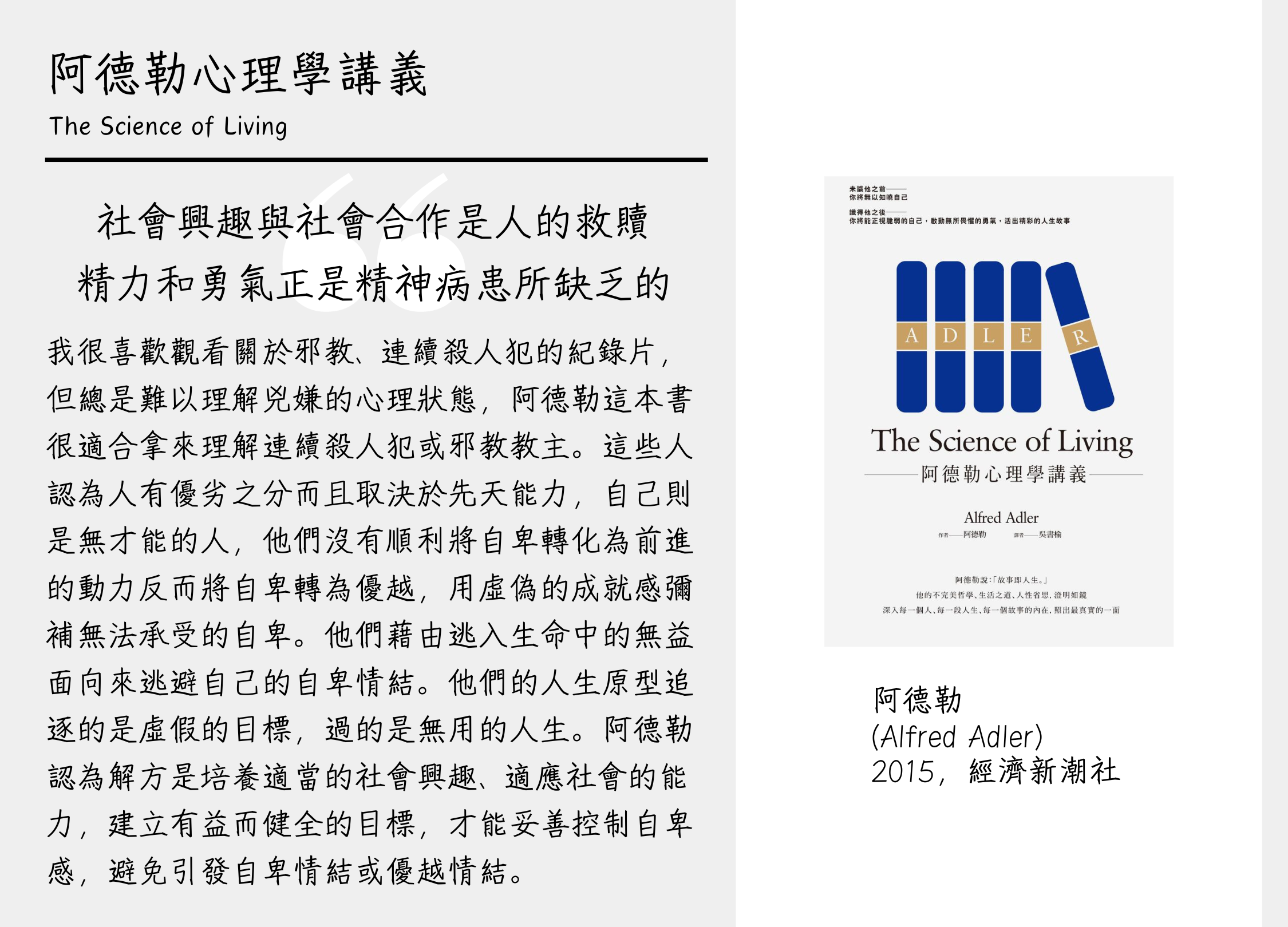
Social interest and cooperation are the redemption of humanity, energy and courage are what the mentally ill lack.
I enjoy watching documentaries about cults and serial killers, but I often find it difficult to understand the psychological state of the perpetrators. Adler’s book is well-suited for understanding serial killers or cult leaders. These individuals believe in the inherent superiority and inferiority of people, viewing themselves as untalented. Instead of turning their feelings of inferiority into motivation for progress, they turn it into a sense of superiority, compensating for their inadequacies with false achievements. They escape their feelings of inferiority by immersing themselves in unproductive aspects of life. Their lives revolve around chasing false goals, living purposeless lives. Adler believes that the solution lies in cultivating appropriate social interests, adapting to society, and establishing beneficial and wholesome goals to properly control feelings of inferiority, thus avoiding the development of inferiority complexes or superiority complexes.
14.當下的力量 The Power of Now / Eckhart Tolle
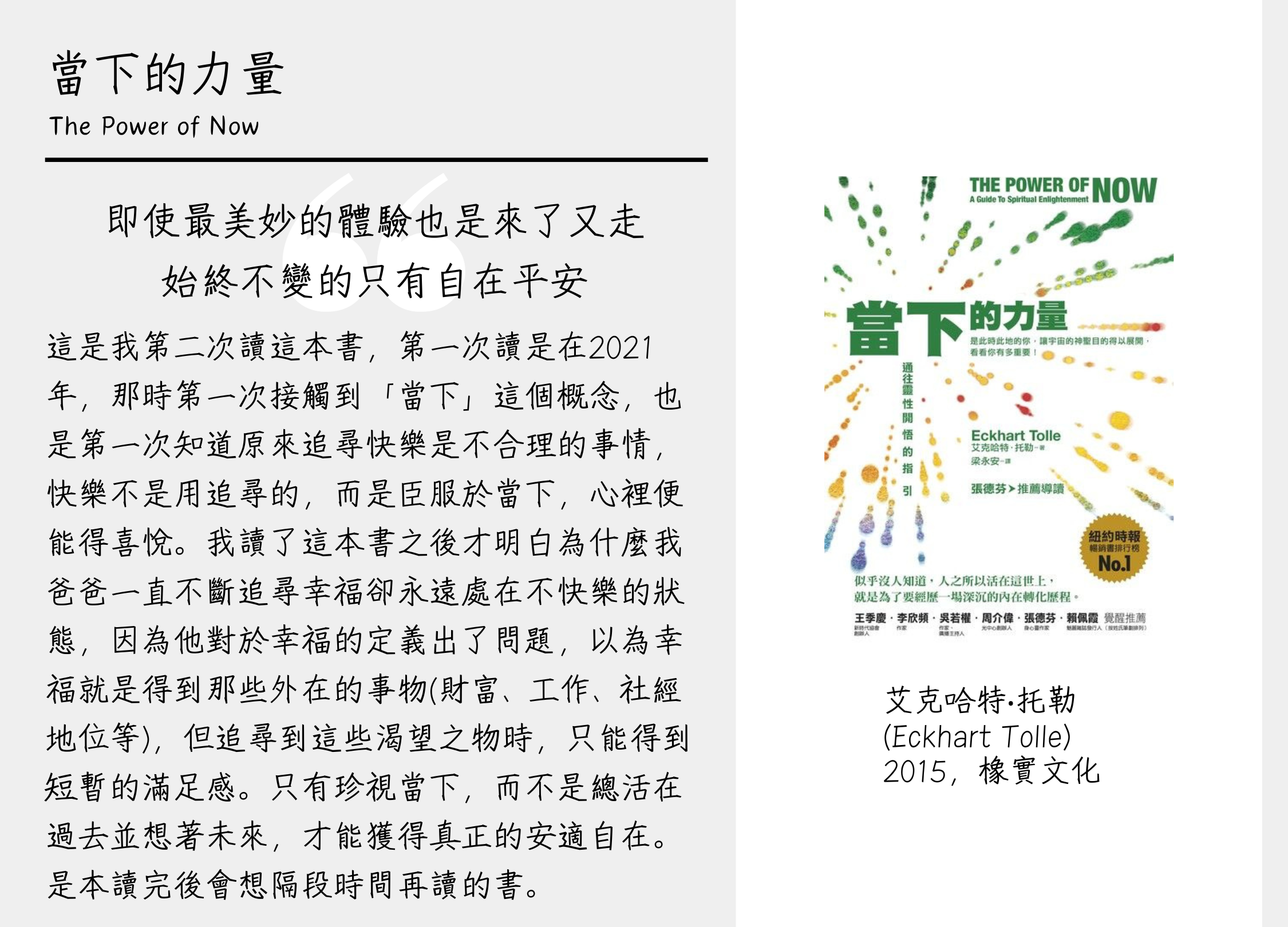
Even the most wonderful experiences come and go, but what remains unchanged is inner peace and tranquility.
This is my second time reading this book, the first time being in 2021. Back then, I first encountered the concept of “the present moment" and learned that pursuing happiness is an unreasonable endeavor. Happiness is not something to be pursued; it is found in surrendering to the present moment, which brings joy to the heart. After reading this book, I understood why my father, despite constantly chasing after happiness, always remained unhappy. It’s because his definition of happiness was flawed; he believed that happiness came from external things such as wealth, job, social status, etc. However, upon achieving these desired external possessions, he only found temporary satisfaction. Only by cherishing the present moment, rather than dwelling on the past and worrying about the future, can one truly attain peace and contentment. It’s the kind of book that one would want to revisit after some time has passed.
15.生死之間 Between Two Worlds / Tyler Henry
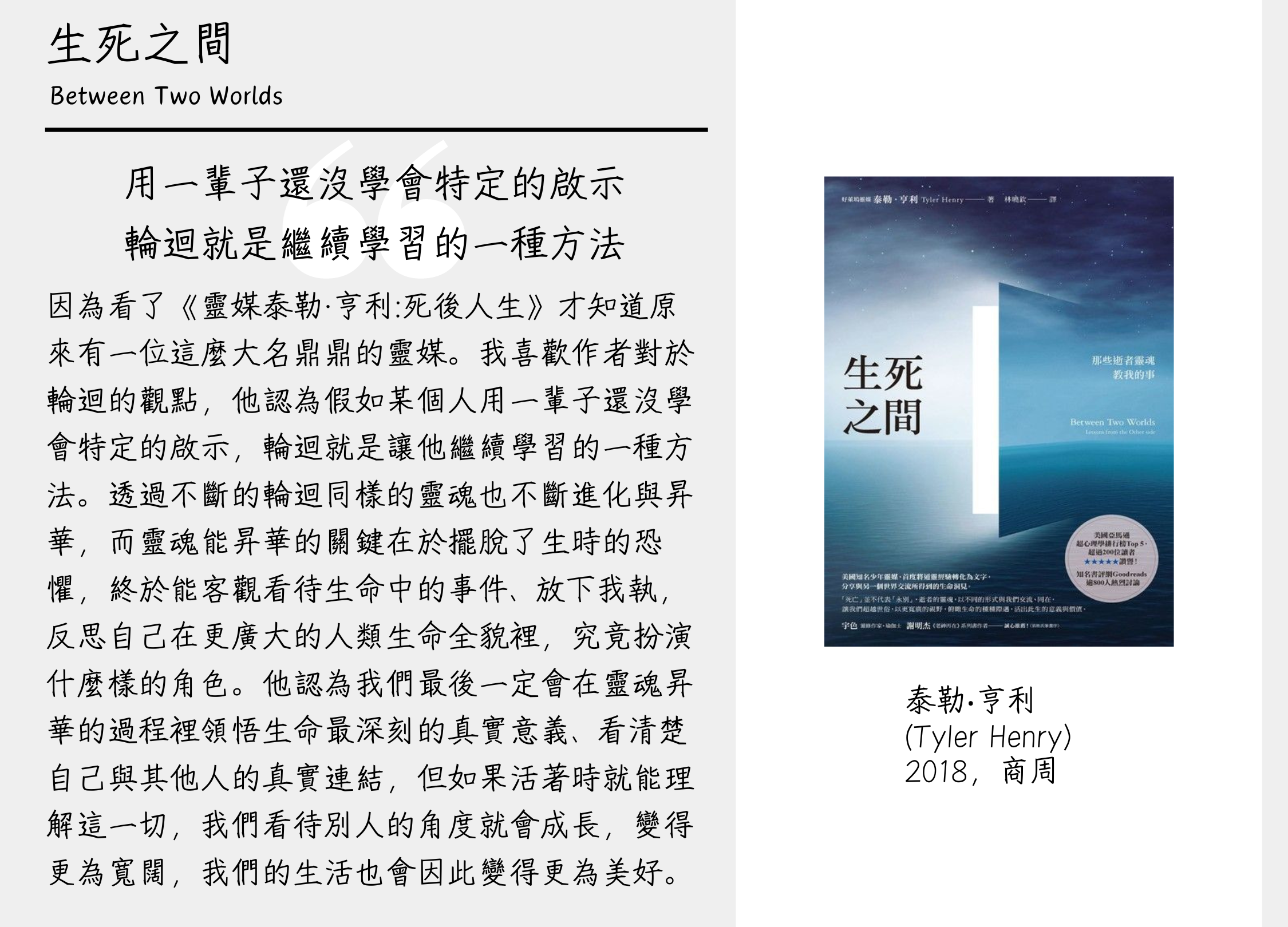
Using one’s entire lifetime without learning specific insights, reincarnation becomes a method for continued learning.
Through watching “Life After Death with Tyler Henry," I discovered the existence of a renowned medium. I appreciate the author’s perspective on reincarnation; he believes that if a person hasn’t learned specific insights in their lifetime, reincarnation serves as a method for them to continue learning. With each cycle of reincarnation, the same soul evolves and ascends. The key to soul ascension lies in shedding the fears of life, finally being able to objectively view life’s events, letting go of attachments, and reflecting on one’s role in the broader scope of human existence. He believes that ultimately, during the process of soul ascension, we will comprehend the deepest truths of life and understand our true connections with others. However, if we can understand all of this while alive, our perspective on others will expand, our lives will become richer, and our existence will become more beautiful as a result.
16.穴道導引 A Guide to Self-Acupressure / Tsai Biming

Reclaiming One’s Time
There is a prevalent concept nowadays that teaches people how to relax and reclaim their time. Meditation is quite challenging for me; it’s hard to empty my mind. However, acupressure guiding suits me better. It focuses on meridians and breathing. During the practice, my mind doesn’t wander elsewhere because I need to concentrate to avoid mistaking the timing of the meridians and breaths. It feels great. Many of the movements are similar to general health exercises, indicating its effectiveness as recognized health exercise. It’s suitable for office workers who need physical activity but lack the time and stamina for extensive workouts. It’s worth recommending. There are also demonstration videos online by readers that one can follow along with, which is quite helpful."
17.鬆開的技、道、心 The Daoyin of Acupoints / Tsai Biming
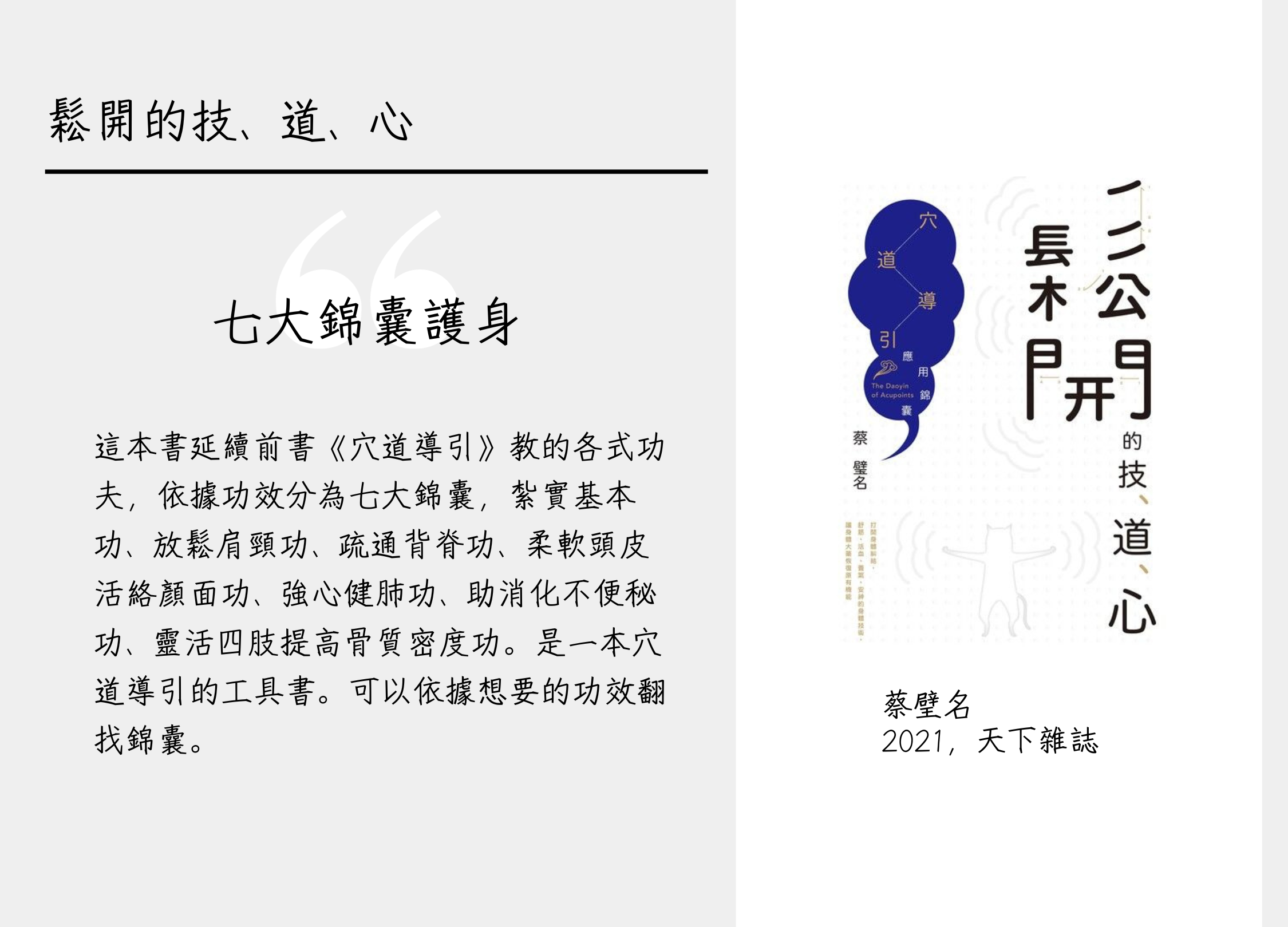
The seven great pouches for strengthening and keeping fit
This book continues the various techniques taught in the previous book, ‘A Guide to Self-Acupressure.’ It categorizes these techniques into seven main strategies based on their effects: solid basic skills, shoulder and neck relaxation techniques, spine clearance exercises, scalp softening and facial rejuvenation exercises, heart and lung strengthening exercises, aiding digestion and relieving constipation exercises, and flexible limb exercises to improve bone density. It serves as a practical guide to acupressure, where readers can flip through the ‘pouches’ based on the effects they desire."
18.胃弱使用說明書 Cure your stomach weakness and life will be better / Tosirou Iketani
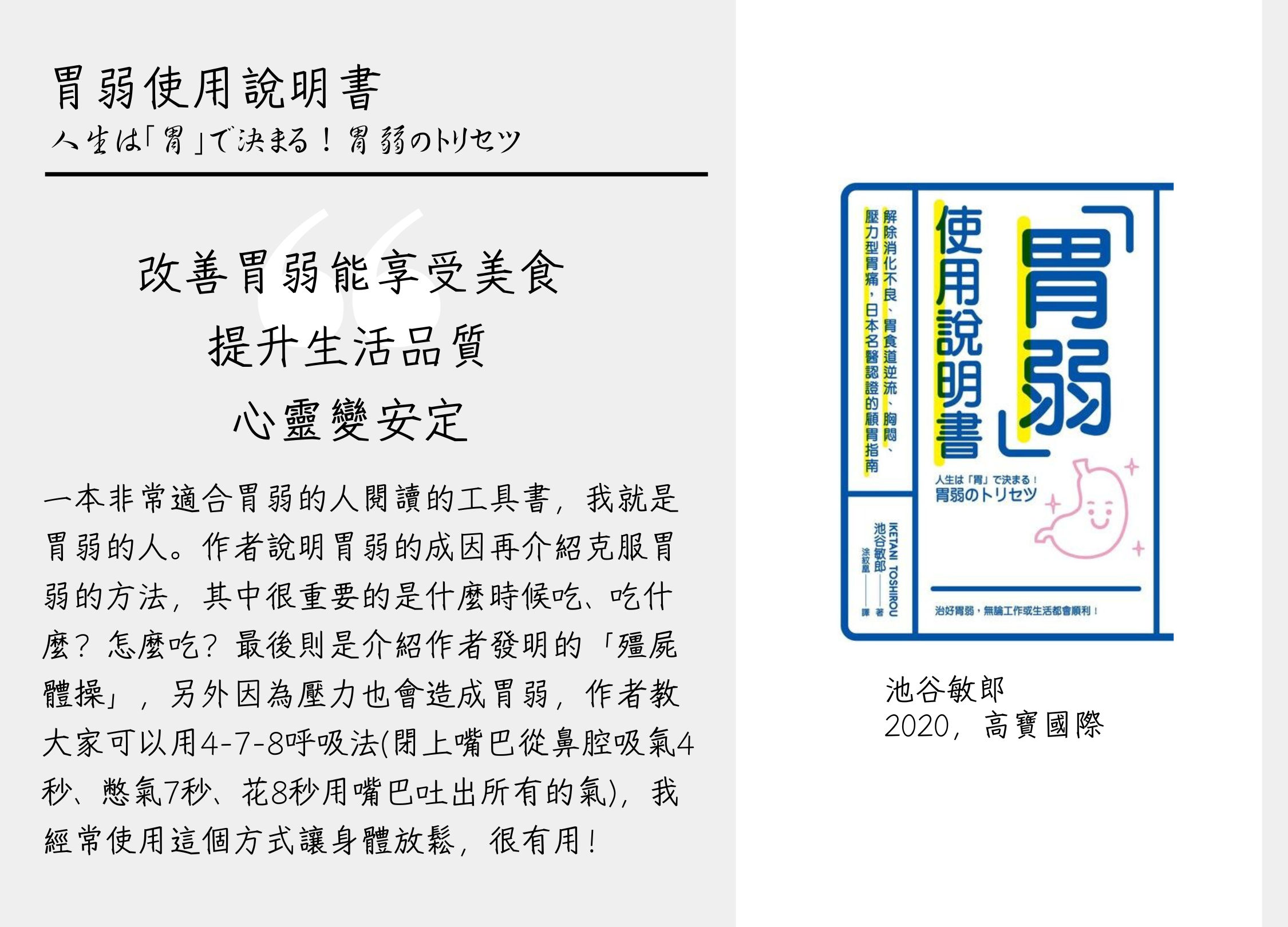
Improving gastric weakness for enjoying food, enhancing quality of life, and achieving inner peace
This is a very suitable handbook for people with gastric weakness, and I am one of them. The author explains the causes of gastric weakness and then introduces methods to overcome it, emphasizing the importance of when to eat, what to eat, and how to eat. Finally, the author introduces the “Zombie Exercise" invented by him. Additionally, since stress can also cause gastric weakness, the author teaches readers to use the 4-7-8 breathing technique (inhaling for 4 seconds through the nose, holding the breath for 7 seconds, and exhaling all the air through the mouth for 8 seconds). I often use this method to relax my body, and it’s very effective!
19.重新與人對話 Reclaiming Conversation / Sherry Turkle
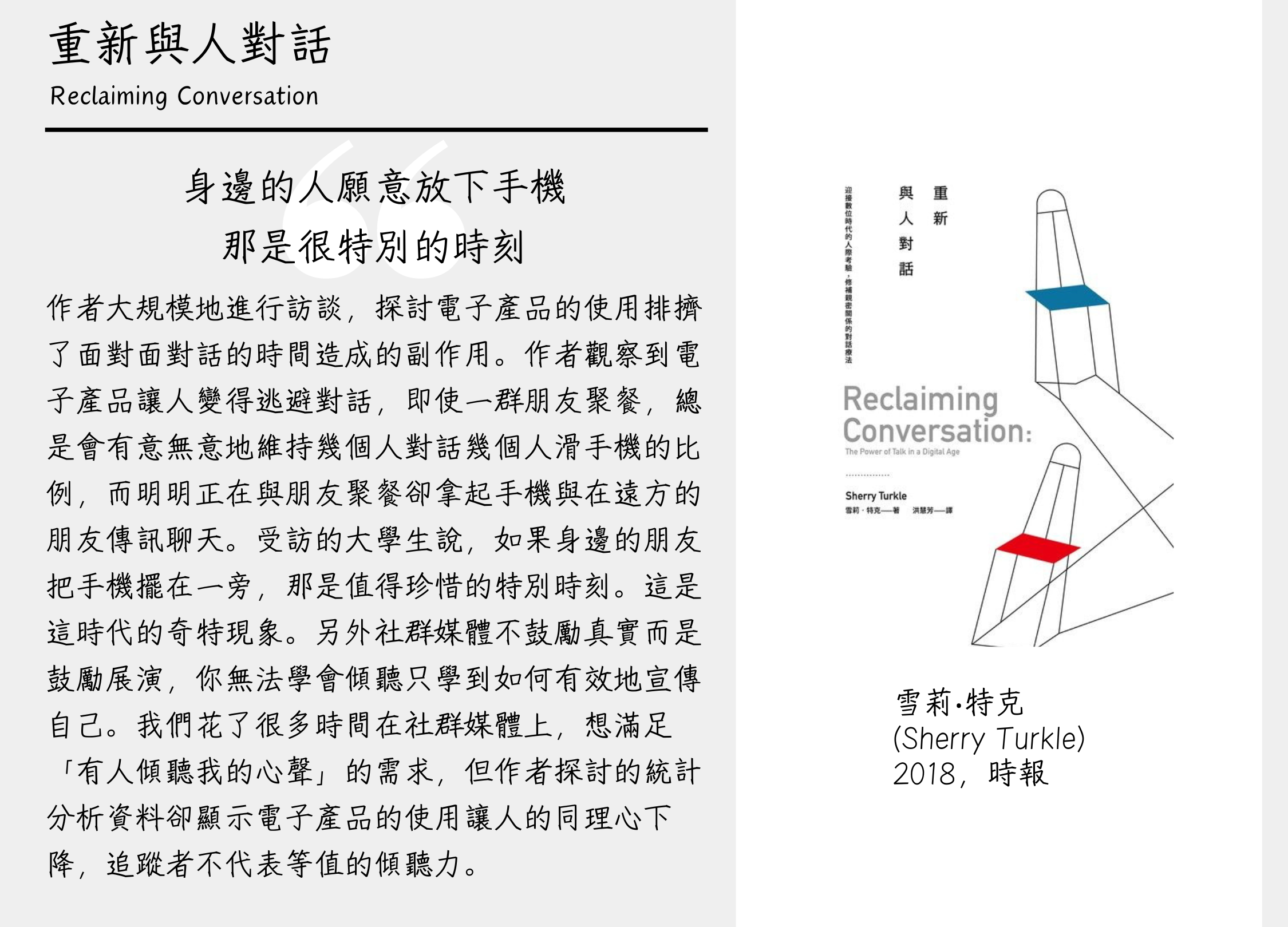
When people around you are willing to put down their phones, It’s a special moment.
The author conducted extensive interviews to explore the side effects of electronic device usage on face-to-face conversations. They observed that electronic devices lead people to avoid conversations; even when a group of friends gathers for a meal, there’s always a proportion of individuals engaged in conversation while others are busy on their phones, either intentionally or unintentionally. Interestingly, even during social gatherings with friends, individuals may pick up their phones to chat with friends who are not present. College students interviewed stated that when their friends put their phones aside, it’s a cherished and special moment. This phenomenon is peculiar to this era.
Furthermore, social media doesn’t encourage authenticity but rather encourages performance. It teaches individuals not to listen but rather how to effectively promote themselves. While we spend a lot of time on social media seeking to fulfill the need for someone to listen to us, statistical analysis data explored by the author shows that the use of electronic devices decreases empathy, and having followers does not equate to having an equivalent level of listening ability.
20.奢華狂潮 Luxury fever / Robert H. Frank

For modern families, the economic challenge isn’t about getting what they need, but rather about obtaining what they want.
Different generations have different status symbols, and the wealthy have set benchmarks for consumption levels. This influence trickles down to other income brackets on the income ladder; middle and low-income groups are increasingly spending money, but their incomes are not growing. They cope with the increasing financial demands of consumption by reducing savings and increasing debt. Today’s high-end styles become tomorrow’s basic styles. Consumers’ desires are insatiable; even if they already have a certain item, they still desire a larger size or a more unique and refined style. Behavioral scientists have found that once a country crosses the threshold of affluence, the average level of happiness among its people is almost unrelated to the material wealth accumulated. So, if we ask whether money can buy happiness, the answer should be “it depends." If working longer hours is for conspicuous consumption, happiness is unlikely to increase compared to before. However, if money is used not for conspicuous consumption but to allocate time and activities for rest and relaxation, it will enhance life satisfaction.
21.工作、消費與新貧 Work, Consumerism and the New Poor / Zygmunt Bauman
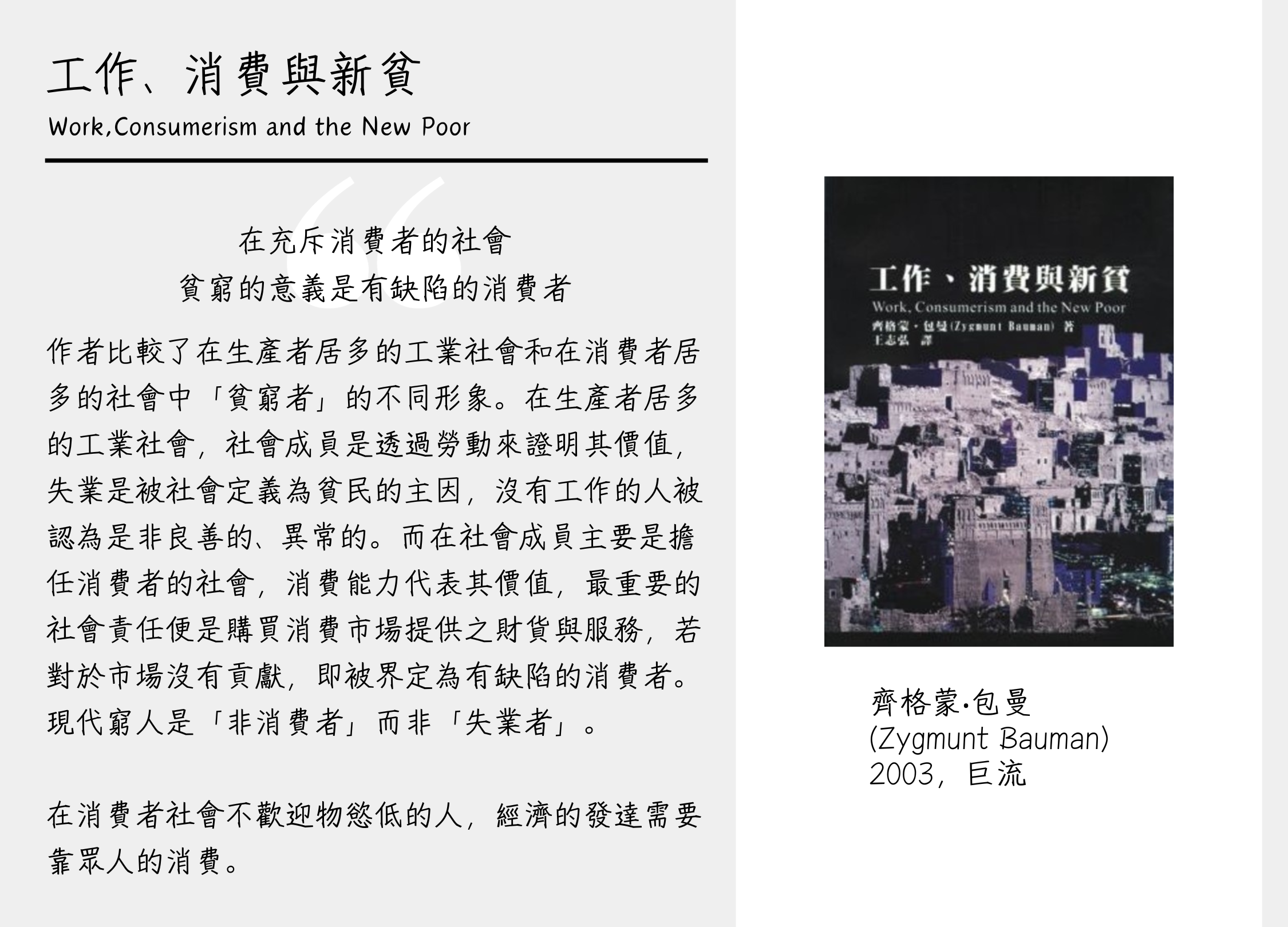
In a society dominated by consumers, poverty is defined as being a defective consumer.
The author compares the different images of “the poor" in industrial societies dominated by producers and those dominated by consumers. In industrial societies dominated by producers, members of society prove their worth through labor, and unemployment is defined as the main cause of poverty. Those without jobs are seen as morally deficient and abnormal. However, in societies where members primarily serve as consumers, purchasing power represents their value. The most important social responsibility is to buy goods and services provided by the consumption market. If someone doesn’t contribute to the market, they are labeled as defective consumers. Modern poverty is characterized by being “non-consumers" rather than “unemployed."
In a consumer society, people with low material desires are not welcomed, as economic prosperity relies on widespread consumption.
22.10倍速時代 Only the Paranoid Survive / Andrew S. Grove
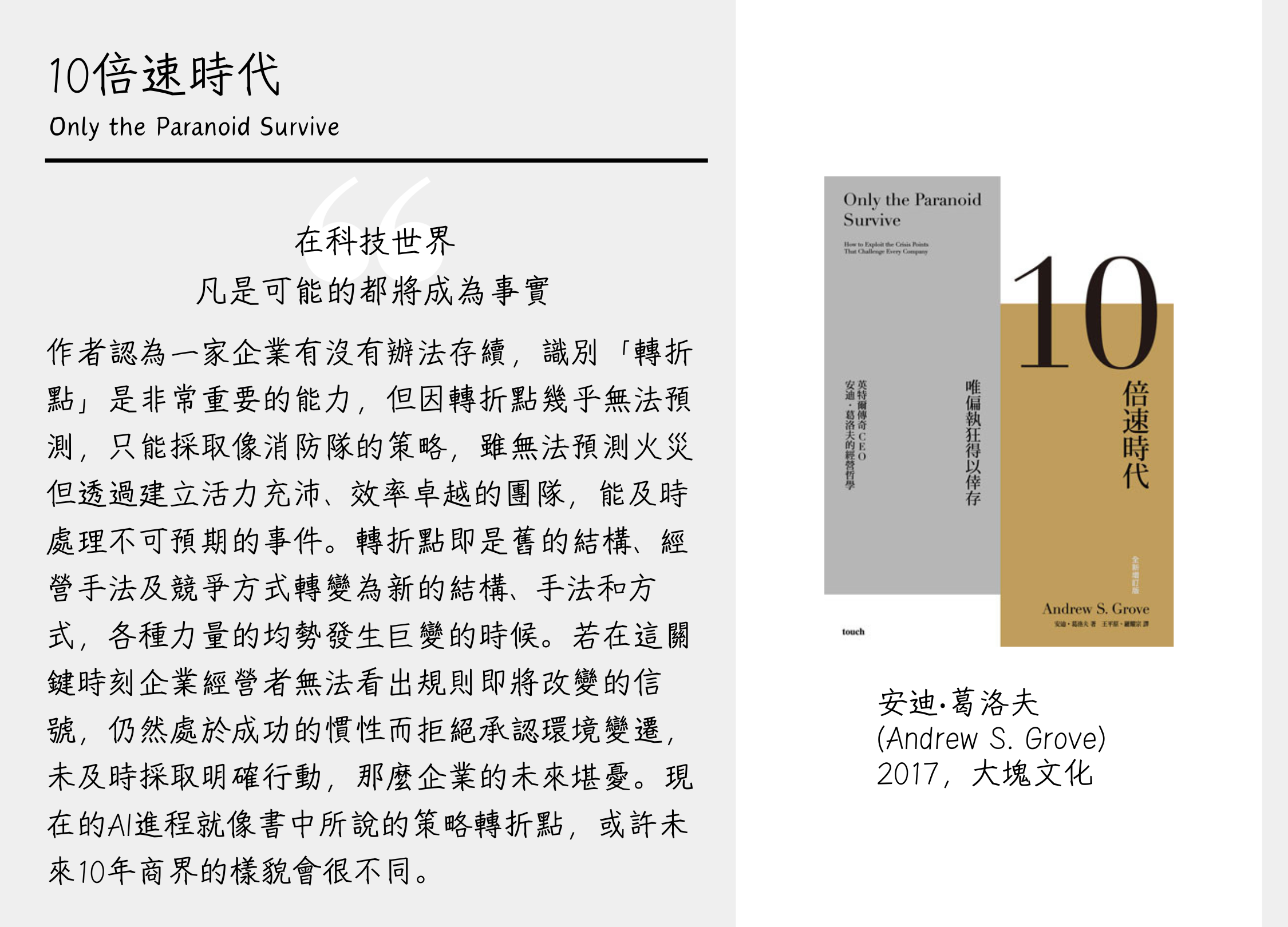
In the world of technology, anything that is possible will become a reality.
The author believes that the ability to identify “inflection points" is crucial for a company’s survival. However, since inflection points are almost impossible to predict, adopting a strategy akin to that of a fire department is necessary. Just as fire departments cannot predict fires but can deal with unexpected events promptly by establishing dynamic and efficient teams, businesses must be prepared to handle unforeseen circumstances. Inflection points mark the transition from old structures, operating methods, and modes of competition to new ones, occurring when the balance of various forces undergoes significant changes. If business operators fail to recognize the signals indicating that the rules are about to change during these critical moments, and instead cling to the inertia of success, refusing to acknowledge environmental changes and failing to take timely and decisive action, then the future of the business may be in jeopardy. The current progress in AI is akin to the strategic inflection points described in the book, and perhaps the landscape of the business world will be very different in the next 10 years.
23.慢富 Get Rich Slowly / George & Dewi

Money grants us the greatest tangible value: freedom and flexibility with our time.
This book is perfect for financial novices. It encapsulates the concepts found in all the top-tier financial literacy books. For those who are already familiar with these concepts, it serves as a refresher, reaffirming the correctness of these viewpoints. However, for those encountering these ideas for the first time, it’s a real boon. Through this lightweight book, readers can grasp these core concepts without feeling overwhelmed and gain valuable insights.
24.灰階思考 Thinking Gray / Xie Menggong
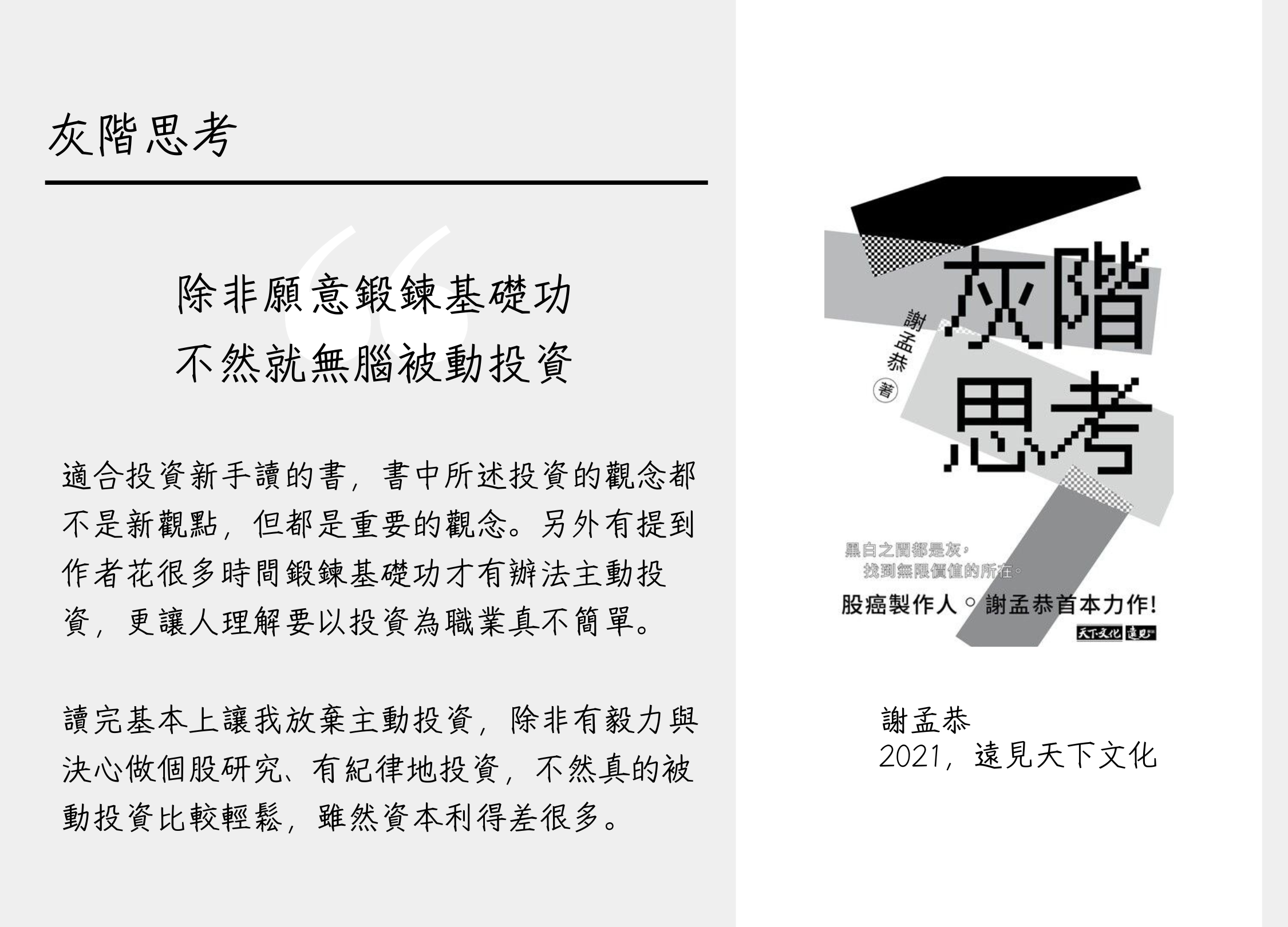
Unless you are willing to hone fundamental skills, otherwise you should choose mindlessly passive investing.
This book is suitable for novice investors. The investment concepts discussed in the book are not new perspectives, but they are all important concepts. Additionally, the author mentioned spending a lot of time honing fundamental skills before being able to actively invest, which further emphasizes how difficult it is to make investing a profession.
After reading, I basically gave up active investing. Unless one has the determination and discipline to conduct stock research and invest systematically, passive investing is indeed more relaxed, although the capital gains are much lower.
25.3天搞懂美股買賣 Understanding Stock Trading in 3 Days / Leung Yihong

Why not buy into the readily recognizable brands of the US stock market?
I had never considered buying US stocks before because the barrier to entry seemed too high. However, after reading this book along with the Get Rich Slowly author’s blog, I gathered the courage to open a US stock brokerage account. Since I had limited funds in my pocket, I only purchased MSFT and VT. Currently, the returns are MSFT (20.33%) and VT (10.99%). The characteristic of US stocks is their significant fluctuations, which makes it quite interesting.
26.拿鐵因子 The Latte Factor / David Bach, John David Mann
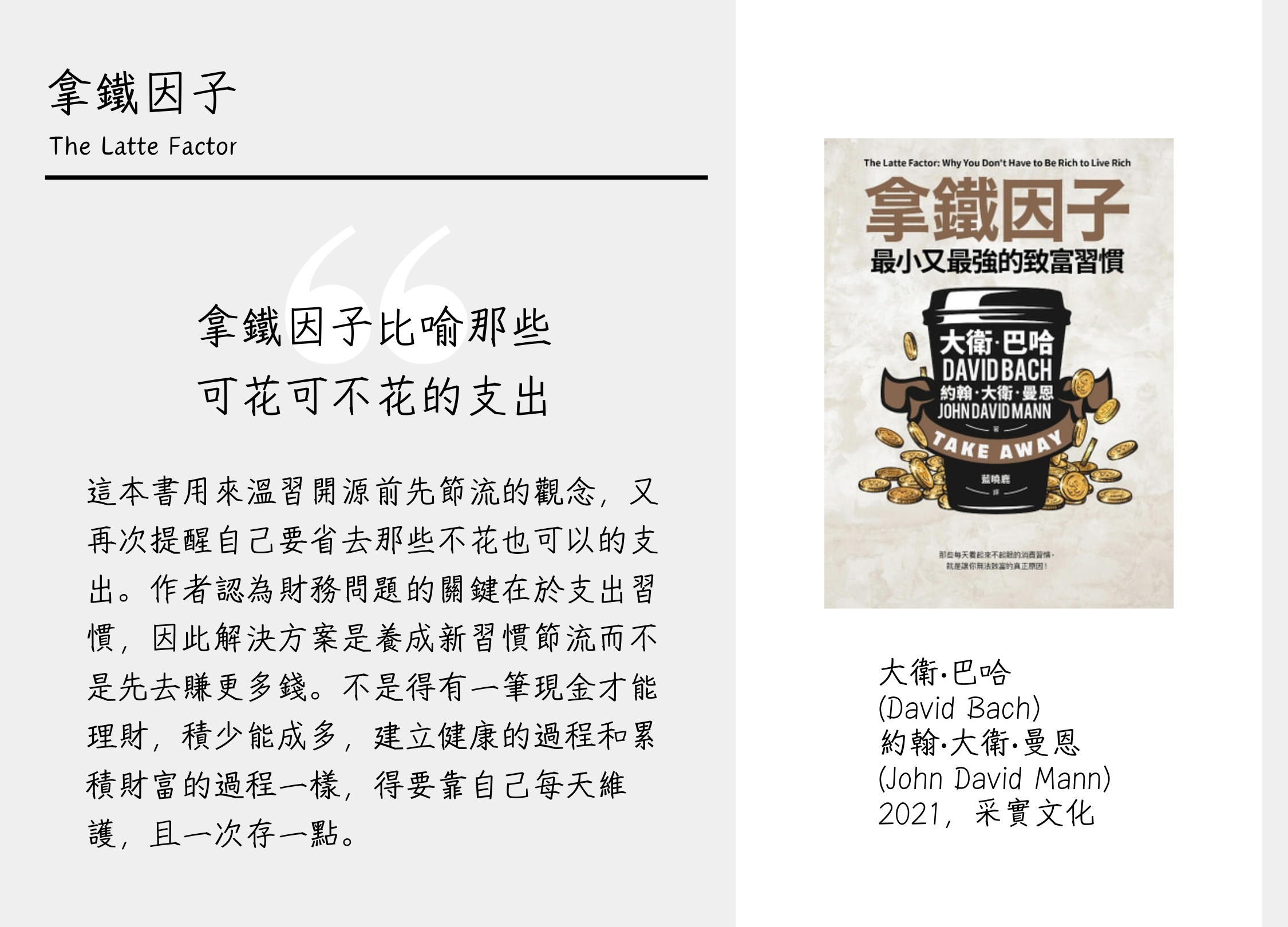
The latte factor is used as a metaphor for discretionary spending.
This book is used to review the concept of cutting expenses before increasing income from other sources, reminding oneself to eliminate unnecessary expenditures. The author believes that the key to financial issues lies in spending habits, so the solution is to cultivate new habits of thrift rather than focusing solely on earning more money. It’s not necessary to have a large sum of cash to manage finances; small savings can accumulate over time. Building financial health is a process that requires daily maintenance and incremental contributions, similar to accumulating wealth.
27.聰明女人致富七招 Smart Women Finish Rich / David Bach
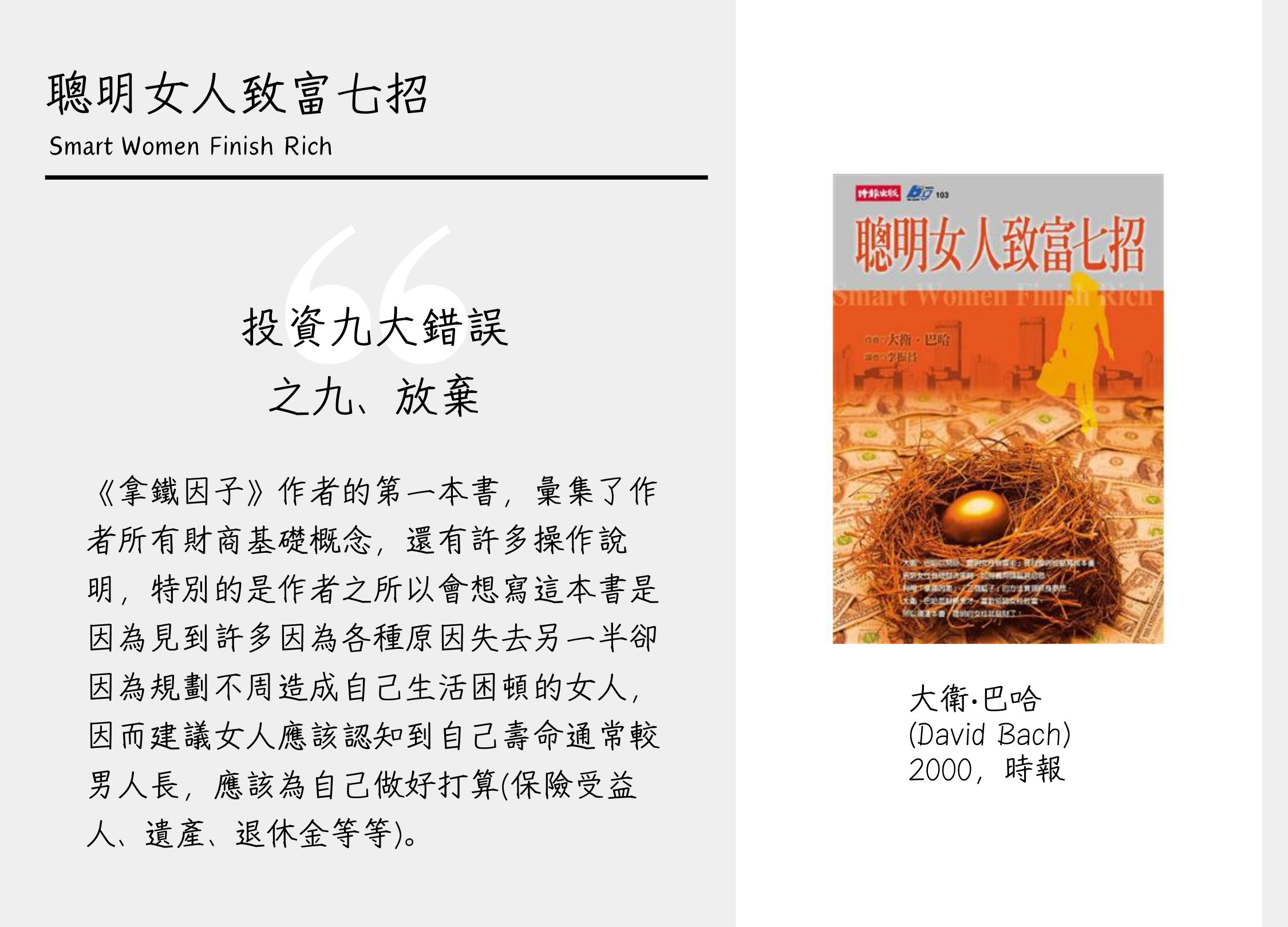
Investment Nine Mistakes, the Ninth: Abandonment.
The first book by the author of “The Latte Factor" collects all the author’s basic financial concepts, along with many operational instructions. What’s particularly notable is the reason the author wanted to write this book: after witnessing many women who lost their partners due to various reasons and ended up in financial distress because of inadequate planning, the author suggests that women should be aware that their life expectancy is usually longer than men’s. Therefore, they should make proper arrangements for themselves (insurance beneficiaries, inheritance, retirement funds, etc.).
28.恆毅力 Grit / Angela Duckworth
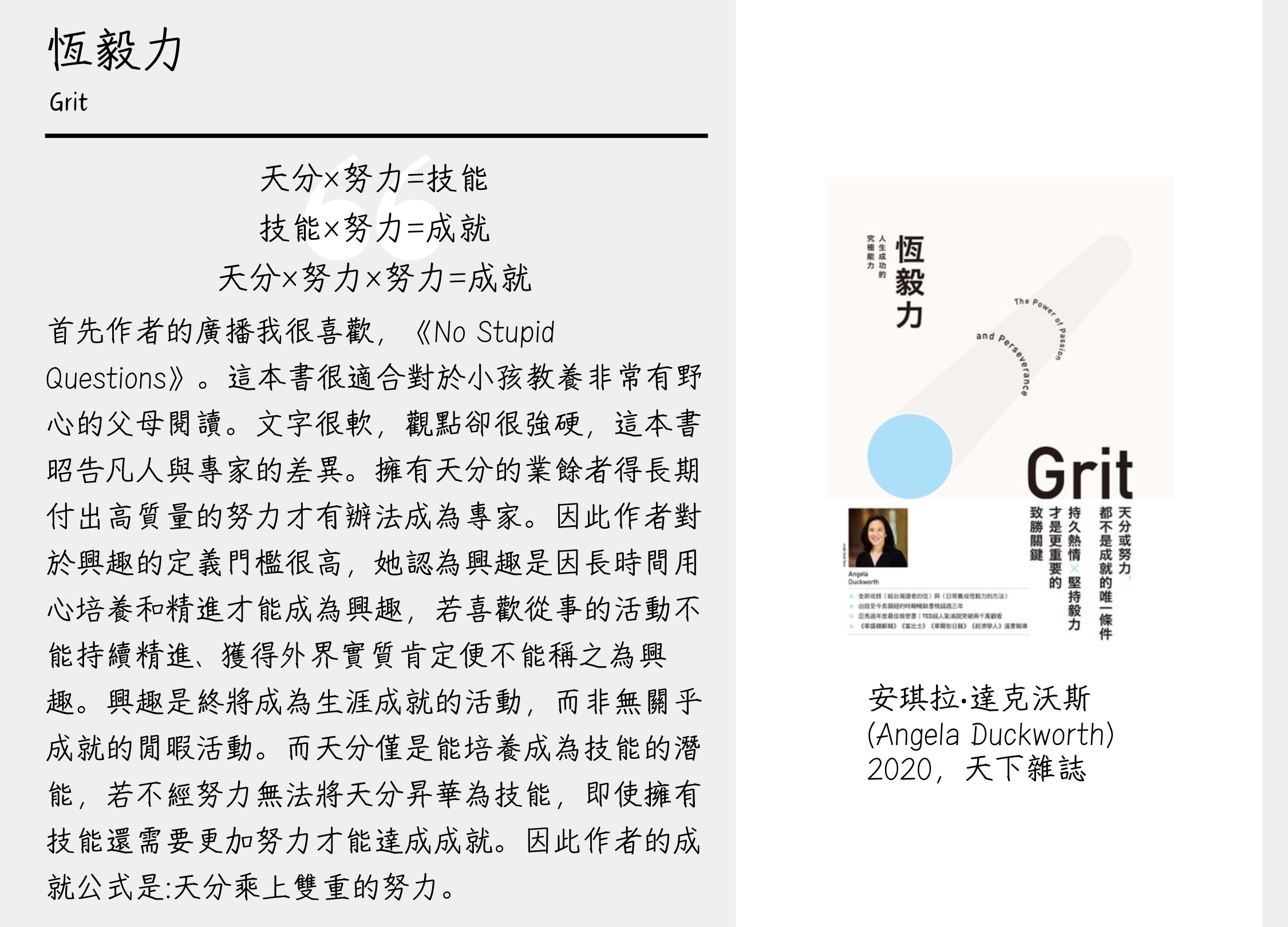
Talent × Effort = Skill
Skill × Effort = Achievement
Talent × Effort × Effort = Achievement
Firstly, I really enjoy the author’s broadcast, “No Stupid Questions". This book is very suitable for ambitious parents who are ambitious about raising their children. The writing style is gentle, yet the viewpoints are firm, clearly delineating the difference between ordinary individuals and experts. Amateur enthusiasts with talent must make long-term, high-quality efforts to become experts. Therefore, the author sets a high threshold for defining interests, believing that interests are cultivated and refined over a long period of dedicated effort. If the activities one enjoys cannot be continuously improved upon or recognized by others, they cannot be considered true interests. Interests are activities that will eventually become career achievements, rather than mere pastimes unrelated to achievements. Talent is merely the potential to develop skills, and without effort, talent cannot be transformed into skill. Even with skills, further effort is required to achieve success. Thus, the author’s formula for achievement is: Talent multiplied by double effort.
29.自然教養 Hunt, Gather, Parent / Michaeleen Doucleff
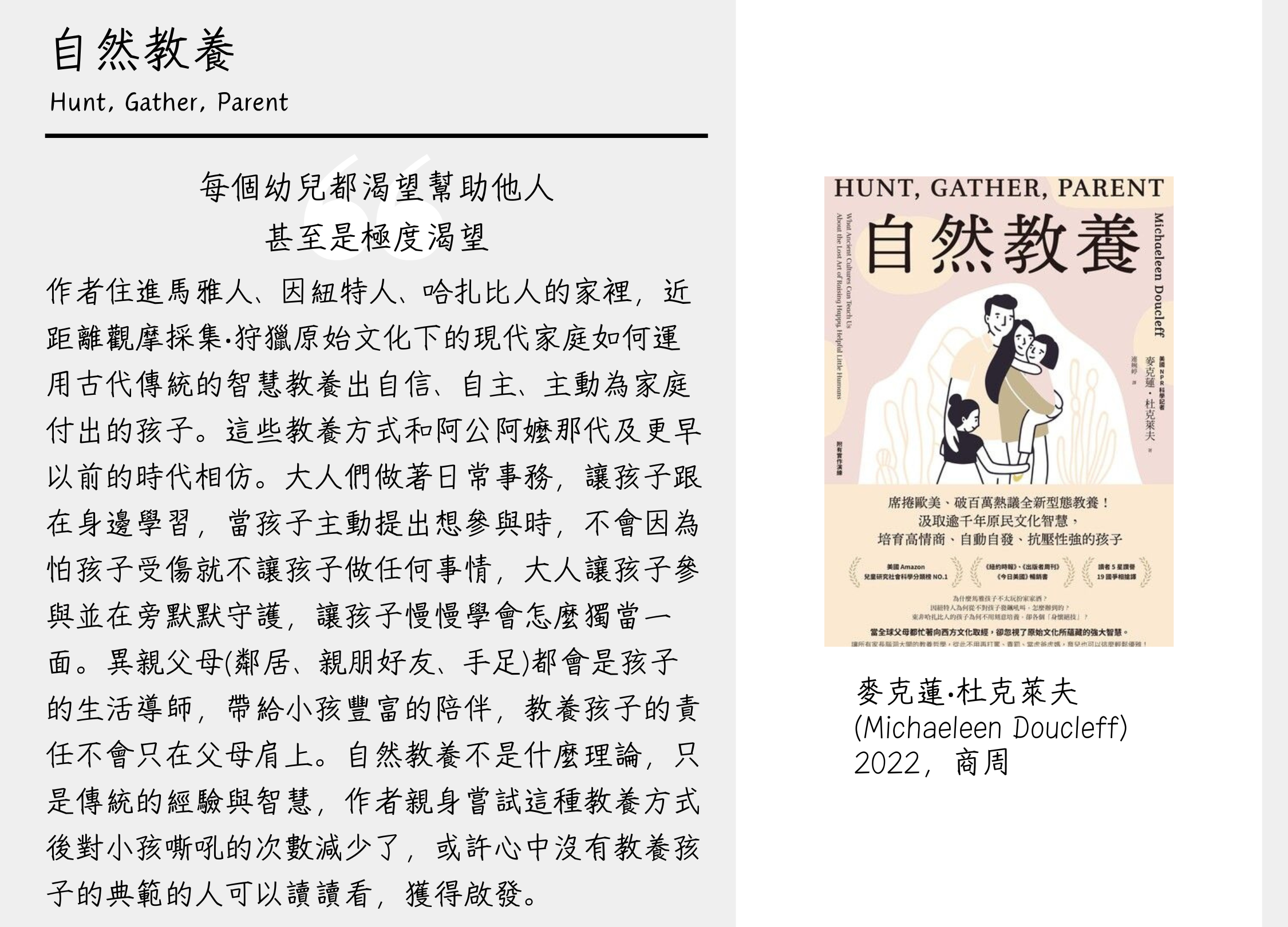
Every young child yearns to help others, sometimes even intensely.
The author lived with the Maya, Inuit, and Hazda families, closely observing how modern families living in primitive cultures of gathering and hunting utilize ancient traditional wisdom to raise confident, independent children who willingly contribute to their families. These parenting methods resemble those of grandparents’ generations and even earlier times. Adults go about their daily tasks, allowing children to learn by observing and participating. When children express a desire to join in, adults do not refrain from letting them do so out of fear of injury; instead, they allow children to participate while quietly watching over them, allowing children to gradually learn how to take charge. Extended family members (neighbors, relatives, friends, siblings) serve as mentors in children’s lives, providing rich companionship and sharing the responsibility of raising children, which does not solely rest on the parents’ shoulders. Natural parenting is not a theoretical concept; it is simply traditional experience and wisdom. After personally trying this approach to parenting, the author found that instances of shouting at children decreased. Perhaps those who lack a parenting model can find inspiration by reading about it.
30.如何養出一個成年人 How to Raise an Adult / Julie Lythcott-Haims
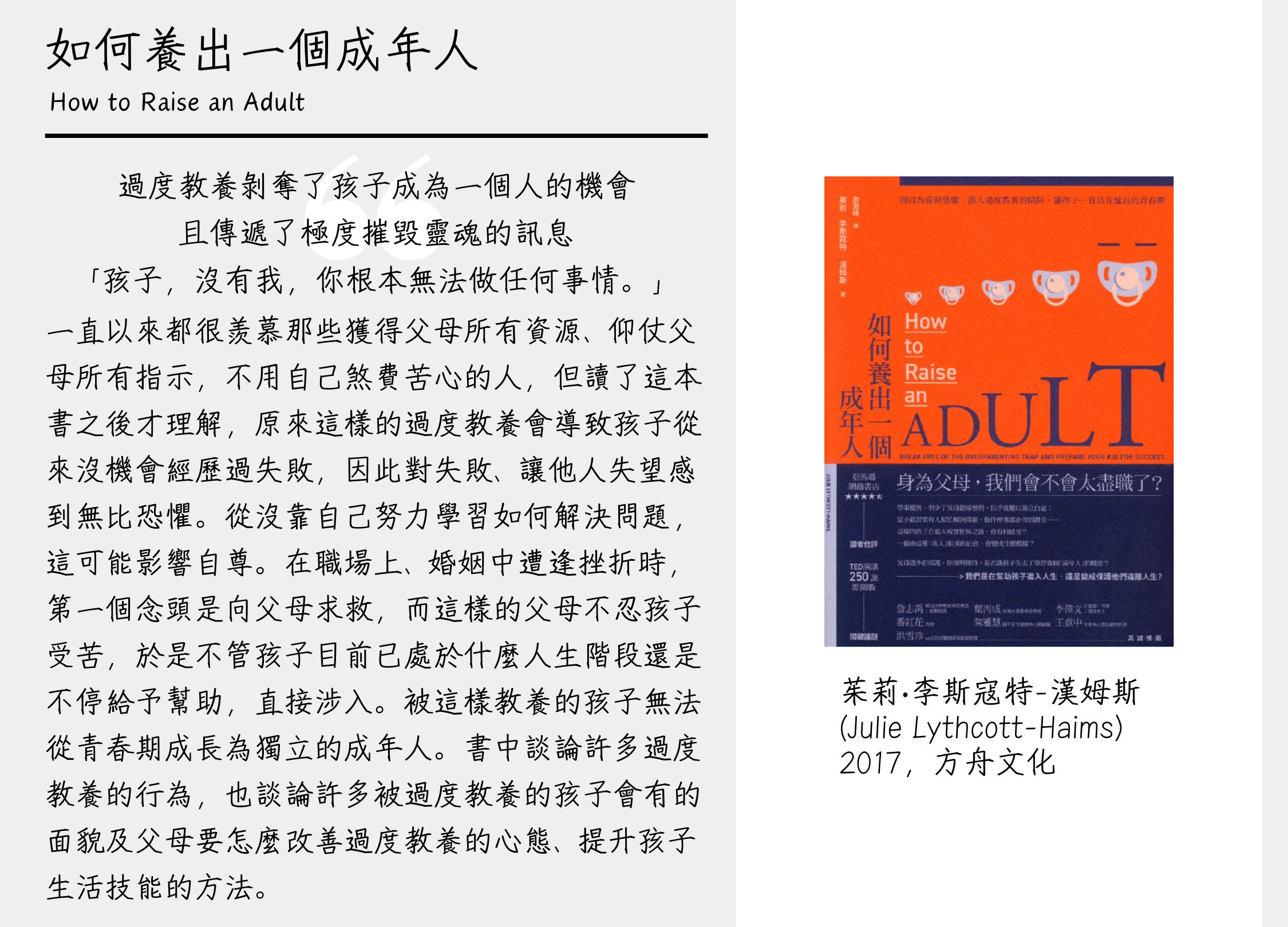
Overparenting deprives children of the opportunity to become independent individuals and sends a message that can severely damage their souls: “Child, without me, you can’t do anything."
I’ve always envied those who have access to all their parents’ resources and rely on their parents’ every instruction without having to exert themselves. However, after reading this book, I realized that such overparenting leads to children never experiencing failure, thus instilling an intense fear of disappointment and failure in others. They’ve never learned how to solve problems through their own efforts, which could affect their self-esteem. When faced with setbacks in the workplace or marriage, their first thought is to seek help from their parents. And because such parents cannot bear to see their children suffer, they continue to intervene and provide assistance, regardless of the stage of life their children are in. Children raised in this way cannot transition from adolescence to independent adulthood. The book discusses many overparenting behaviors and the manifestations that overparented children may exhibit, as well as how parents can change their overparenting mindset and improve their children’s life skills.
31.非典型人生建言 10½ Things No Commencement Speaker Has Ever Said / Charles Wheelan
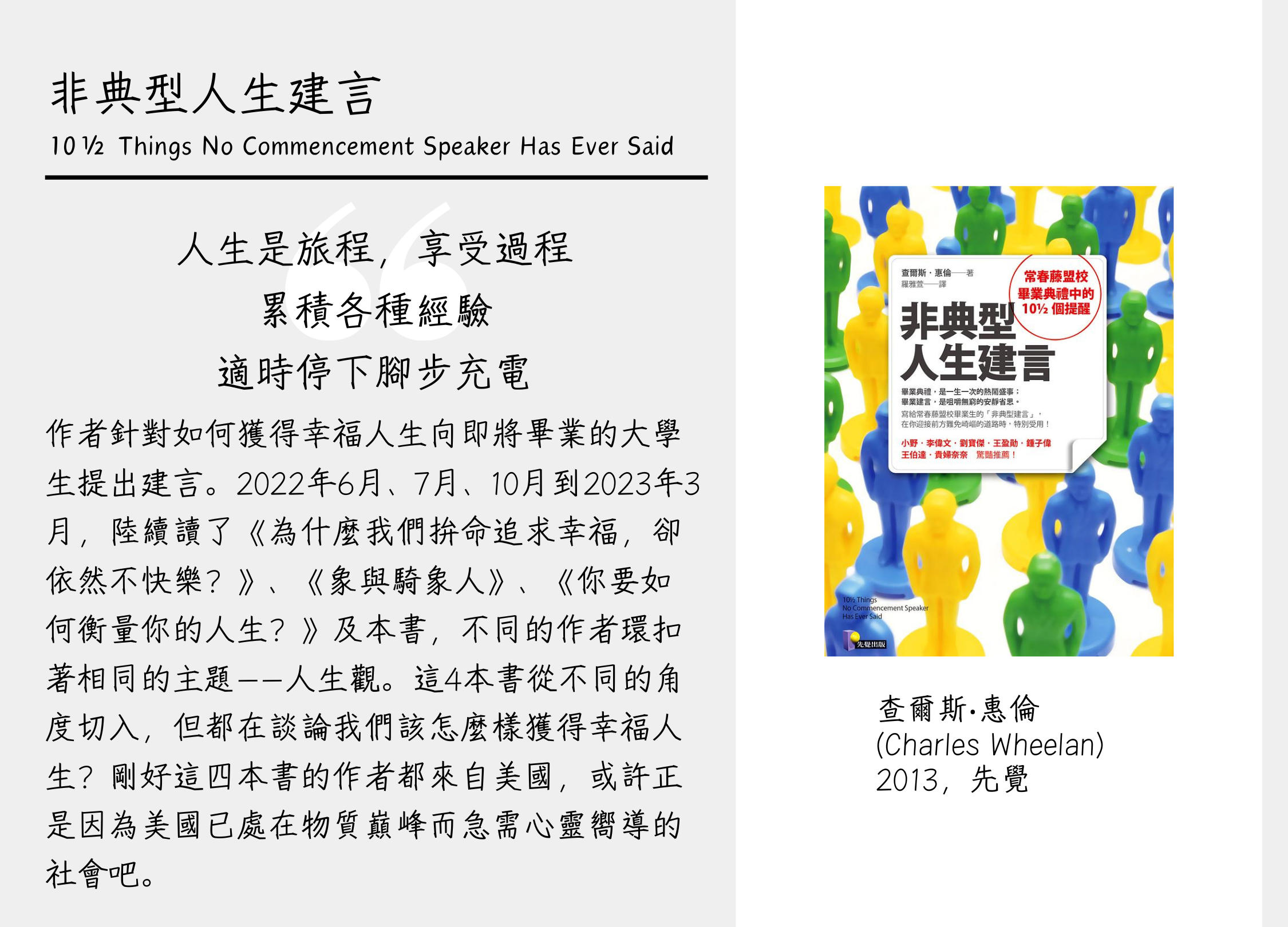
Life is a journey, meant to be enjoyed, where one accumulates various experiences and occasionally pauses to recharge.
The author offers advice to graduating college students on how to lead a fulfilling life. From June 2022 to March 2023, I sequentially read “America the Anxious," “The Happiness Hypothesis: Finding Modern Truth in Ancient Wisdom," “How Will You Measure Your Life?" and this book, each by different authors but revolving around the same theme – the philosophy of life. These four books approach the topic from different angles but all discuss how to attain a happy life. Interestingly, all four authors are from the United States, perhaps because the United States is already at the pinnacle of materialism and thus in need of spiritual guidance.
32.蒙田隨筆全集 上卷 Montaigne Essais I / Michel de Montaigne
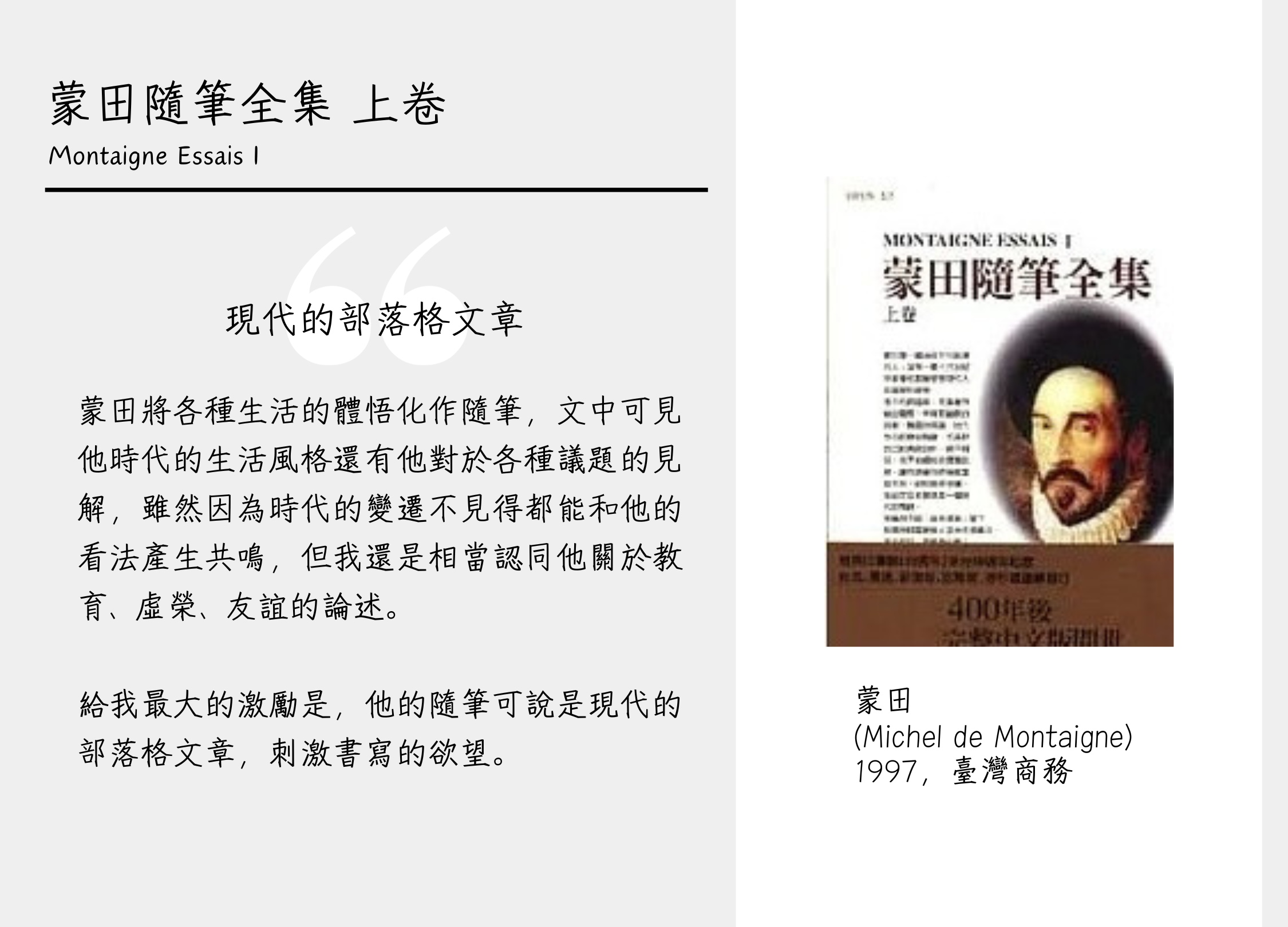
Montaigne’s essays are like modern-day blog posts.
Montaigne turns various life experiences into essays, reflecting his era’s lifestyle and his insights on various issues. While not all of his views may resonate with modern readers due to changes over time, I still strongly agree with his discussions on education, vanity, and friendship.
What inspires me the most is that his essays can be likened to modern-day blog posts, igniting a desire for expressive writing.
33.偽魚販指南 Guide for Fake Fishmongers / Lin Kailun
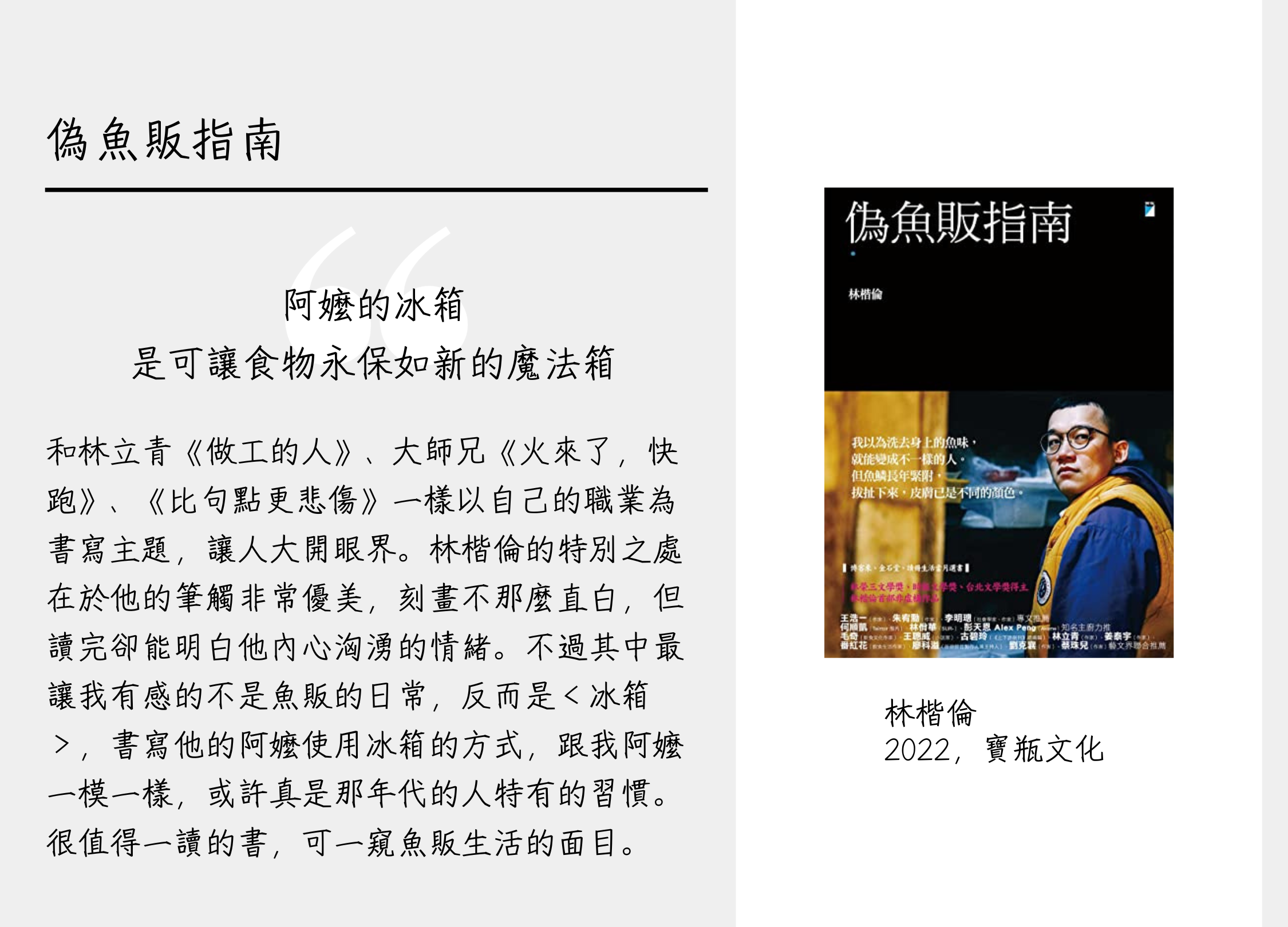
Grandma’s use of the refrigerator is like treating it as a magical box capable of preserving food indefinitely.
Similar to the works of Lin Linqing’s “Working People," Da Shixiong’s “Fire is Coming, Run Quickly," and “Sadder than Periods," Lin Kailun’s writing revolves around his own profession, offering eye-opening insights. What sets the author apart is his remarkably elegant prose, which depicts scenes not so explicitly but still manages to convey the emotions surging within him. However, what struck me most was not the fishmonger’s daily life but rather the portrayal of the “Refrigerator." The depiction of his grandmother’s use of the refrigerator mirrors that of my own grandmother, perhaps a unique habit of people from that era. It’s a book well worth reading, offering a glimpse into the life of a fishmonger.
34.雪卡毒 Ciguatera Fish Poisoning / Lin Kailun

Each short story in the book carries a strong sea scent.
Lin Kailun’s new book, “Ciguatera Fish Poisoning," compiles his award-winning works. Each short story carries a strong sea scent, which is essentially Lin Kailun’s hallmark. He said that by immersing himself in the stories, one can feel as if he were a fish diving deep into the dark sea, silent and lonely. Finishing this book leaves a chilling sensation.
The title refers to the neurotoxin accumulated in the bodies of coral reef fish through the food chain. Consuming such fish can cause food poisoning. The characters and the sea itself are intertwined in the book, evoking feelings of unease, drift, world-weariness, and confusion.
35.太陽依舊升起 The sun also rises / Ernest Miller Hemingway
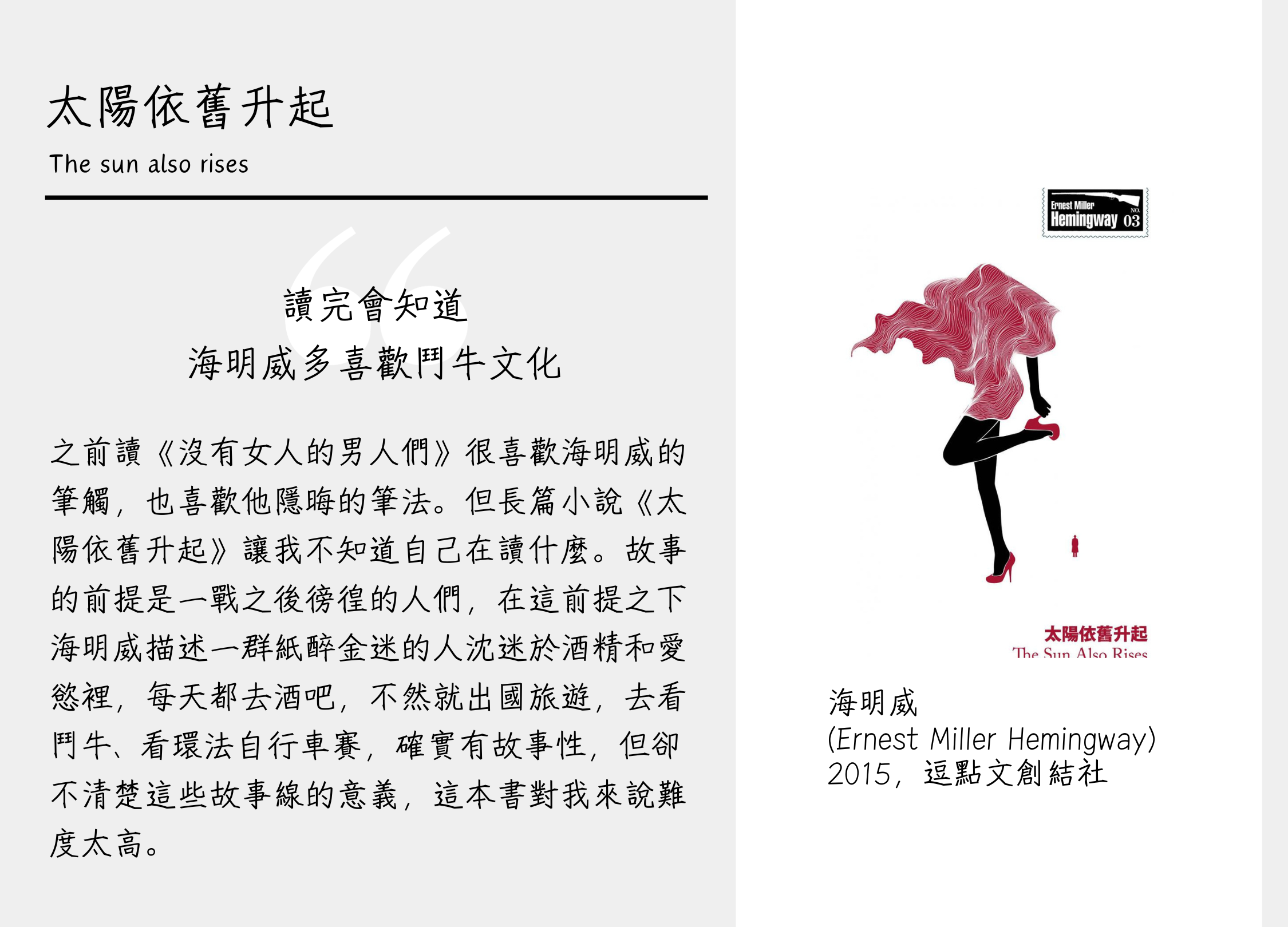
After reading this book, one will understand Hemingway’s deep affinity for bullfighting culture.
Previously, I enjoyed Hemingway’s writing style and appreciated his subtle approach in “Men Without Women." However, the novel “The Sun Also Rises" left me uncertain about what I was reading. Set against the backdrop of the post-World War I era, Hemingway portrays a group of disillusioned individuals indulging in alcohol and lust. They spend their days in bars or traveling abroad to watch bullfights or the Tour de France. While the narrative is intriguing, the meaning behind these storylines remains unclear to me, making this book quite challenging to grasp.
36.孿生子 Twins / Saori Fujisaki
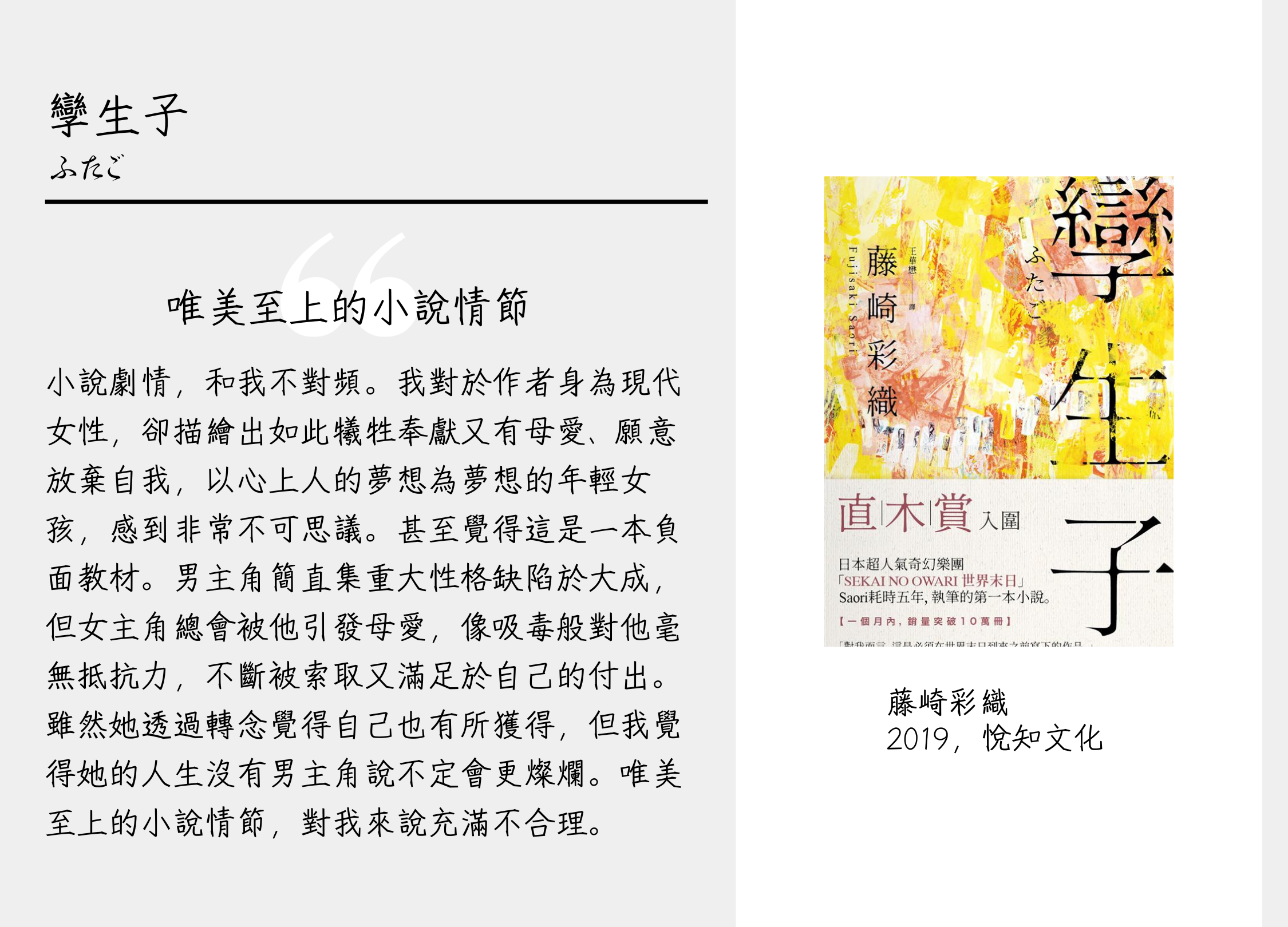
A novel with an emphasis on beauty above all else.
The storyline of this book doesn’t resonate with me. I find it incredibly unbelievable that the author, as a modern woman, portrays a young girl sacrificing herself and her own dreams for the sake of her beloved’s aspirations, displaying a sacrificial and motherly love. I even consider it a negative example. The male protagonist is depicted with significant character flaws, yet the female lead is always drawn to him with a maternal affection, seemingly unable to resist him like an addict, constantly giving in to his demands while finding satisfaction in her own sacrifices. Although she may find some sense of fulfillment through her change of heart, I believe her life could have been much more radiant without the male lead. The novel’s emphasis on beauty above all else seems irrational to me.
37.傀儡花 Puppet Flower / Yao-Chang Chen
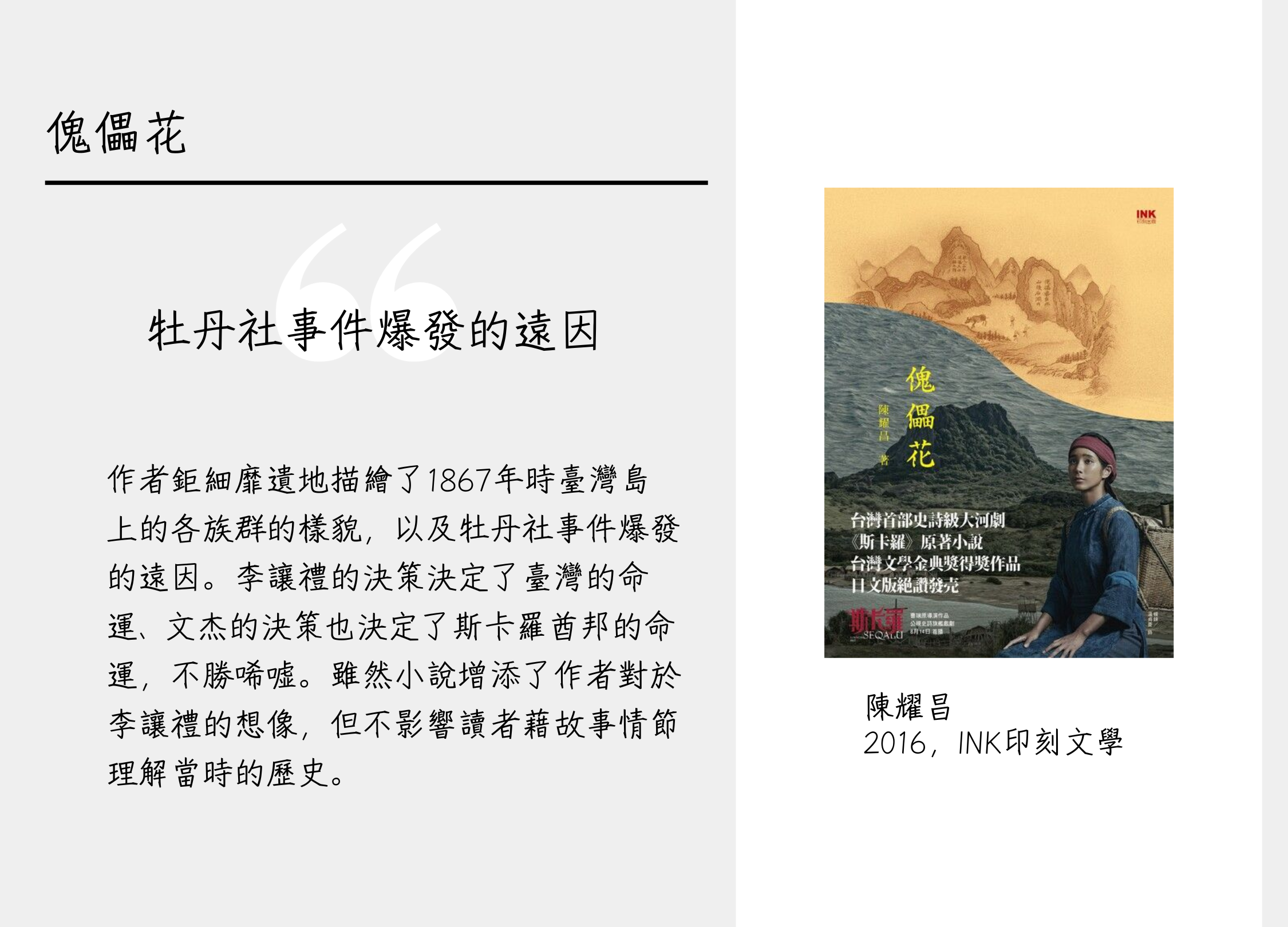
This book depicts the underlying causes of the Mudan Incident.
The author meticulously portrays the various ethnic groups on the island of Taiwan in 1867, as well as the underlying causes of the Mudan Incident. The decisions made by Charles W. Le Gendre determined the fate of Taiwan, while Jagarushi Guri Bunkiet’s decisions also determined the fate of the Seqalu tribe, which is deeply regrettable. Although the novel adds the author’s imagination regarding Charles W. Le Gendre, it does not detract from readers’ understanding of the historical context through the storyline.
38.在黑暗中舉起火炬 A torch in the dark / Li Jingyuan, Isabella Labate
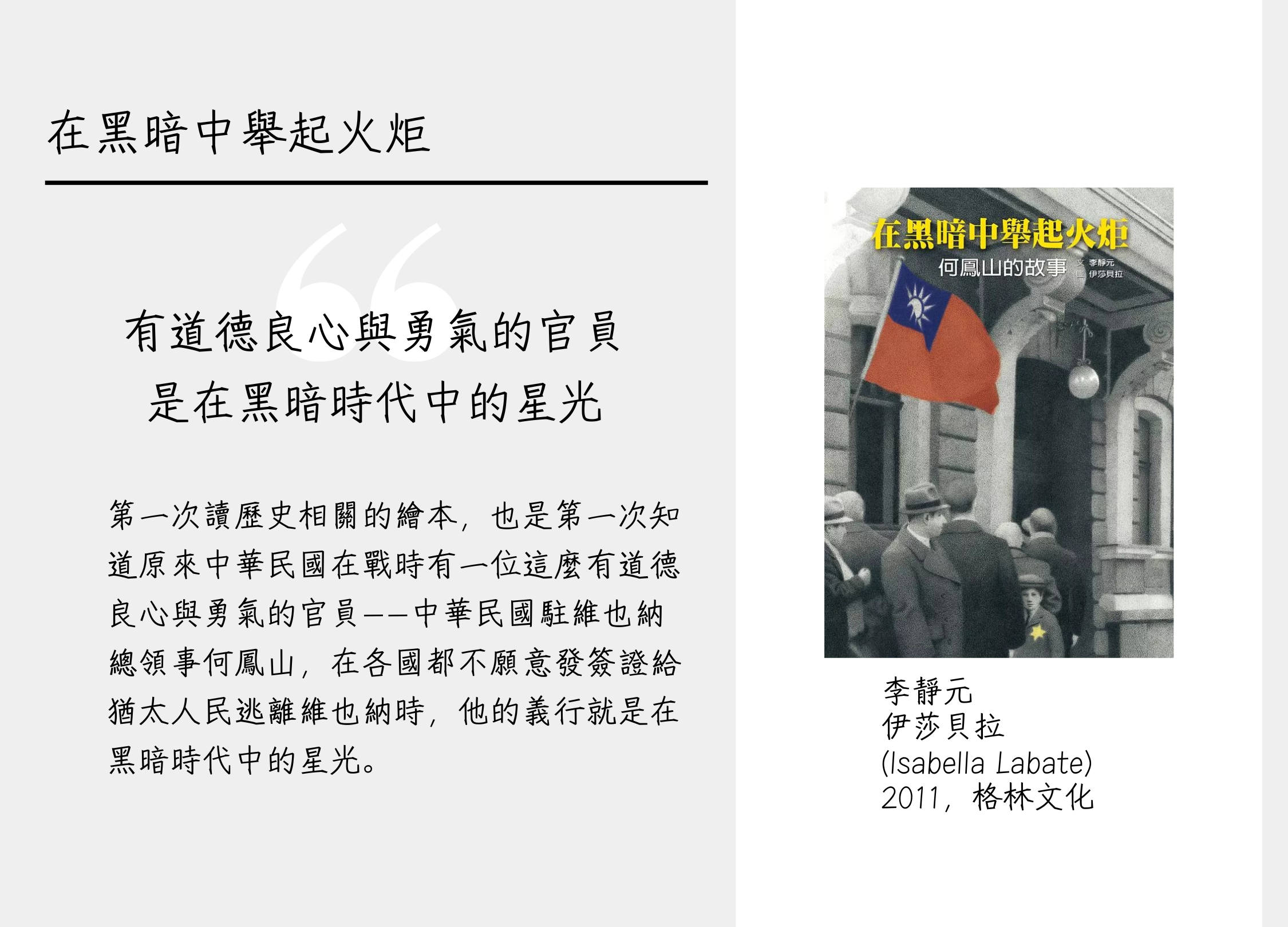
Officials with moral conscience and courage are like stars in dark times.
This is the first time I’ve read a history-related picture book, and it’s also the first time I’ve learned that during wartime, the Republic of China had such a morally conscientious and courageous official – Ho Fengshan, the Consul General of the Republic of China in Vienna. When other countries were unwilling to issue visas to Jewish people fleeing Vienna, his acts of righteousness were like stars shining in the darkness of that era.
39.原子彈之父:羅伯特‧奧本海默 The Father of the Atomic Bomb: Robert Oppenheimer / Zhang Hongye, Yuan Jixian
40.戰爭終結者歐本海默 The Terminator of War: Oppenheimer / Chen Shaozhi, Xu Xingsheng
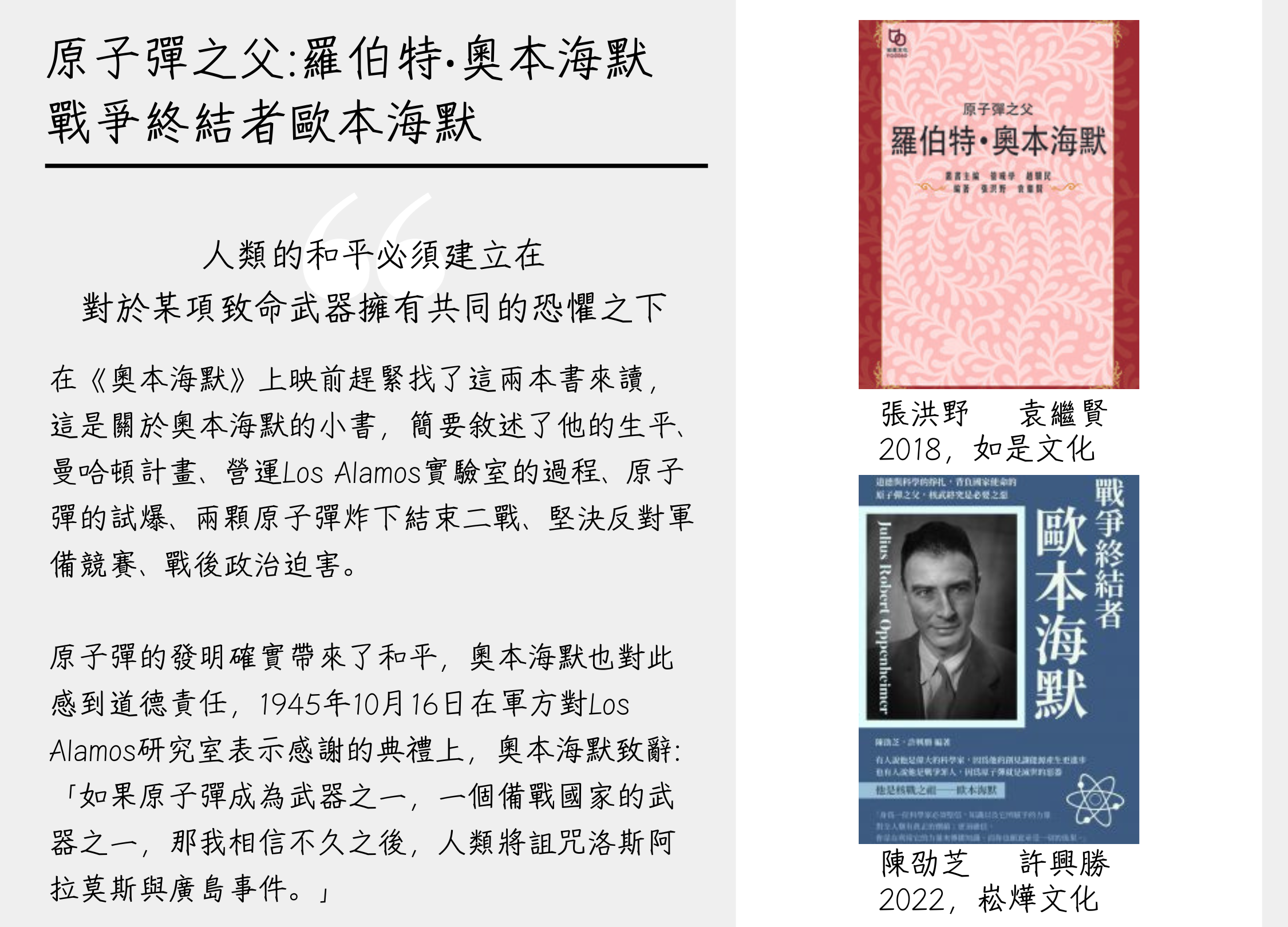
Human peace must be built on a shared fear of a deadly weapon.
Before the release of “Oppenheimer," I hurried to find these two books to read. They provide a brief account of Oppenheimer’s life, the Manhattan Project, the operation of the Los Alamos laboratory, the testing of the atomic bomb, the end of World War II with the dropping of two atomic bombs, his staunch opposition to the arms race, and the post-war political persecution he faced.
The invention of the atomic bomb did indeed bring about peace, and Oppenheimer felt a moral responsibility for it. On October 16, 1945, at a ceremony where the military thanked Los Alamos Laboratory, Oppenheimer gave a speech: “If atomic bombs are to be added as new weapons to the arsenal of a warring world, or to the arsenals of nations preparing for war, then the time will come when mankind will curse the names of Los Alamos and Hiroshima."
41.延安的「革命鴉片」 The ‘Revolutionary Opium’ of Yan’an / Chen Yung-fa
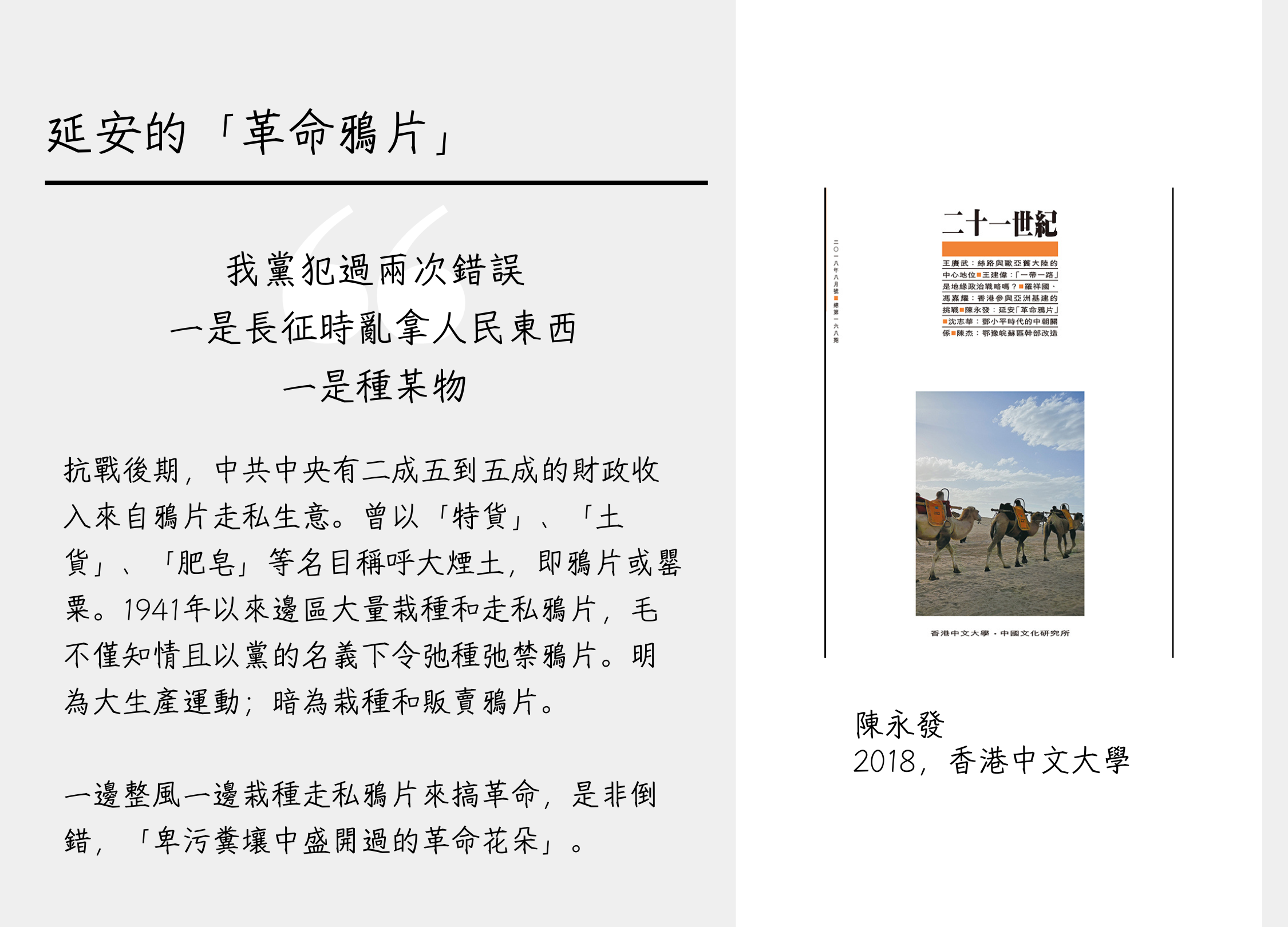
Our party has made two mistakes: one is looting from the people during the Long March, the other is planting something.
In the late stages of the War of Resistance Against Japan, 25% to 50% of the Chinese Communist Party’s central government’s revenue came from opium smuggling. They referred to opium or poppies under various names such as “special goods," “local goods," or “soap." Since 1941, there has been a large-scale cultivation and smuggling of opium in the border areas. Mao not only knew about it but also ordered the planting and relaxation of opium prohibition in the name of the party. It was ostensibly for the Great Production Movement, but in reality, it was for the cultivation and sale of opium.
Planting and smuggling opium under the guise of revolution while carrying out rectification campaigns is perverse and absurd, a “revolutionary flower blooming in the lowly soil."
42.明朝那些事兒 貳 Those Things in Ming Dynasty Volume 2 / Dang Nian Ming Yue
43.明朝那些事兒 參 Those Things in Ming Dynasty Volume 3 / Dang Nian Ming Yue
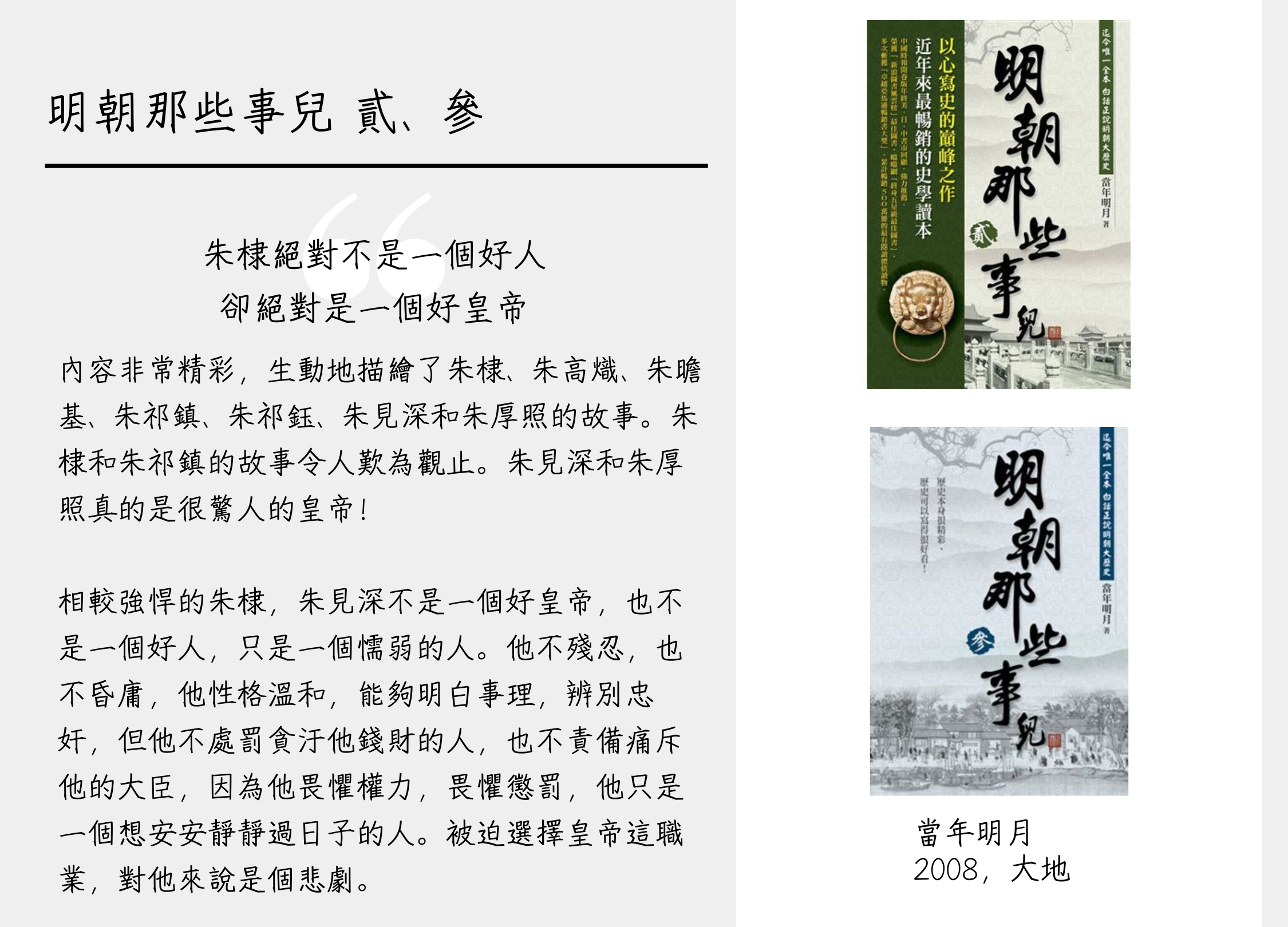
Zhu Di is definitely not a good person but absolutely a good emperor.
The content is very exciting, vividly depicting the stories of Zhu Di, Zhu Gaochi, Zhu Zhanji, Zhu Qizhen, Zhu Qiyu, Zhu Jianshen, and Zhu Houzhao. The stories of Zhu Di and Zhu Qizhen are breathtaking. Zhu Jianshen and Zhu Houzhao were truly remarkable emperors!
Compared to the powerful Zhu Di, Zhu Jianshen is not a good emperor nor a good person; he is simply a weak individual. He is neither cruel nor incompetent; his temperament is mild, able to understand reasoning and discern loyalty from treachery. However, he does not punish those who embezzle his wealth, nor does he rebuke his ministers who criticize him, because he fears power and punishment. He is just someone who wants to live quietly. Being forced to choose the profession of emperor is a tragedy for him.
44.朕知道了 Saha / Fu Songyan
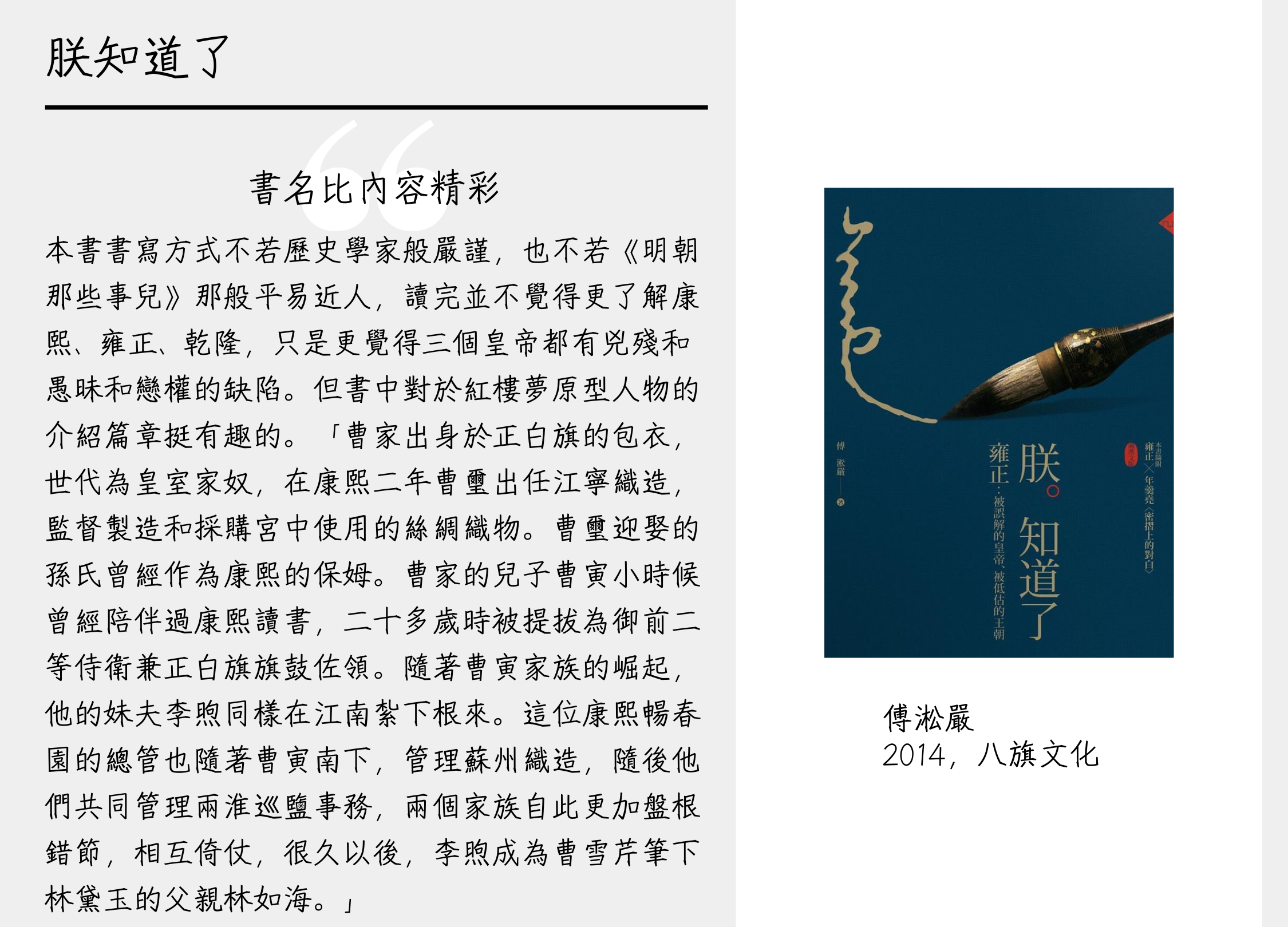
A book whose title is more exciting than its content.
The writing style of this book is not as rigorous as that of a historian, nor as approachable as “Those Things in Ming Dynasty." After reading it, I do not feel a deeper understanding of Kangxi, Yongzheng, or Qianlong, but rather a recognition that all three emperors had their flaws of cruelty, ignorance, and a lust for power. However, the chapters introducing the prototype characters of the Dream of the Red Chamber are quite interesting. “The Cao family originated from the Bannermen of the Plain White Banner, serving generations as servants to the imperial family. In the second year of Kangxi’s reign, Cao Xi was appointed as the supervisor of weaving in Jiangning, overseeing the production and procurement of silk fabrics used in the palace. The wife welcomed by Cao Xi, Sun, had previously served as a nursemaid to Kangxi. Cao Yin, the son of the Cao family, accompanied Kangxi in his childhood studies and was promoted to second-grade Imperial Guard and Deputy Leader of the Plain White Banner at the age of over twenty. As the Cao family rose, his brother-in-law Li Xu also established himself in Jiangnan. This manager of Kangxi’s Changchun Garden also followed Cao Yin southward to manage weaving in Suzhou. Subsequently, they jointly managed the salt affairs in the two Huai regions. The two families thus became intricately intertwined, relying on each other. Much later, Li Xu became Lin Daiyu’s father Lin Ruhai in Cao Xueqin’s portrayal."
45.八代灣的神話 Kavavatanen No Ta-U Jimasik / Syaman Rapongan, Chu Jiahui
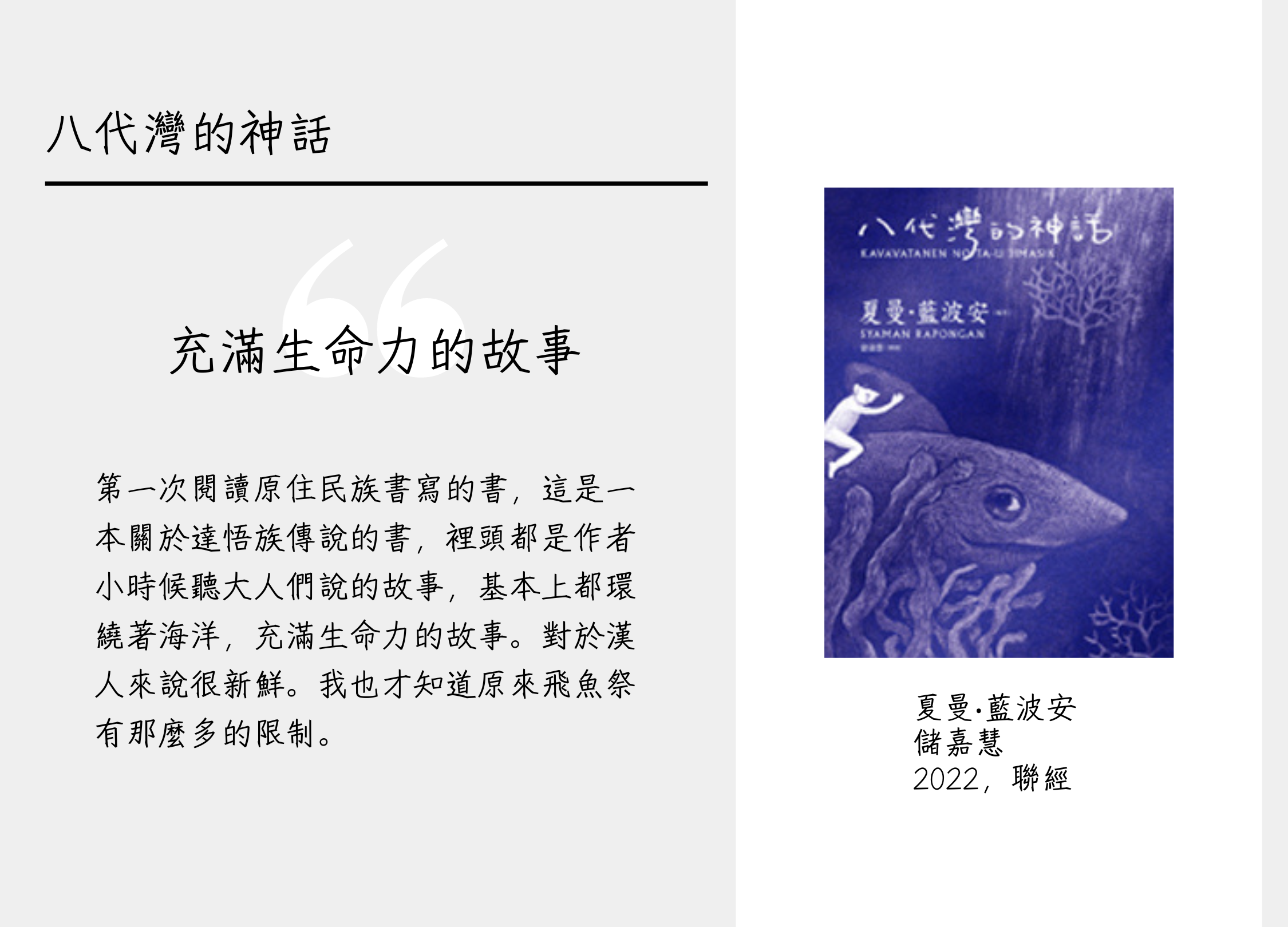
A story brimming with vitality.
This is the first time I’ve read a book written by an indigenous author. It’s a book about Tao mythology, filled with stories the author heard from elders in his childhood. These tales mostly revolve around the ocean, presenting narratives brimming with vitality. It’s quite refreshing for someone of Han descent. I also learned that the Flying Fish Festival has so many restrictions.
46.有感覺 SENSATIONAL / Ha Jung-woo
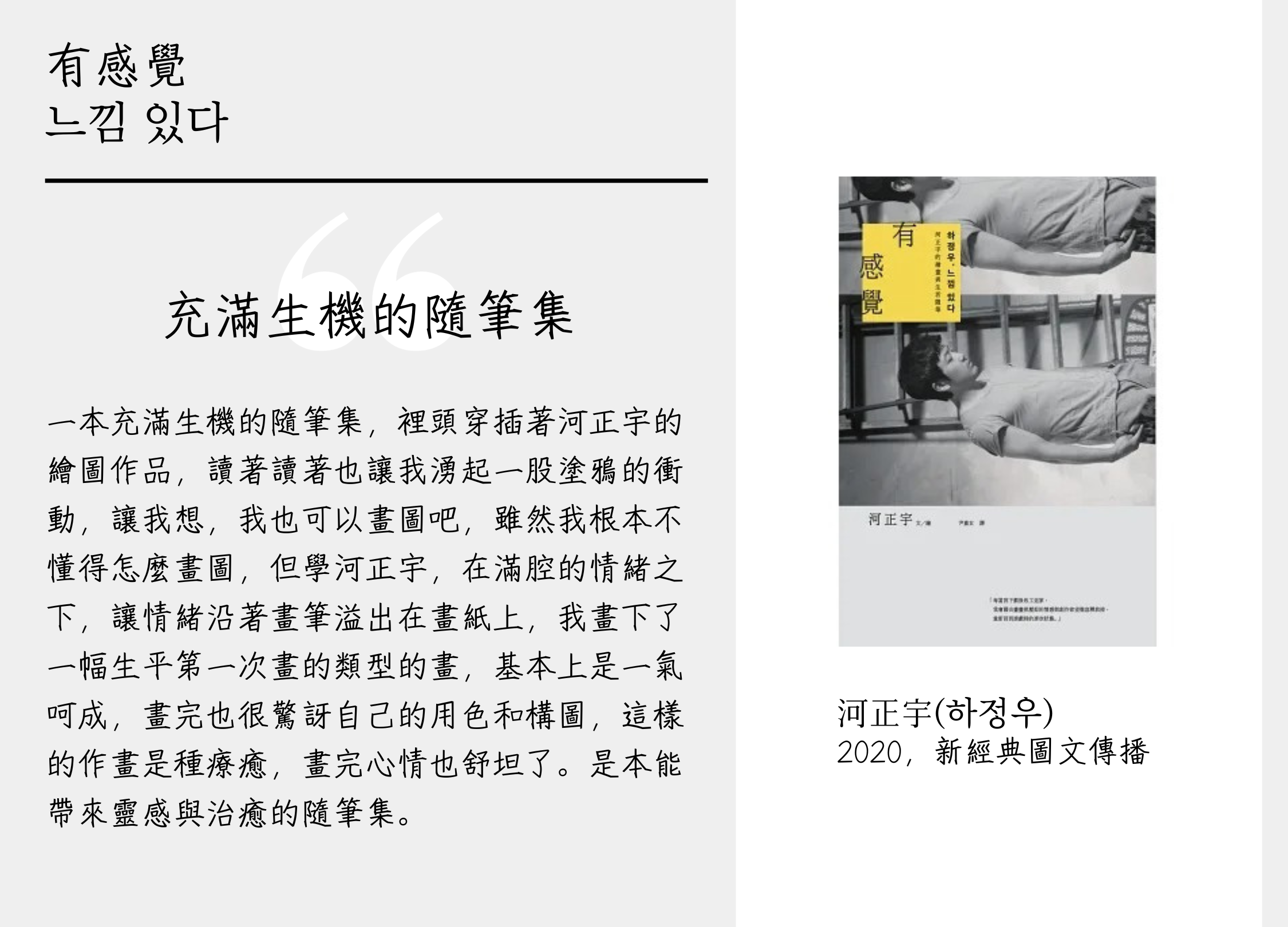
A vibrant collection of essays.
This is a vibrant collection of essays, interspersed with Ha Jung-woo’s artwork. As I read through it, I felt a surge of inspiration to doodle myself. It made me think, maybe I can draw too, even though I have no idea how to. Following Ha Jung-woo’s lead, I let my emotions flow onto the paper through the brush, resulting in my first-ever attempt at drawing. Surprisingly, it turned out quite well, both in terms of color and composition. This kind of drawing is therapeutic; it brought healing, and after finishing, I felt much lighter. It’s a collection of essays that instinctively inspires and heals.
47.你不能等到日子不再艱難,才決定開始快樂 You can’t wait until life isn’t hard anymore before you decide to be happy / Xu Duoduo
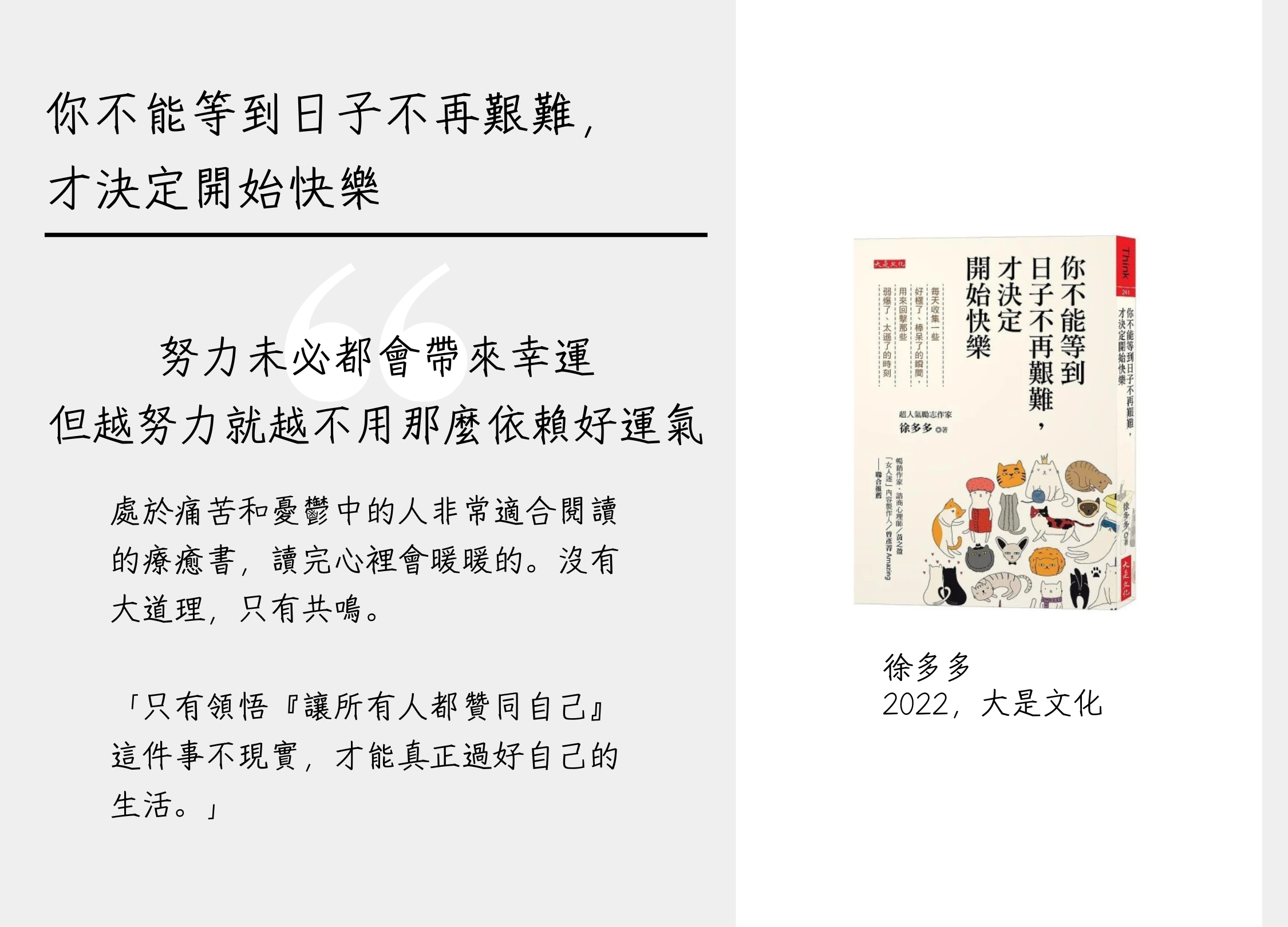
Effort may not always bring luck, but the more effort you put in, the less you need to rely on good luck.
This is a healing book that is perfect for people in pain and depression. After reading it, your heart will feel warm. There are no big truths, just resonance.
“Only by understanding that ‘making everyone agree with oneself’ is unrealistic can one truly live a good life."
48.罐頭 Pickle / Li Weijing, Soupy

A tender and sensitive narrative.
Although I haven’t read any of Li Weijing’s works before, I could feel her tender and sensitive character through this picture book, along with the adorable cat depicted within.
49.我從沒計畫成為一個同志 Yuri no Real / Asako Makimura
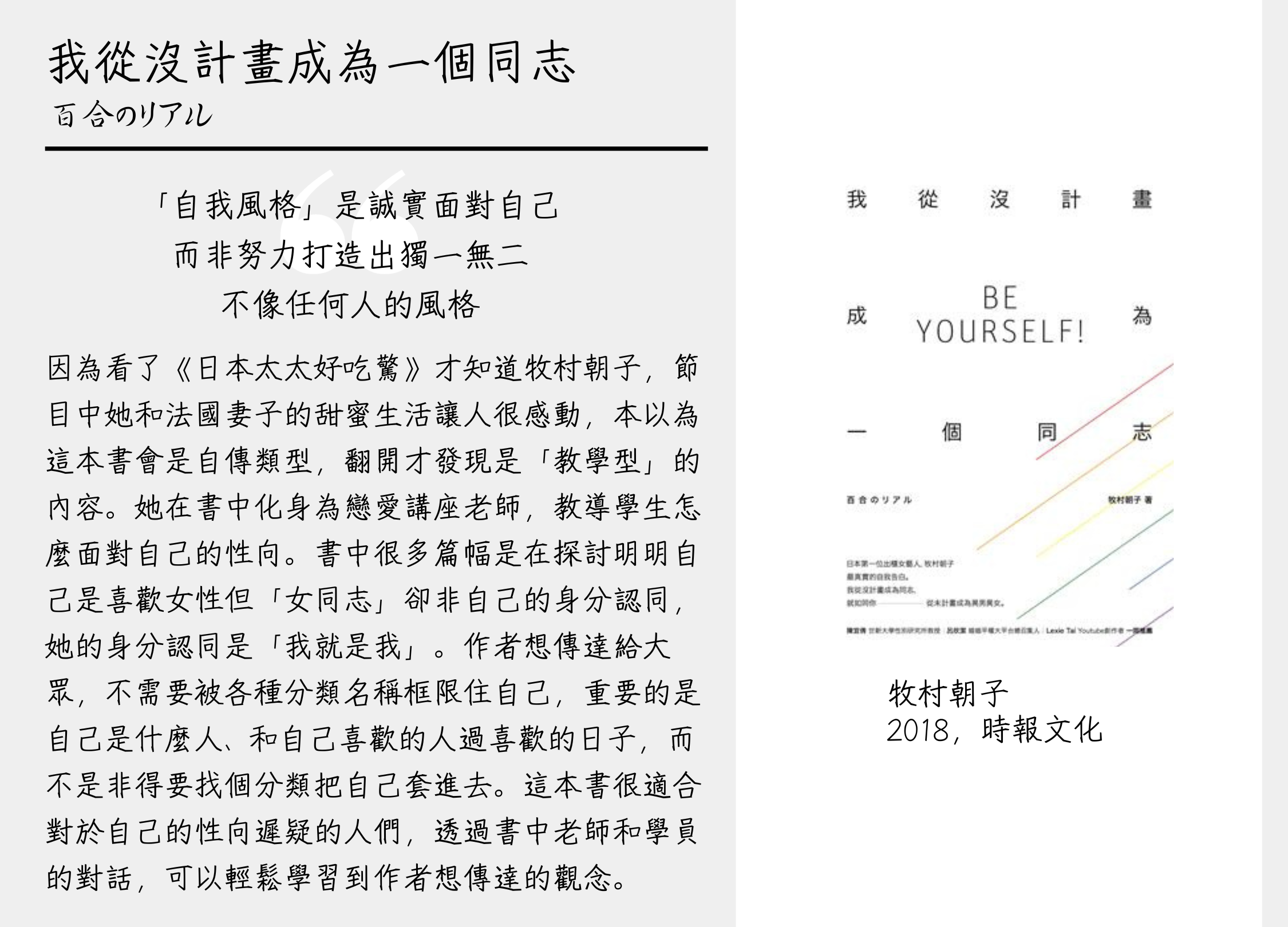
“Self-style" is about honestly facing oneself rather than striving to create something unique that doesn’t resemble anyone else’s style.
I came to know about Asako Makimura after watching “Sekai no Nihonjin Tsuma wa Mita!" The heartwarming life she shares with her French wife in the program deeply moved me. I initially thought this book would be autobiographical, but upon opening it, I realized it was more of an instructional guide. In the book, Makimura takes on the role of a love seminar teacher, instructing students on how to confront their own sexual orientation. Much of the content explores the dilemma of being attracted to women but not identifying as a “lesbian." Instead, her identity is simply “I am who I am." The author’s message to the public is clear: one doesn’t need to be confined by various labels; what matters is being true to oneself, enjoying life with the people one loves, rather than forcing oneself into a category. This book is suitable for those who may be uncertain about their sexual orientation. Through the conversations between the teacher and the students in the book, readers can easily grasp the concepts the author seeks to convey.
50.不敗的智慧 The Importance of Sun Tzu’s Art of War in Business / Kazuhiro Nagao
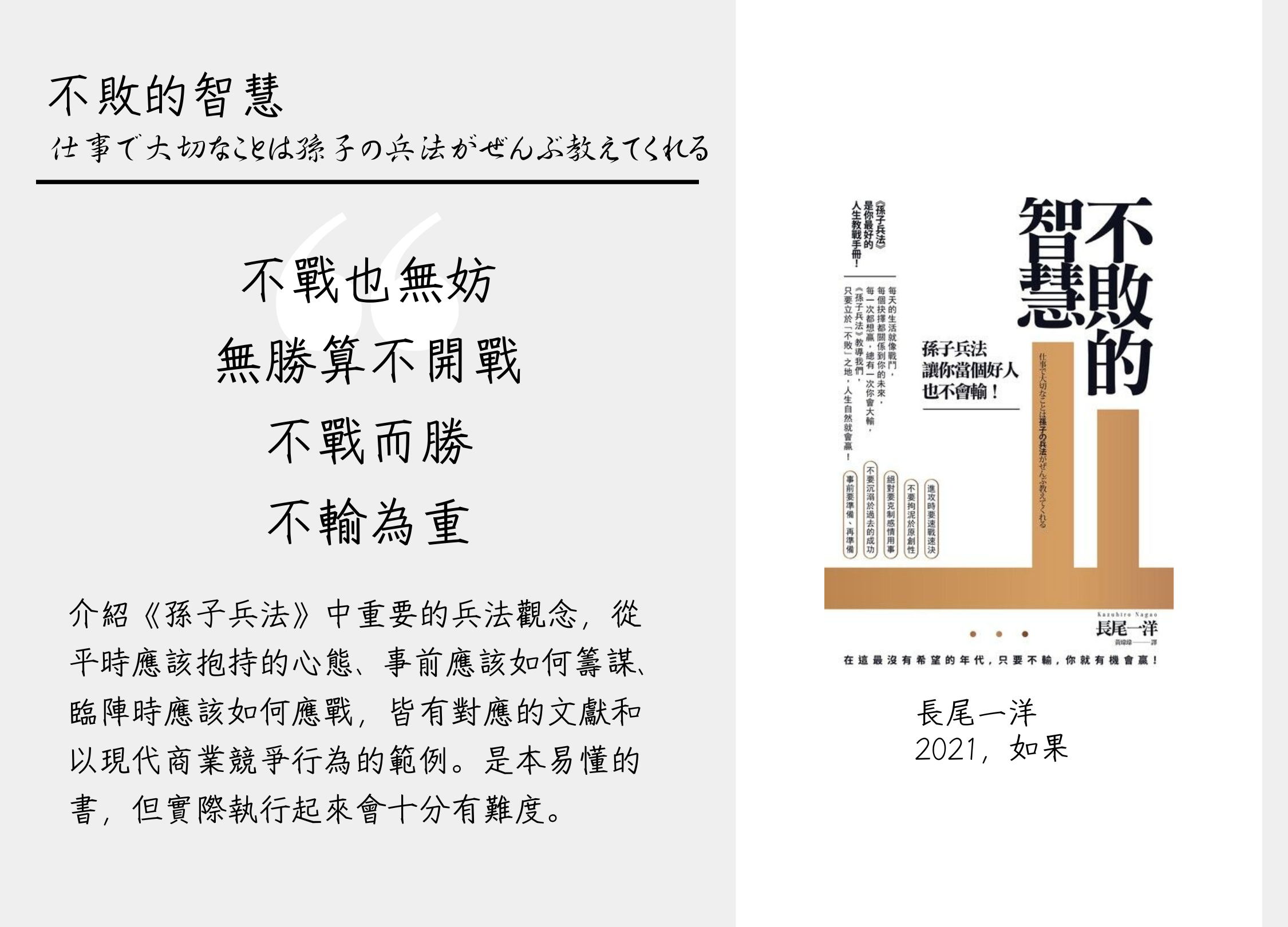
Sun Tzu’s Art of War teaches everything about work: not fighting is sometimes the best strategy, engaging in battles without a clear chance of winning is unwise, winning without fighting is the ultimate victory, and avoiding defeat is paramount.
This book introduces important strategic concepts from “The Art of War" by Sun Tzu. It covers the mindset one should maintain during peaceful times, how to plan ahead, and how to respond in battle, all with corresponding examples from modern business competition. It’s an easy-to-understand book, but implementing its teachings can be quite challenging in practice.
51.我不是教你詐3:現代社會處事篇 I’m Not Teaching You to Cheat 3: Dealing with Modern Society / Liu Yong
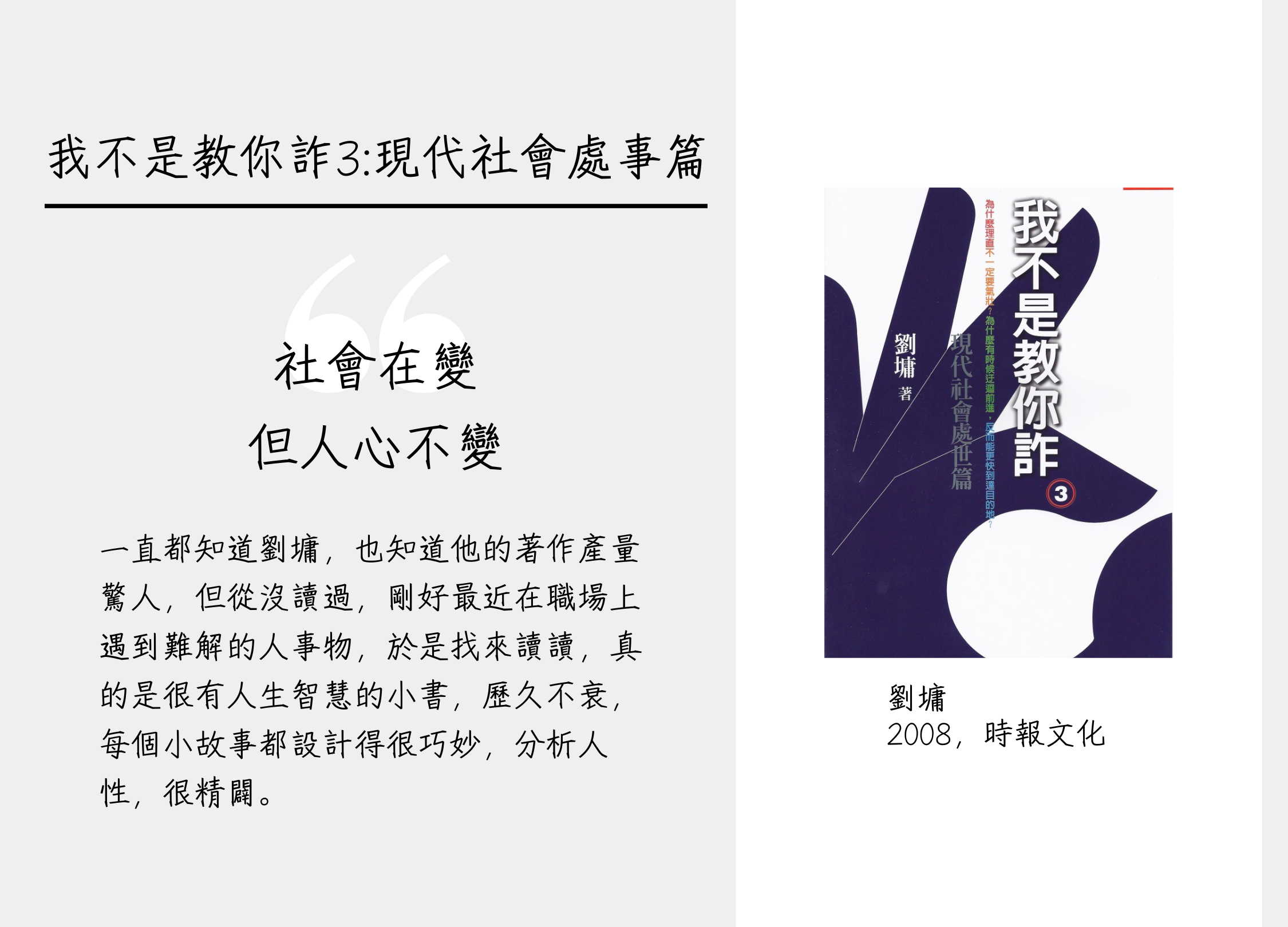
Society is changing, but human nature remains constant.
I’ve always been aware of Liu Yong and his prolific output of works, but I’ve never read any of them. Recently, I encountered some challenging situations in the workplace, so I decided to give his book a read. It turned out to be a book full of wisdom for life, enduring and insightful. Each short story is cleverly designed, analyzing human nature with precision.
52.運勢決定人生 Advice from a Veteran Lawyer Who Has Seen the Lives of 10,000 People: How to Improve Your Luck / Nishinaka Tsutomu
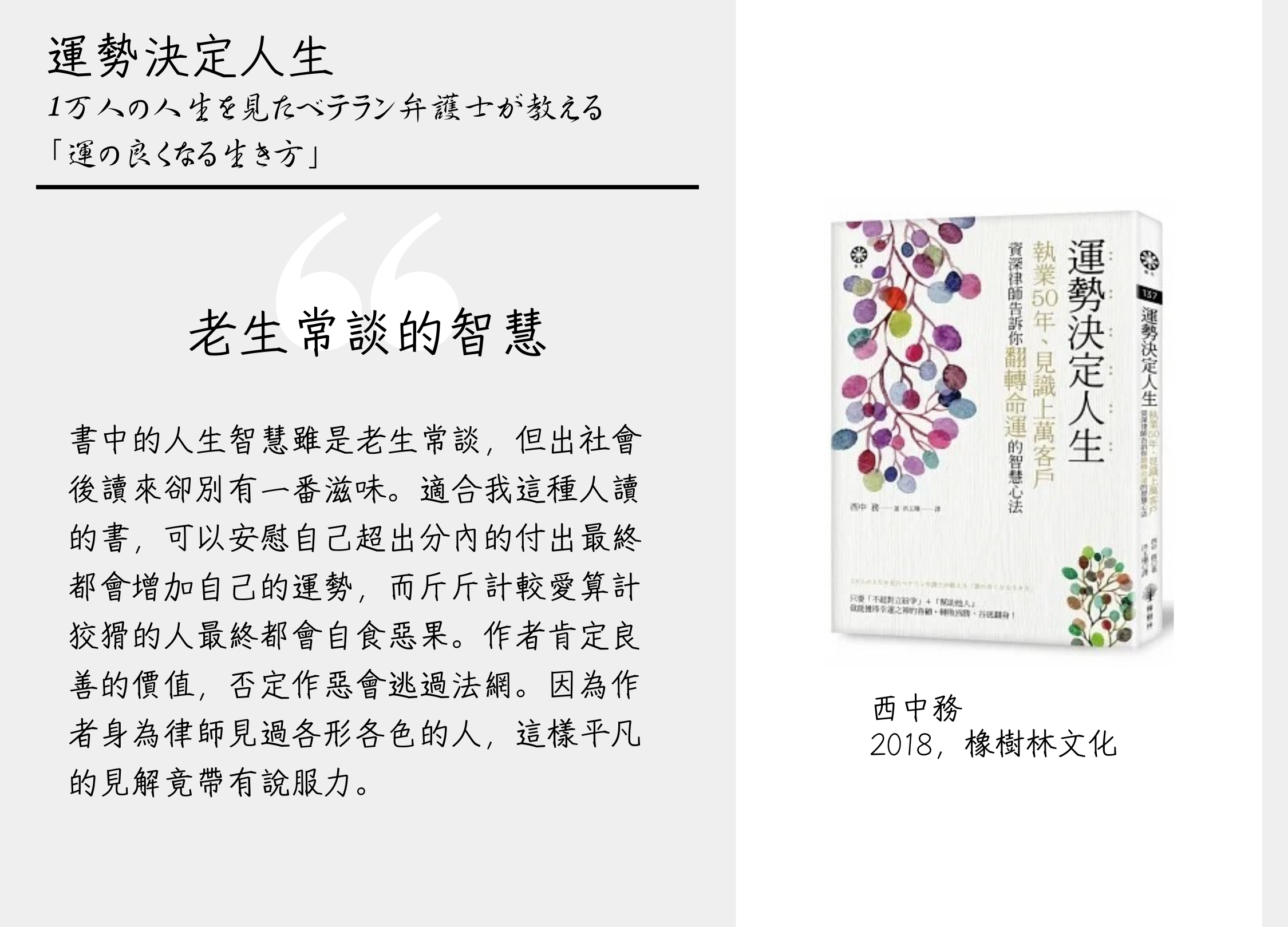
The wisdom of old sayings
The life wisdom found in the book “How to Improve Your Luck" may seem like old clichés, but reading them after entering society gives them a whole new flavor. It’s the kind of book that resonates with someone like me, offering comfort in the belief that going beyond the call of duty will ultimately enhance one’s luck. Conversely, it warns that those who are overly calculating and deceitful will eventually face the consequences of their actions. The author affirms the values of goodness while refuting the notion that evil deeds can escape punishment. Given the author’s background as a lawyer who has encountered all sorts of people, these seemingly mundane insights carry a persuasive force.
53.風險管理與內部控制的15堂必修課 15 Essential Courses in Risk Management and Internal Control / Chen Qingxiang
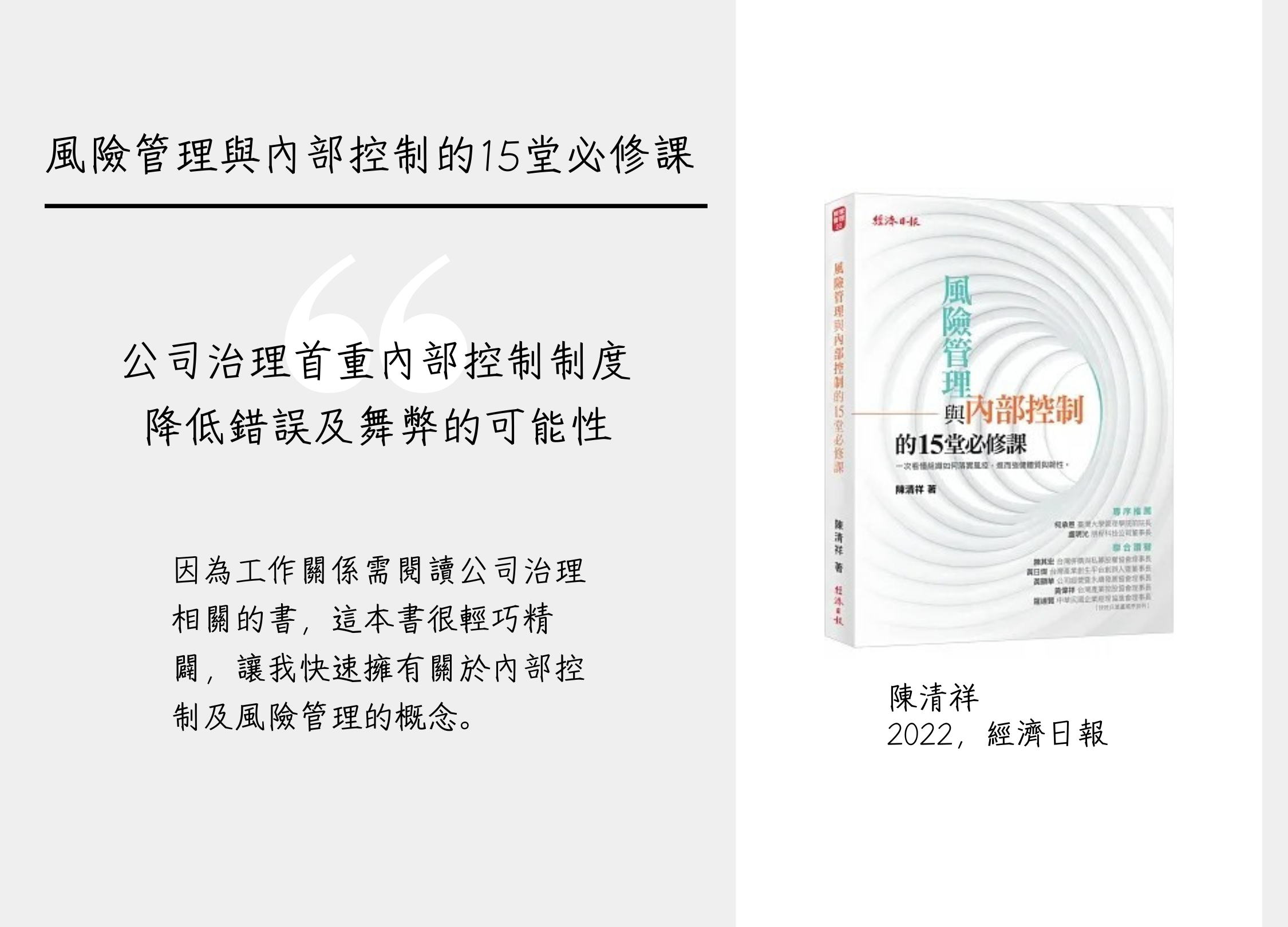
Effective corporate governance prioritizes internal control systems to reduce the likelihood of errors and fraud.
Due to work-related requirements, I needed to read books on corporate governance, and this one is concise and insightful, allowing me to quickly grasp concepts related to internal control and risk management.
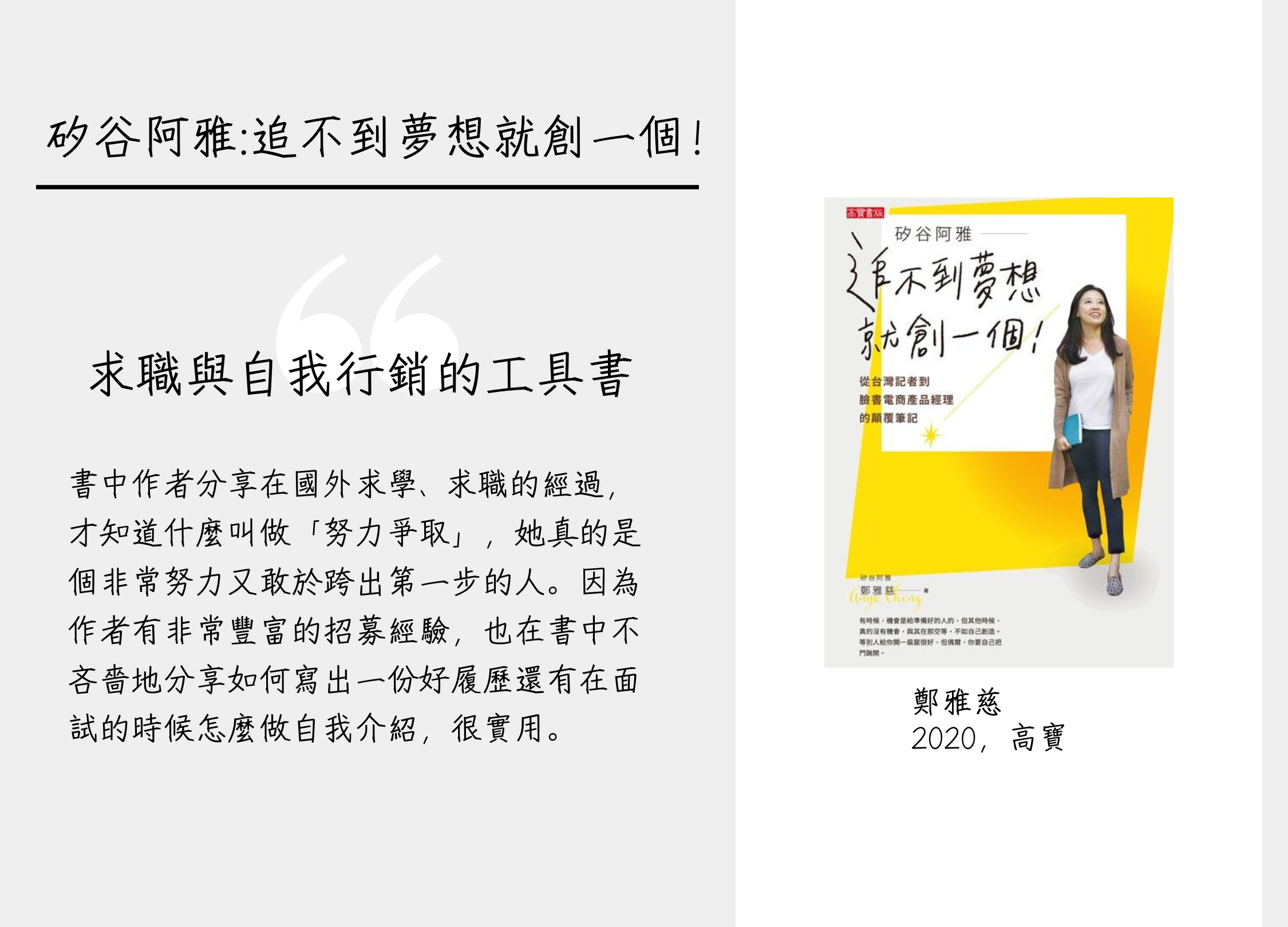
54.矽谷阿雅:追不到夢想就創一個!
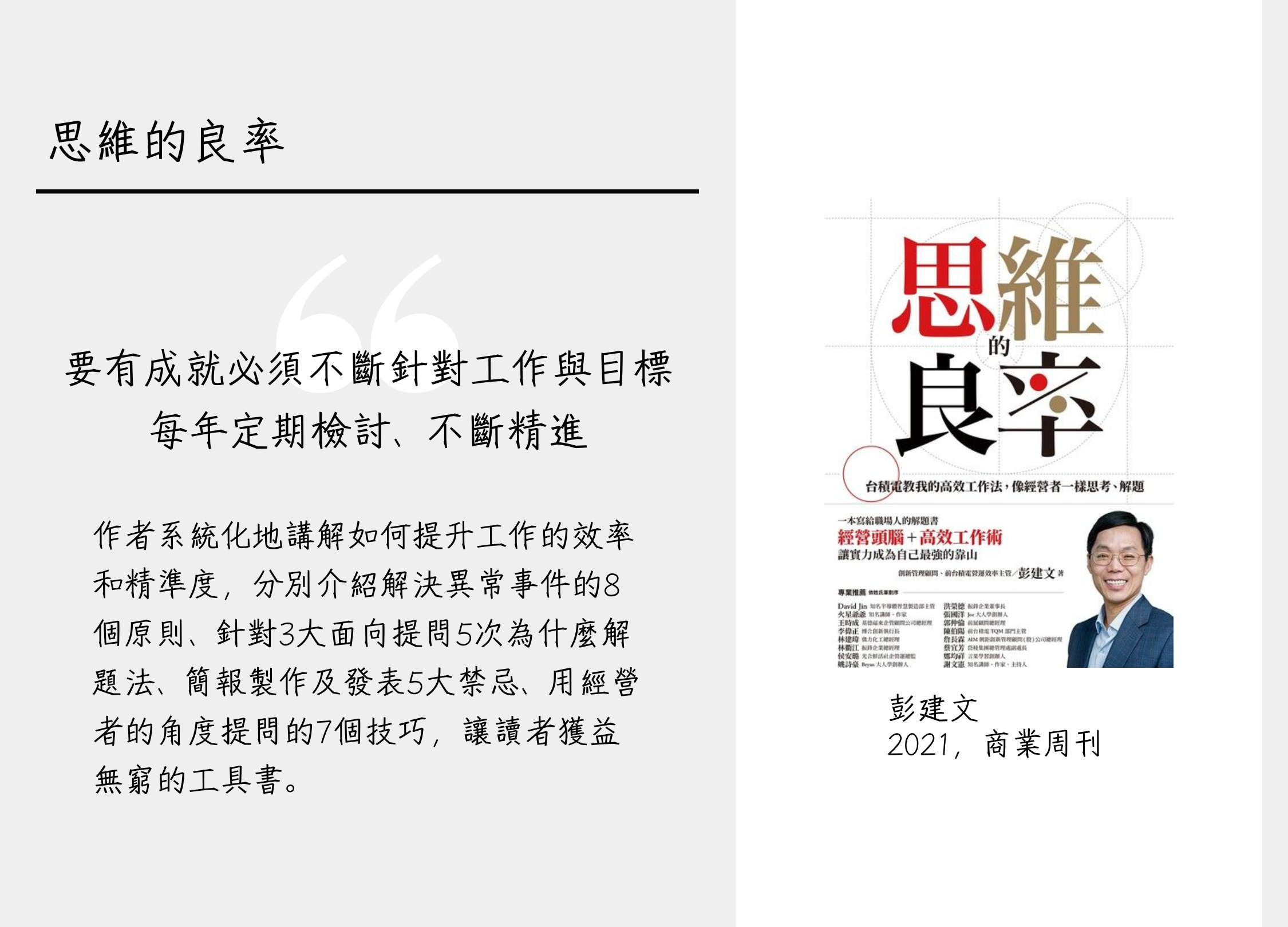
55.思維的良率
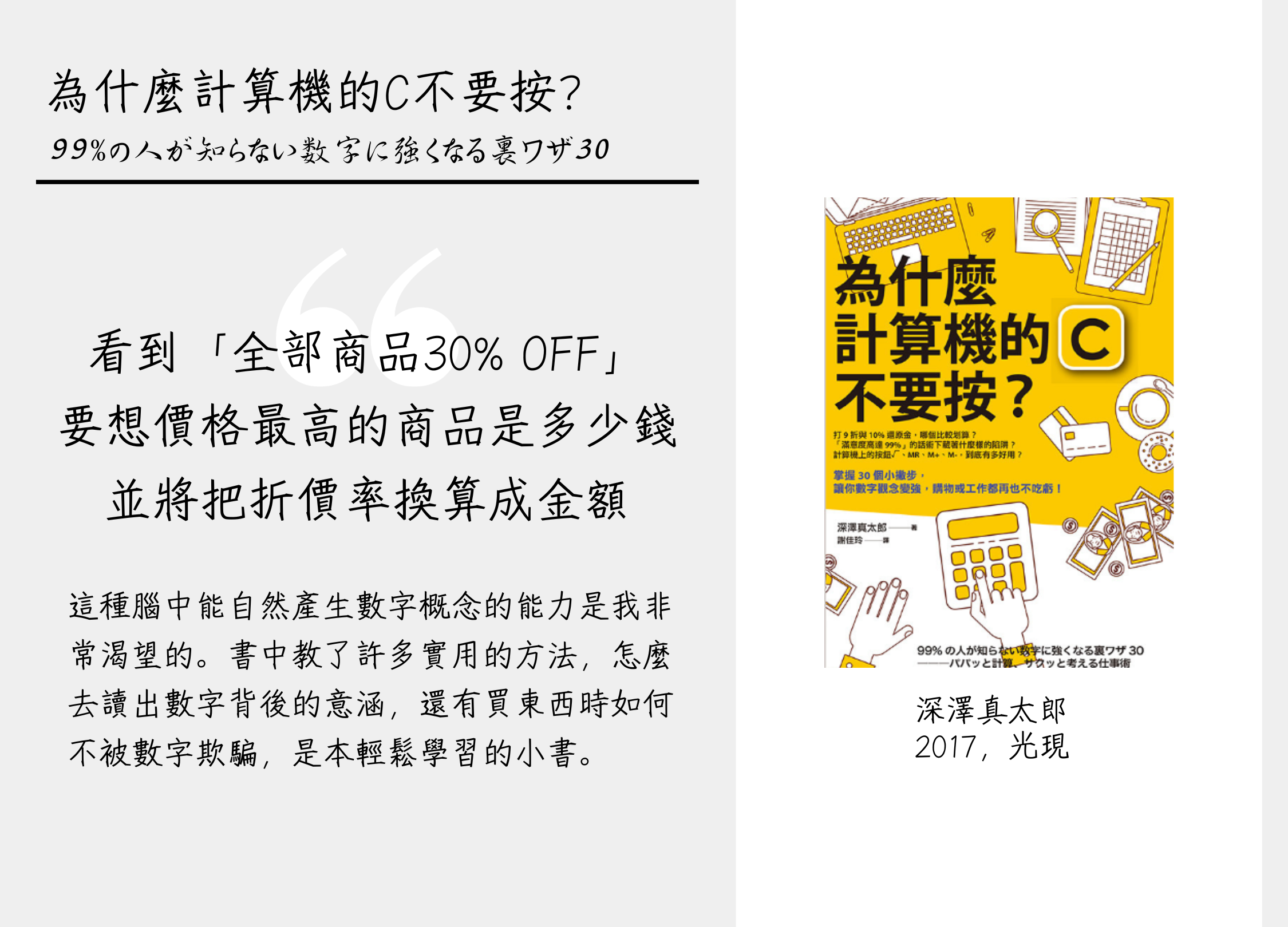
56.為什麼計算機的C不要按?
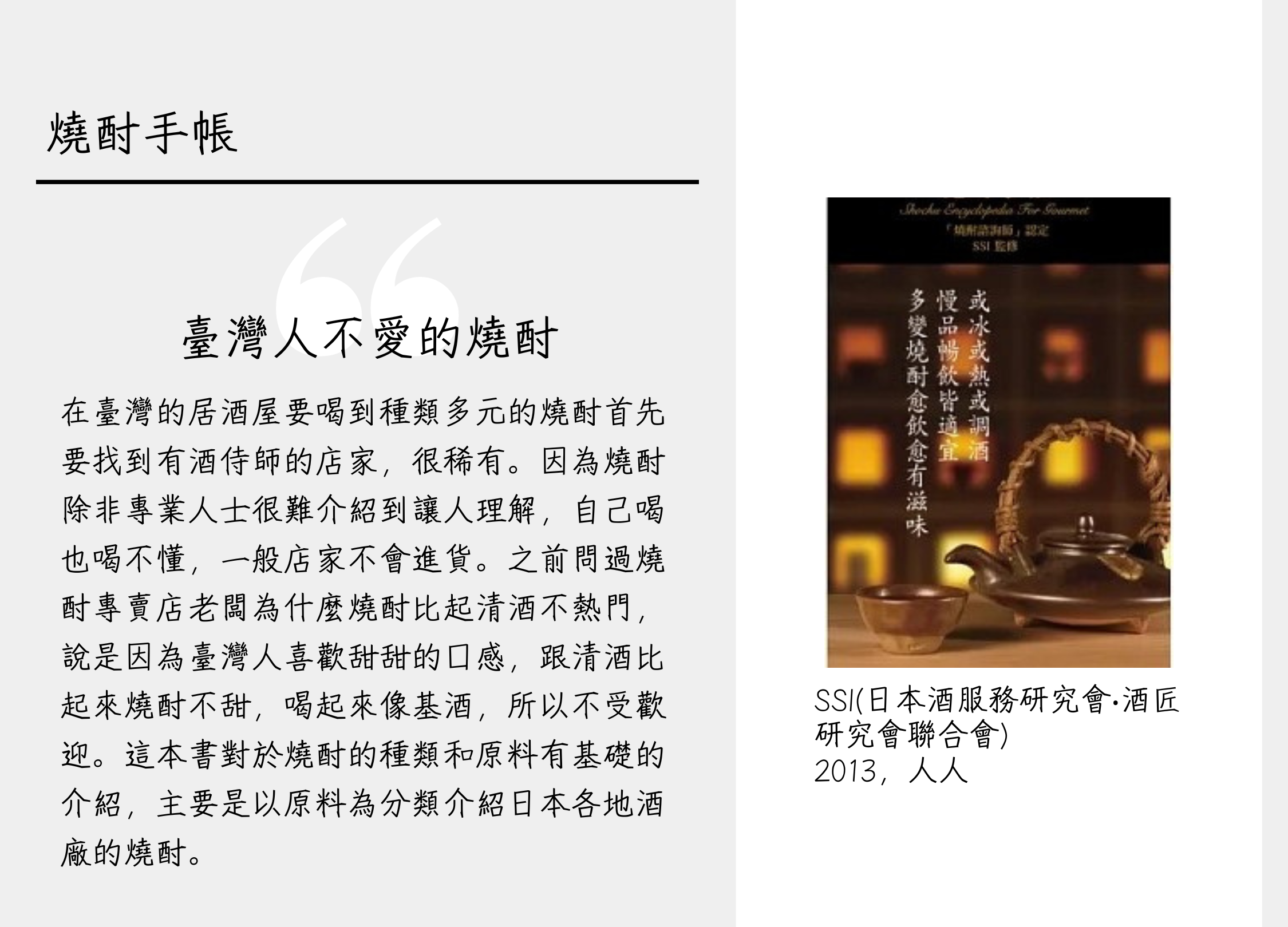
57.燒酎手帳
58.衝破慣性

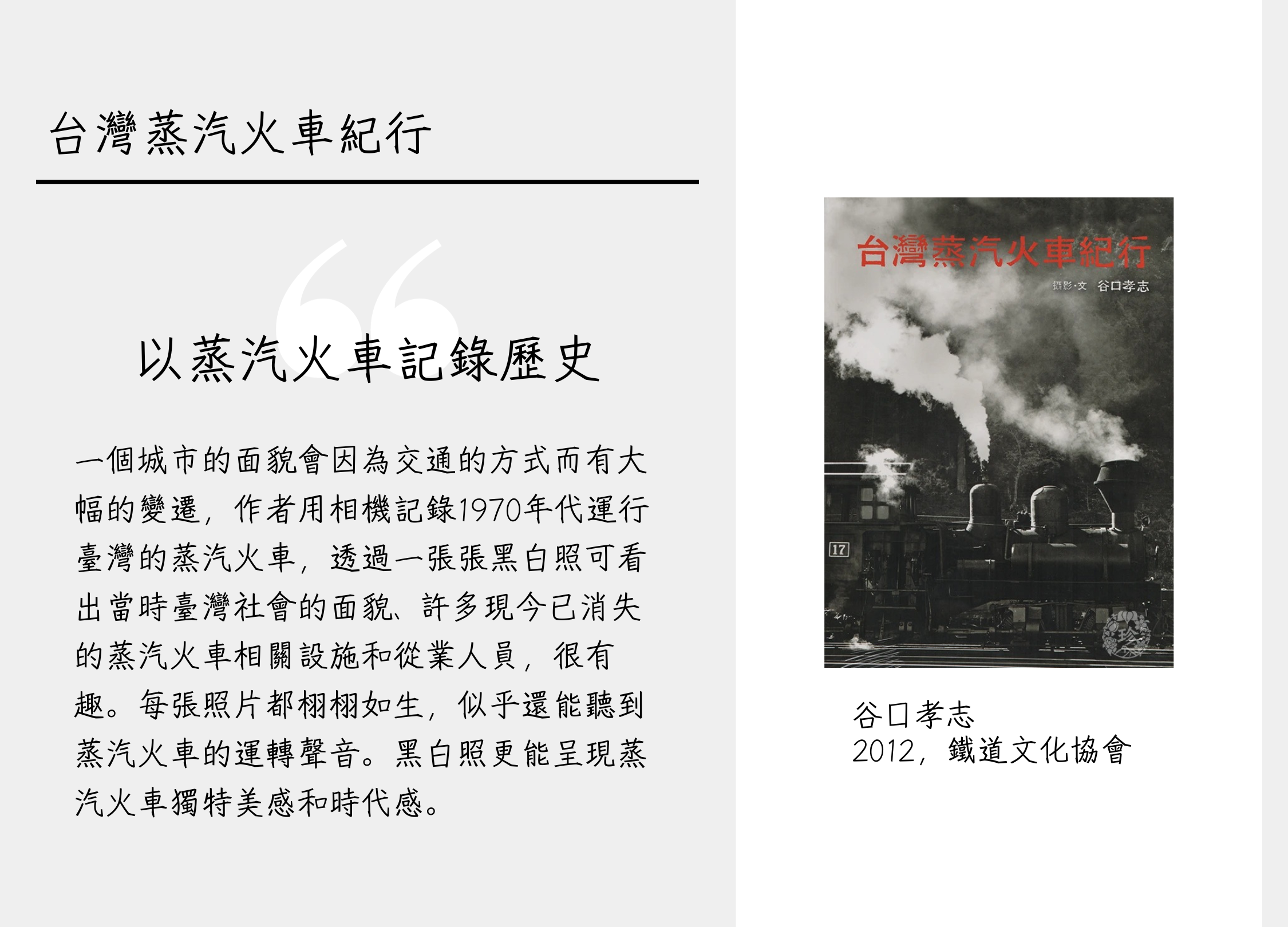
59.台灣蒸汽火車紀行
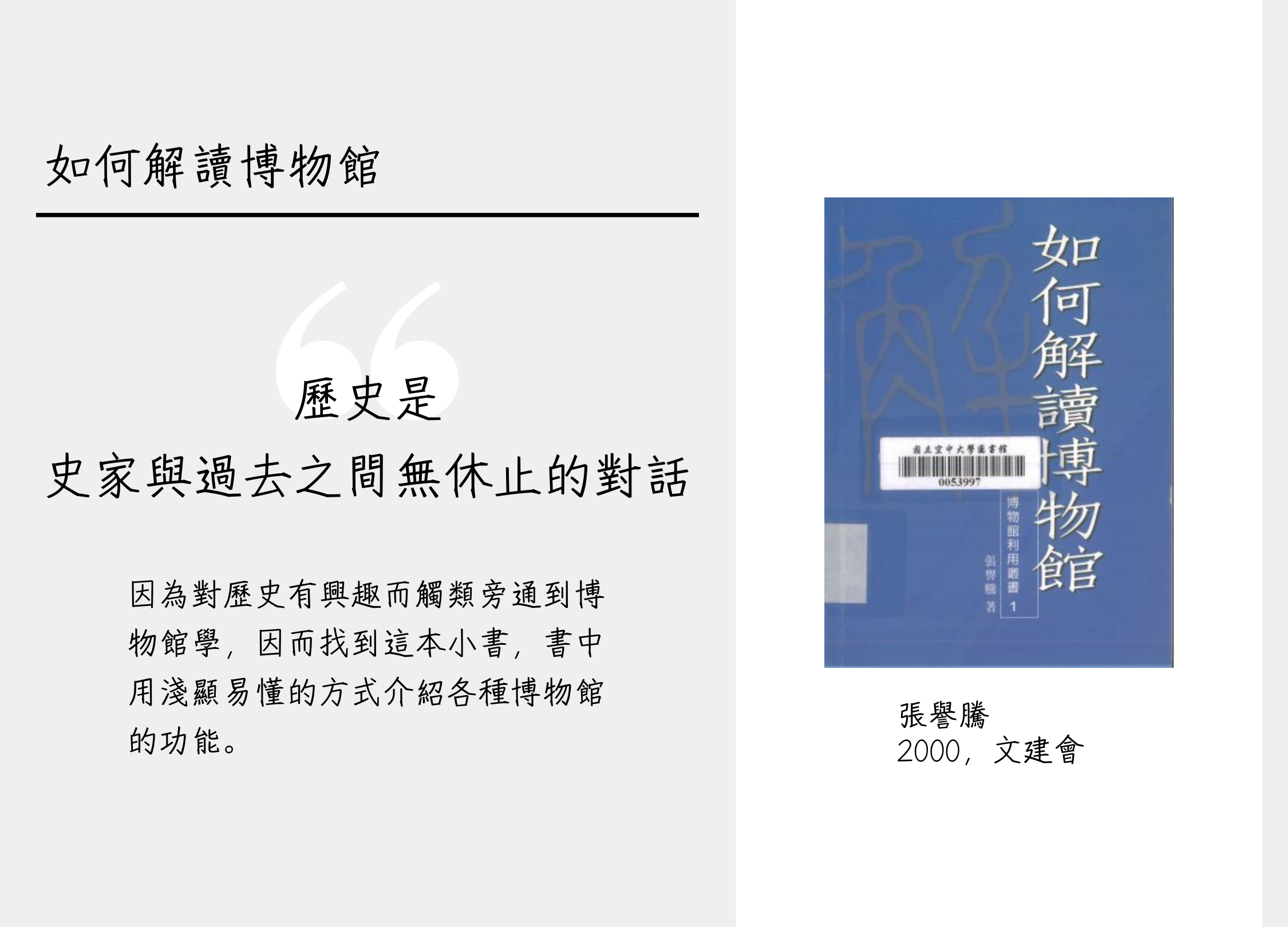
60.如何解讀博物館

 遲來的啟蒙 Start From Here Now